Sophisticated backtesting is not only possession of high-esteemed hedge funds anymore.
Impressive Team and support, Backtesting engine with detailed reports, The Strategy builder.

Great purchase!
I have always manually invested in stocks and cryptocurrencies, but after studying Vestinda, I must say it has enormous potential.

Mature platform for trading
Pro: Easy to use, Nice UX, A lot of customization for strategies, Back testing is an awesome tool, can check any strategy in history.

Quantitative Strategies & Backtesting results for FET
Here are some FET trading strategies along with their past performance. You can validate these strategies (and many more) for free on Vestinda across thousands of assets and many years of historical data.
Quantitative Trading Strategy: Long Term Investment on FET
The backtesting results for the trading strategy spanning from March 15, 2020, to March 15, 2021, have produced promising statistics. The profit factor stands at an impressive 3.41, indicating that the strategy has generated significant profits relative to its losses. The annualized return on investment (ROI) is an outstanding 67.42%, signifying a strong performance over the examined period. On average, the holding time for trades amounts to approximately 1 week and 1 day, while the strategy executes an average of 0.09 trades per week. There have been a total of 5 closed trades, with a winning trades percentage of 60%. These results indicate a successful and potentially lucrative trading strategy.

 FETUSDT

Choose another period and try again.
Quantitative Trading Strategy: Math vs. the market on FET
The backtesting results for the trading strategy, covering the period from March 15, 2020, to March 15, 2021, reveal impressive statistics. The profit factor stands at an impressive 3.52, indicating a potentially profitable strategy. The annualized return on investment (ROI) is an astounding 3929.62%, demonstrating exceptional performance within the given timeframe. On average, trades were held for approximately 1 day and 6 hours, suggesting a relatively short-term approach. With an average of 2.62 trades per week, the strategy displayed moderate activity. The strategy encompassed a total of 137 closed trades, and an impressive 77.37% of them were profitable. Overall, these statistics indicate a highly successful and potentially profitable trading strategy.
FETUSDT
Choose another period and try again.
FET (FETUSDT) Moving Averages: Powerful Strategies for Fetch Trading
Introduction
Moving averages are fundamental tools for traders aiming to identify trends and make informed decisions in the volatile cryptocurrency market. For FET (FETUSDT), utilizing moving averages like the EMA (Exponential Moving Average) and SMA (Simple Moving Average) can provide actionable insights into price movements. This guide delves into effective strategies for using moving averages to optimize Fetch trading.
Why Use Moving Averages for FET Trading?
- Trend Identification: Smoothens price data to reveal the underlying trend direction.
- Dynamic Support/Resistance: Acts as floating levels for potential price reversals.
- Versatility: Applicable across various timeframes and market conditions.
Top Moving Averages Strategies for FET Trading
1. Golden Cross and Death Cross Strategy
Concept:
Leverage the intersection of two moving averages to identify trend reversals.
Setup:
- Use a 20-period EMA (short-term) and a 100-period EMA (long-term).

Execution Rules:
- Buy Signal (Golden Cross): Enter long when the 20 EMA crosses above the 100 EMA.
- Sell Signal (Death Cross): Exit or go short when the 20 EMA crosses below the 100 EMA.
Best For:
Long-term trend traders.
2. Momentum Scalping with EMA and VWAP
Concept:
Combine a fast-moving average with VWAP for short-term momentum trades.
Setup:
- Use a 10-period EMA to track short-term trends.
- Add VWAP to identify value zones.
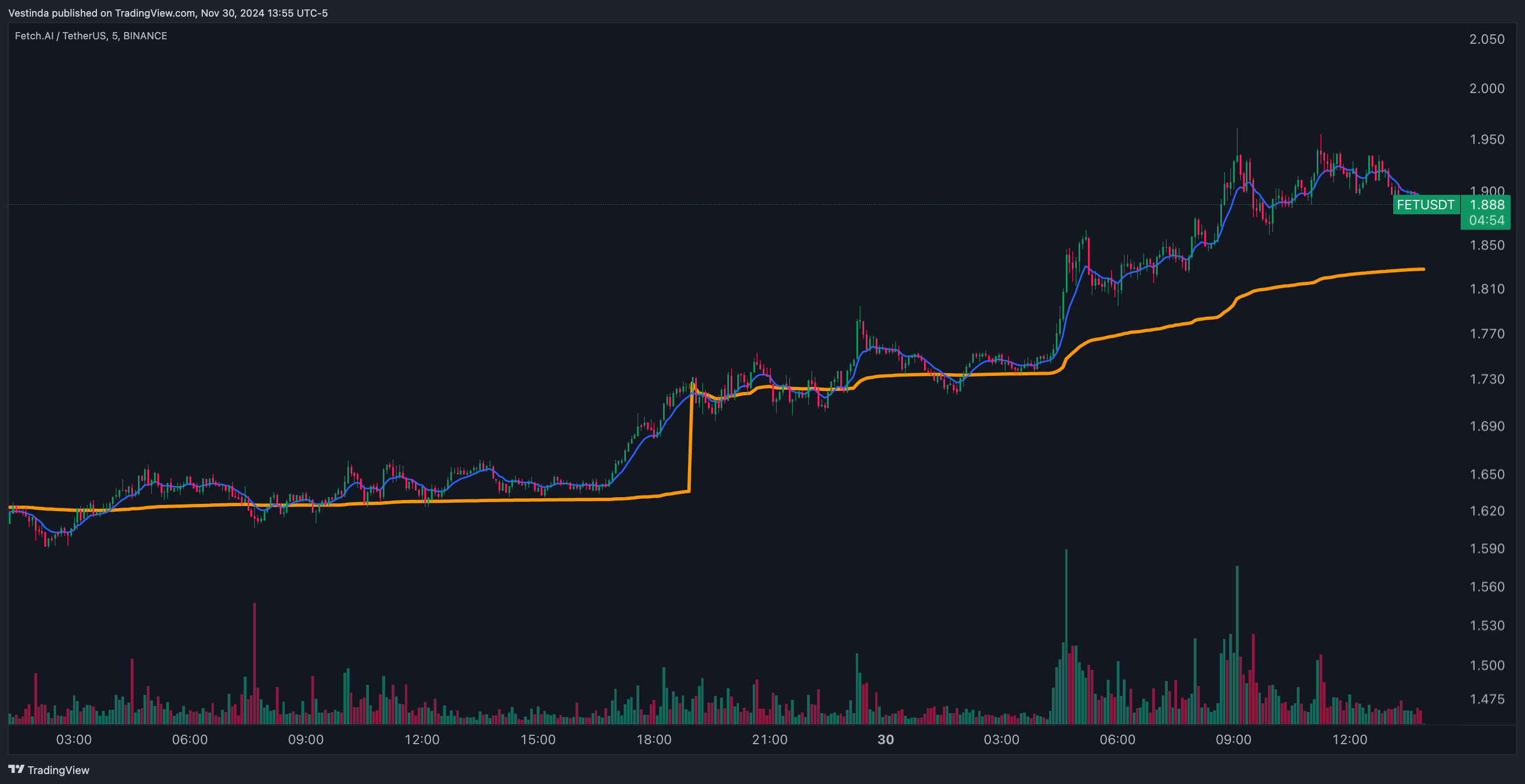
Execution Rules:
- Buy Signal: Enter long when price bounces above VWAP, confirmed by EMA trending upward.
- Sell Signal: Exit when price breaks below VWAP or EMA flattens.
Best For:
Scalping in volatile market conditions.
3. Trend Confirmation with SMA and RSI
Concept:
Validate moving average signals using RSI for momentum confirmation.
Setup:
- Use a 50-period SMA to detect medium-term trends.
- Add RSI (14) to gauge momentum.

Execution Rules:
- Buy Signal: Enter long when price is above the 50 SMA, and RSI is above 50.
- Sell Signal: Exit when price drops below the 50 SMA, or RSI falls below 50.
Best For:
Swing traders seeking additional confirmation.
How to Optimize Moving Averages for FET
- Adjust Periods for Volatility: Shorter periods (10-20) for active markets; longer periods (50-100) for steadier trends.
- Combine with Other Indicators: Use tools like RSI, MACD, or Bollinger Bands to strengthen trade signals.
- Backtest Strategies: Evaluate performance on historical FET price data to refine parameters.
Risk Management Tips
- Dynamic Stop-Losses: Place stops below the moving average for long trades and above for short trades.
- Position Sizing: Risk no more than 1-2% of your total portfolio on a single trade.
- Diversification: Incorporate other strategies to reduce reliance on a single approach.
Common Mistakes to Avoid
- Over-Reliance on Crossovers: Use additional confirmation from volume or momentum indicators.
- Ignoring Market Context: Avoid trading solely based on moving averages in sideways markets.
- Neglecting Updates: Periodically review moving average settings to match current market conditions.
Conclusion
Moving averages offer a robust foundation for developing profitable FET trading strategies. By leveraging tools like the Golden Cross, VWAP, and RSI, traders can adapt to various market conditions and enhance decision-making. With disciplined application and ongoing strategy refinement, moving averages can be a powerful ally in Fetch trading.
Mastering Moving Averages for Fetch Trading
- Identify the desired time period to calculate the moving average.
- Compile a list of closing prices for Fetch within the chosen time period.
- Add up all the closing prices and divide the result by the number of prices.
- Repeat steps 2 and 3 for each subsequent time period.
- Plot the moving average values on a graph to visualize the trend.
- Observe the direction and slope of the moving averages to identify trends.
- Consider the crossover of different moving averages as a potential buying or selling signal.
SMA vs EMA: Comparative Moving Averages in FET
Moving averages are commonly used in technical analysis to identify trends and generate trading signals. There are different types of moving averages, with two of the most popular being the simple moving average (SMA) and the exponential moving average (EMA).
The simple moving average calculates the average price over a specific time period and gives equal weight to each data point. It is easy to calculate and provides a smooth line on a chart. On the other hand, the exponential moving average assigns more weight to recent prices, making it more responsive to changes in the market. This can help traders identify trends and potential reversals earlier.
In FET, the Fetch.ai token, understanding the differences between these two moving averages can assist traders in making informed decisions when analyzing price movements and identifying potential entry and exit points. Ultimately, the choice between SMA and EMA depends on individual trading strategies and preferences.
External Influences: News, Events, and Fetch
When considering external factors, it is important to pay attention to news and events happening around the world. These factors can greatly impact individuals, businesses, and the overall economy. Staying informed about current events can help make informed decisions and prepare for potential challenges or opportunities. This includes monitoring political developments, economic indicators, and social trends. Fetch, or FET, can be a valuable tool in staying up-to-date with the latest news and events. Fetch aggregates news and events from various sources, providing users with a comprehensive and real-time view of what is happening globally. By utilizing Fetch, individuals and businesses can better anticipate and adapt to external factors, ensuring they stay ahead in an ever-changing world.
Exploring Fetch Trading: Unraveling Moving Averages
Moving averages are powerful tools used in FET trading to analyze stock market trends. These indicators smooth out price fluctuations and help traders identify market signals. A moving average is calculated by adding the closing prices of a specific period and dividing the sum by the number of periods. It provides insights into the average price over time, revealing whether a stock is trading above or below its average value. Moving averages are categorized into two types: simple moving average (SMA) and exponential moving average (EMA). SMA assigns equal weightage to all data points, while EMA gives more importance to recent prices. Traders often use different moving averages to create strategies and make informed decisions. By understanding moving averages in FET trading, investors can gain an edge in predicting future price movements.
Understanding the Power of FET
Fetch is a novel technique used in computer architecture to improve memory access performance. It involves fetching instructions from the memory and moving them into the CPU for execution. FET is an integral part of the processor's instruction pipeline, ensuring a continuous flow of instructions to be executed. It plays a crucial role in minimizing idle time and maximizing overall processor efficiency. By fetching the next set of instructions before they are needed, FET reduces the latency and improves the speed of program execution. This allows the CPU to execute instructions at a faster rate, leading to improved overall system performance. FET is commonly implemented in modern processors, including those found in personal computers, smartphones, and other electronic devices.
-
 Create
account -
 Discover profitable
strategies -
 Connect exchange
& start earning
Frequently Asked Questions
Yes, moving averages can be applied to FET trading with leverage on futures contracts. Moving averages can help identify trends and provide buy or sell signals based on price crossovers. Traders can use different time periods of moving averages to suit their strategy and leverage allows for amplified gains or losses. However, it is important to consider other technical indicators and risk management strategies when trading with leverage to minimize potential losses.
Exchange-related factors can have a significant impact on the accuracy of moving averages in foreign exchange trading (FET). The accuracy of moving averages relies on the availability of accurate and timely exchange rate data. Factors such as exchange rate volatility, liquidity, and trading volume can affect the accuracy of moving averages. Higher volatility or low liquidity can result in erratic price movements, making it difficult for moving averages to accurately reflect the underlying trend. Additionally, discrepancies in price data across different exchanges can also affect the accuracy of moving averages. Therefore, traders should consider these exchange-related factors to ensure the reliability of moving averages in FET.
Moving averages can certainly be applied to long-term investment strategies for FET (Future Enterprises Limited). By calculating the average price over a specified time period, moving averages can help identify trends and potential buying or selling opportunities for long-term investors. They provide a smoothed representation of the stock's price movement, helping investors gauge the overall direction and momentum of the security. By using longer-term moving averages, such as the 50-day or 200-day moving average, investors can gain insights into the stock's long-term trends and make more informed investment decisions for FET.
Moving averages can indeed be applied to FET trading on leverage. By calculating the average price of an asset over a specific period, moving averages can help identify trends and potential entry or exit points. Traders can use different moving average lengths to suit their strategy, such as the 50-day or 200-day moving average. However, it is important to note that no indicator or strategy guarantees success and trading on leverage carries additional risks. Traders should carefully assess market conditions and risk-management techniques before incorporating moving averages in their FET trading strategy.
During FET flash crashes, interpreting moving average signals can be useful in understanding the market trend. When the moving average line crosses below the shorter-term moving average, it may indicate a short-term bearish signal. Conversely, if the moving average line crosses above the shorter-term moving average, it may suggest a short-term bullish signal. However, it is important to consider other factors such as volume and market sentiment before making any trading decisions during flash crashes to avoid potential pitfalls.
Conclusion
In conclusion, FET (Fetch) Moving Averages Trading Strategies provide traders with valuable insights into market trends and help them make informed investment decisions. By understanding the concepts of moving averages, particularly EMA and SMA, traders can identify key support and resistance levels, gauge market momentum, and reduce price fluctuations' noise. Incorporating FET moving averages into trading approaches enhances traders' understanding of market trends, allowing for more calculated and strategic trading. Whether you're a novice or experienced trader, utilizing moving averages can greatly enhance your trading strategy and increase your chances of success in the markets.

Successful traders rely on backtesting to be profitable.
Be like them with our
Free Backtesting Guide