
-
 Create
account -
 Build trading strategies
with no code -
 Validate
& Backtest -
 Automate
& start earning
Automated Strategies & Backtesting results for SOL
Here are some SOL trading strategies along with their past performance. You can validate these strategies (and many more) for free on Vestinda across thousands of assets and many years of historical data.
Automated Trading Strategy: Lock and keep profits on SOL
According to the backtesting results statistics for a trading strategy conducted from February 26, 2021, to December 17, 2023, the strategy demonstrated promising performance. The profit factor was measured at 1.9, indicating a favorable ratio between the gross profit and gross loss generated. The annualized ROI stood impressively high at 272.43%, highlighting the significant growth potential of the strategy over the given time frame. The average holding time for trades was approximately 6 weeks and 5 days, showcasing a relatively medium-term approach. With an average of 0.05 trades per week and a total of 8 closed trades, the strategy maintained a conservative trading approach. Additionally, the return on investment amounted to an exceptional 756.75%. The strategy achieved a 50% winning trades percentage, showcasing a balanced mix of profitable and losing trades. Furthermore, it outperformed a buy-and-hold strategy by generating excess returns of 59.47%, indicating a superior investment alternative.

 SOLUSDT

Choose another period and try again.
Automated Trading Strategy: Follow the trend on SOL
Based on the backtesting results statistics from November 18, 2020, to December 8, 2023, the trading strategy showcased a promising profit factor of 2.04. This indicates that for every unit of risk undertaken, the strategy managed to generate a profit of 2.04 units. The annualized return on investment (ROI) also displayed an impressive figure of 949.03%, implying significant growth over the tested period. On average, the strategy held positions for approximately one week, which suggests a short-term approach. With an average of 0.37 trades per week, the strategy seemed to maintain a calculated and selective approach. With a total of 60 closed trades, the winning trades percentage amounted to 31.67%, showcasing potential for improvement in trade execution and entry points. Overall, the strategy's return on investment stood at an impressive 2875.84%.
SOLUSDT
Choose another period and try again.
Quick Guide to Trading Solana
Step 1: Choose a Cryptocurrency Exchange
Select a reliable exchange such as Binance, Coinbase, Kraken, or Bybit. Consider security, fees, and user interface.
Step 2: Create Your Account
- Sign Up: Visit the exchange’s website, click "Sign Up," and provide your email and password.
- Verify Identity: Complete the verification process by providing necessary documents.
- Enable Security: Activate two-factor authentication (2FA) and additional security features.
Step 3: Fund Your Account
- Deposit Funds: Go to the "Deposit" section, select your deposit method, and follow instructions.
- Check Balance: Ensure your deposited funds are available for trading.
Step 4: Trade Solana

- Navigate to Trading Page: Find and select the Solana (SOL) trading pair (e.g., SOL/USDT).
- Place an Order: Choose between a market or limit order, enter the amount, and confirm.
- Review Trade: Check the "Order History" to review your completed trade.
Mastering Scalping Trades on Solana: A Comprehensive Guide
Introduction
Solana has rapidly gained popularity in the cryptocurrency trading world due to its high-speed transactions and scalability. For traders seeking quick profits, scalping on Solana offers an exciting opportunity. This article will guide you through the essentials of scalping, focusing on the 5-minute timeframe, resistances, Fibonacci levels, price structure, and key indicators like RSI, MACD, and SuperTrend.
Understanding Scalping
Scalping is a trading strategy that involves making multiple trades throughout the day to capitalize on small price movements. Unlike swing trading or long-term investing, scalping focuses on quick, short-term gains.
- Pros:
- Quick profit realization
- Less exposure to market risks
- High number of trading opportunities
- Cons:
- Requires constant attention and quick decision-making
- Higher trading costs (fees) due to frequent trading
Setting Up Your Chart
Choosing the Right Timeframe
For scalping, the 5-minute timeframe is ideal because it captures short-term price movements without the noise seen in lower timeframes.

Key Chart Components
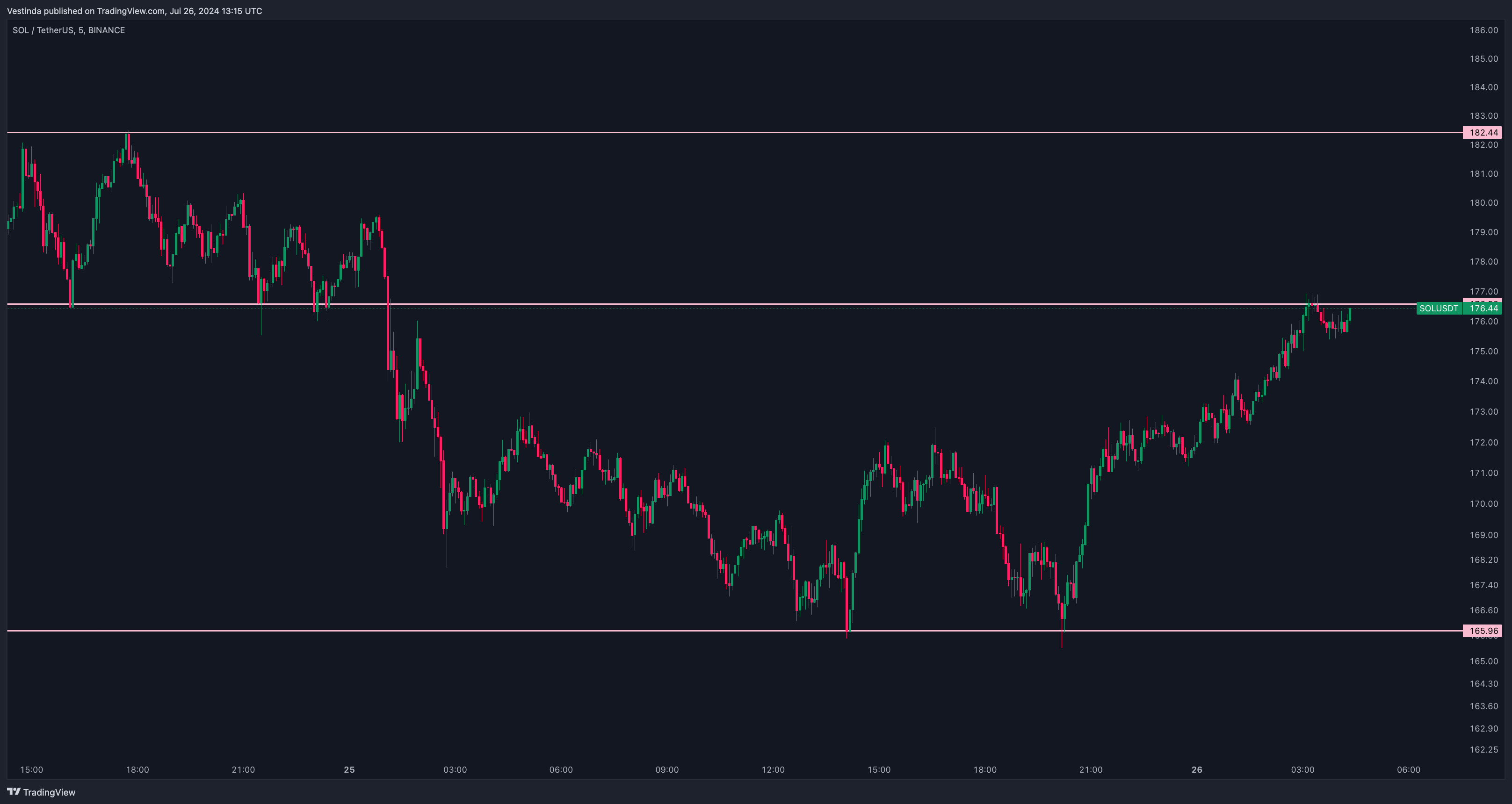
- Resistances: Identify key resistance levels where price has previously reversed.
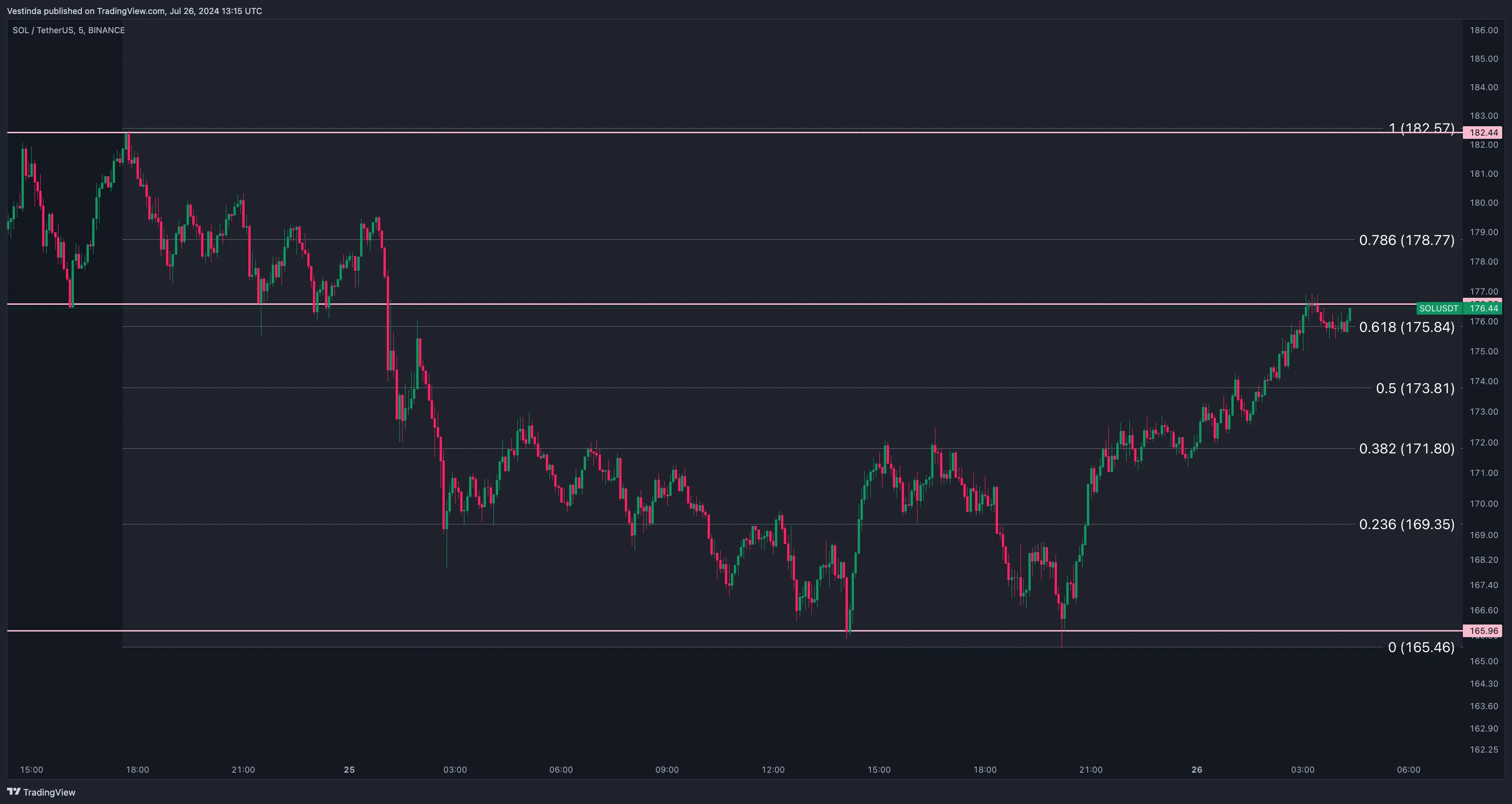
- Fibonacci Levels: Use Fibonacci retracements to find potential support and resistance levels.
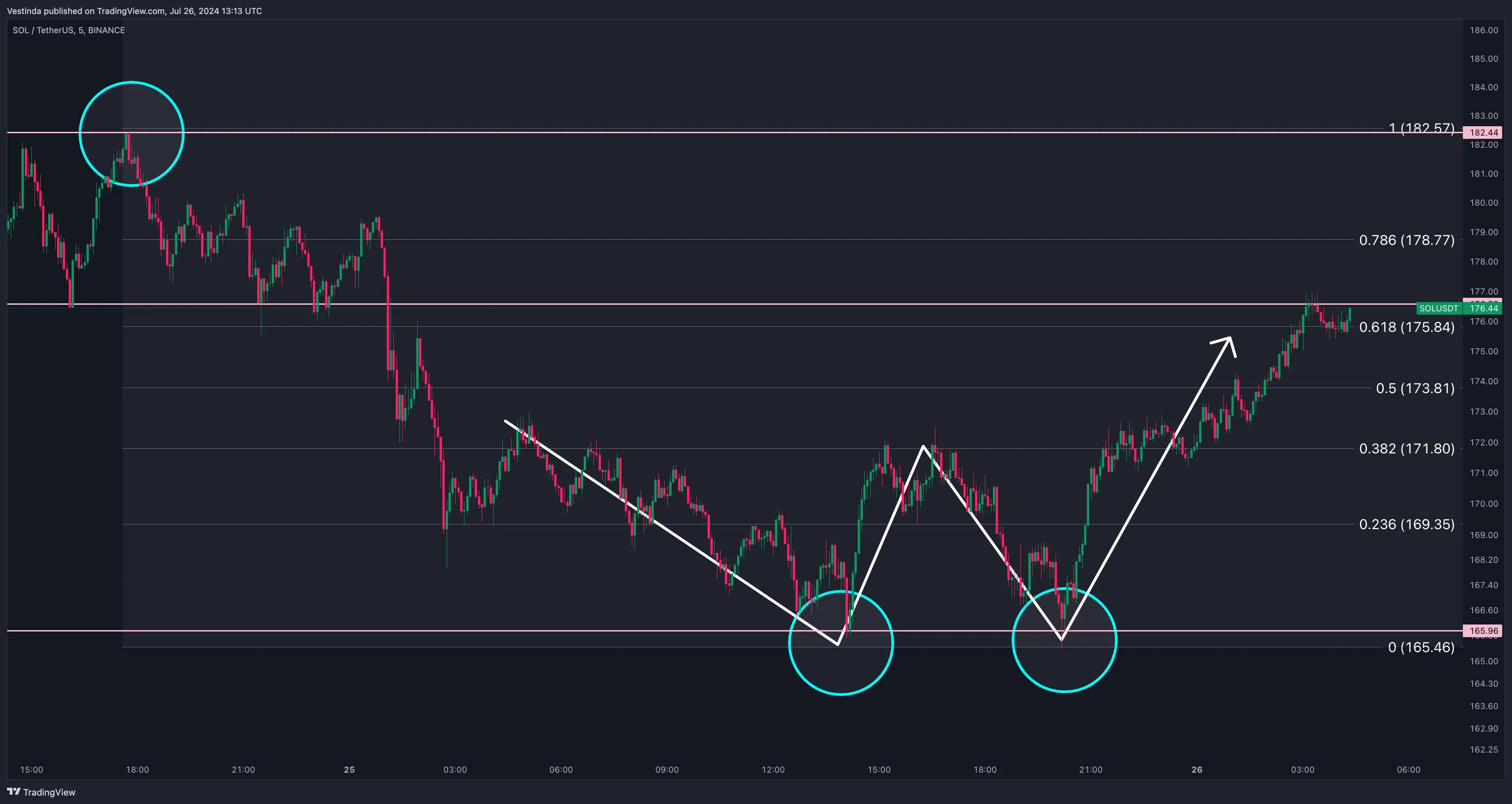
- Price Structure: Analyze price patterns and structures to anticipate future movements.
Step-by-Step Setup:
- Open a 5-minute chart for Solana.
- Identify and mark resistance and support levels.
- Apply Fibonacci retracement levels from recent high to low.
- Observe price structures for patterns like double bottoms or head and shoulders.
Essential Indicators for Scalping
Relative Strength Index (RSI)
The RSI measures the speed and change of price movements. It ranges from 0 to 100, with levels above 70 indicating overbought conditions and below 30 indicating oversold conditions.
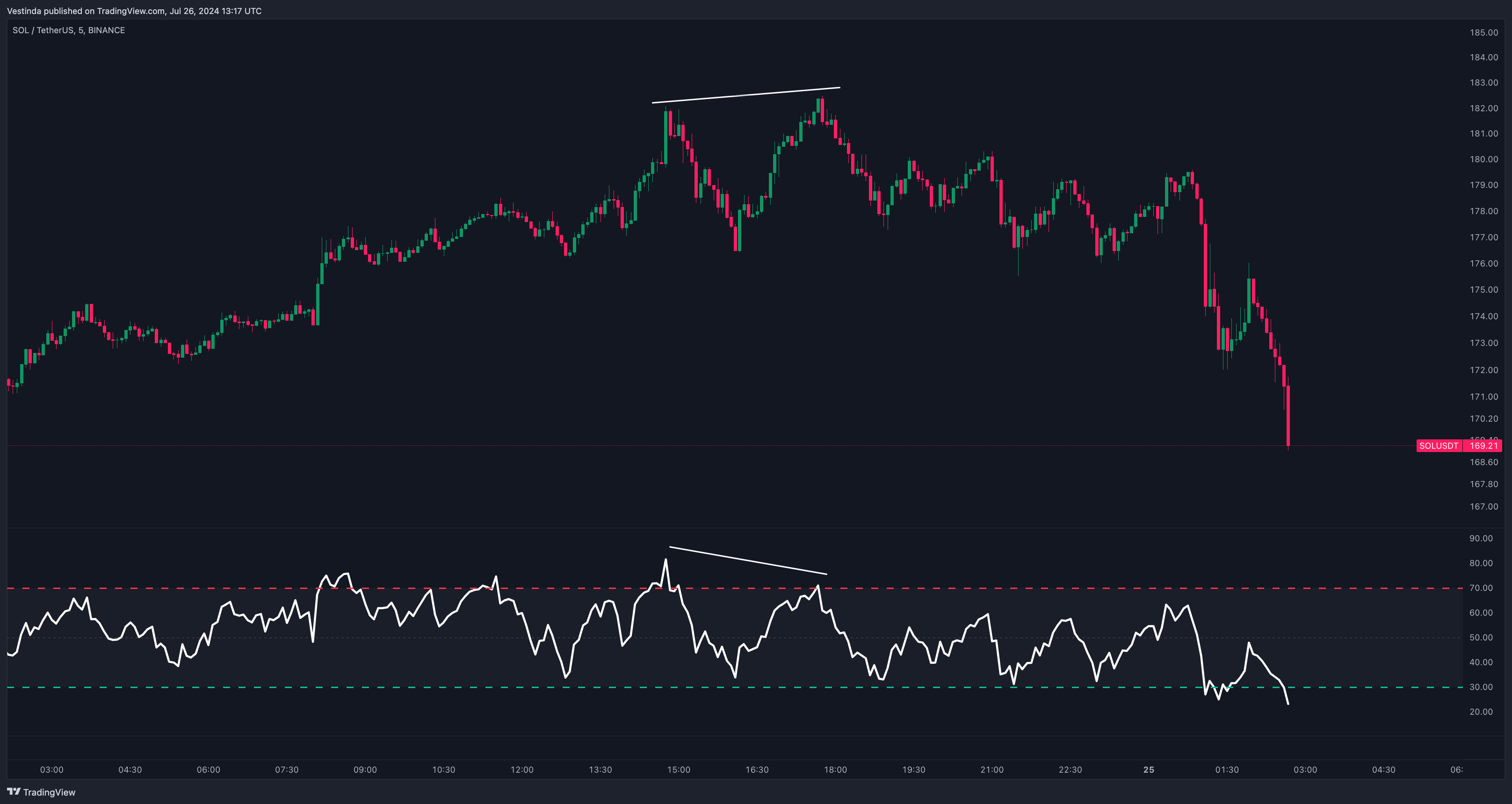
Example: On Solana’s 5-minute chart, an RSI above 70 might signal a potential reversal, suggesting a sell opportunity.
Moving Average Convergence Divergence (MACD)
MACD is a momentum indicator that shows the relationship between two moving averages of a security’s price. The MACD line crossing above the signal line indicates a bullish signal, while crossing below indicates a bearish signal.
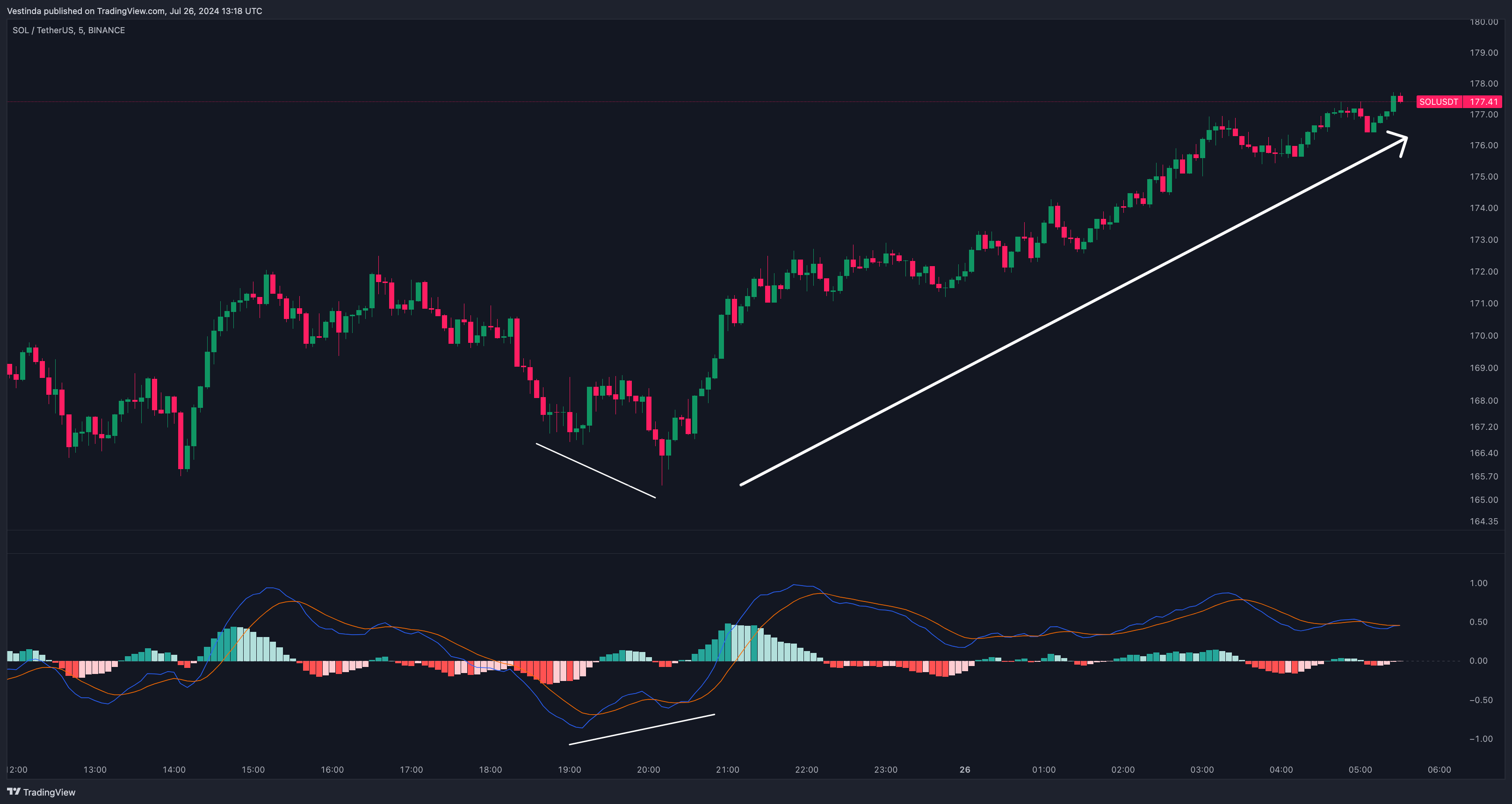
Example: When the MACD line crosses above the signal line on Solana’s 5-minute chart, it can be a signal to enter a long position.
SuperTrend Indicator
The SuperTrend indicator helps identify the current trend direction. It turns green in an uptrend and red in a downtrend, providing clear signals for trend-following trades.
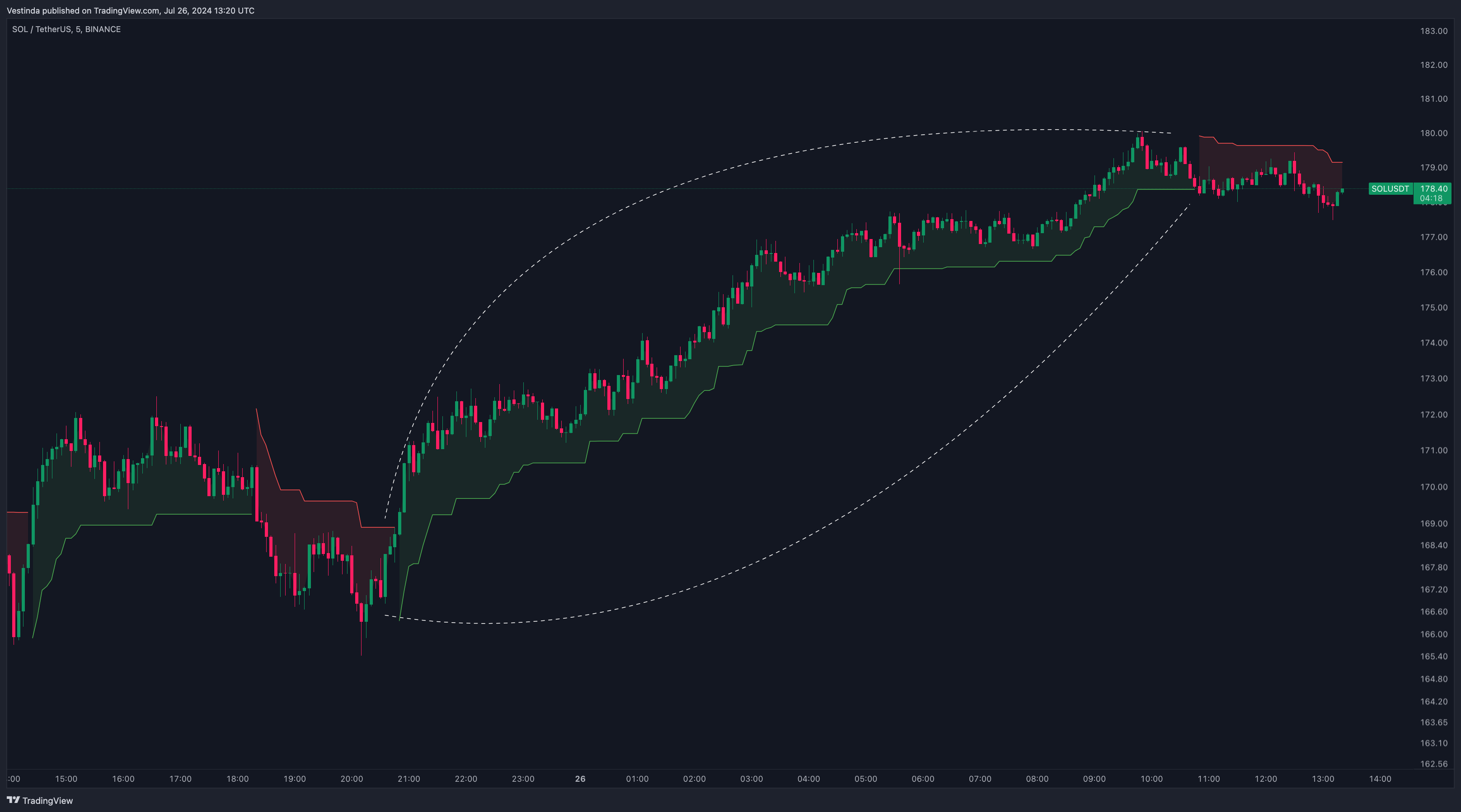
Example: If the SuperTrend turns green on Solana’s 5-minute chart, it confirms an uptrend, supporting a long position.
Practical Scalping Strategies
Identifying Entry Points
- Look for confluence of signals (e.g., RSI, MACD, SuperTrend).
- Use resistance and Fibonacci levels to find precise entry points.

Example: When Solana’s price approaches a Fibonacci support level and RSI is oversold with a bullish MACD crossover, it’s a strong entry point.
Managing Trades and Exit Strategies
- Place stop-loss orders just below recent support levels to minimize risk.
- Set profit targets based on resistance levels or a fixed reward-to-risk ratio.
Common Mistakes to Avoid
- Overtrading: Stick to your strategy and avoid impulsive trades.
- Ignoring Risk Management: Always use stop-loss orders to protect your capital.
- Neglecting Market Conditions: Stay updated on market news and events that could impact Solana’s price.
Conclusion
Scalping on Solana can be highly rewarding if done correctly. By combining resistances, Fibonacci levels, price structures, and key indicators like RSI, MACD, and SuperTrend, you can develop a robust scalping strategy. Practice on a demo account first, and share your experiences in the comments section below.
Additional Resources
- Tools: TradingView for chart analysis, Vestinda for automated trading.
- Further Reading: Articles on advanced scalping techniques and Solana market analysis.
- Video Tutorials: Step-by-step guides on setting up and using RSI, MACD, and SuperTrend.
Winning Scalping Tactics for Changing SOL Volatility
Scalping Strategies for Low and High SOL Volatility
Scalpers seeking to profit off of SOL's volatility must have adaptable strategies. In low volatility environments, scalpers should focus on smaller price movements. Short-term trades, capitalizing on quick price fluctuations, can be profitable. Patience and disciplined risk management are key as opportunities may be scarce. Conversely, during periods of high volatility in SOL, scalpers may opt for bigger price swings. Longer trades can provide ample profit-making opportunities, but timing is crucial. Scalpers must navigate the market carefully and utilize tools such as trailing stop orders to protect gains. Regardless of volatility levels, scalping requires precision, quick decision-making, and a deep understanding of SOL's behavior. Successful scalpers adapt to market conditions and are always ready to modify their strategies.
Liquidity Key for Optimal SOL Scalping
The importance of liquidity cannot be overstated when it comes to SOL scalping. Liquidity refers to the ease with which a trader can buy or sell an asset without causing significant price movements. In the case of SOL scalping, having high liquidity is crucial to execute quick trades. This is because scalpers aim to profit from small price fluctuations within a short period. High liquidity ensures that there are enough buyers and sellers in the market, reducing the risk of slippage and enabling traders to enter and exit positions easily. Additionally, a liquid market provides more accurate price information, allowing scalpers to make informed decisions. Overall, liquidity plays a vital role in the success of SOL scalping strategies, enabling traders to execute their trades efficiently and take advantage of short-term price movements.
Mastering Solana Slippage in Scalping Strategies
One of the challenges in SOL scalping is managing slippage, which refers to the difference between the expected price of a trade and the executed price. Slippage can occur due to market volatility, order book depth, and trading volume. To minimize slippage, traders can implement various strategies. Firstly, using limit orders instead of market orders allows traders to set the maximum price they are willing to pay or the minimum price they are willing to sell at. This helps avoid unfavorable price fluctuations. Additionally, traders can also consider using stop-loss and take-profit orders to automatically close positions at predetermined prices. Furthermore, staying updated with the latest market news and analysis can help traders anticipate and prepare for potential price movements, mitigating the impact of slippage. By employing these tactics, traders can improve their SOL scalping strategies and optimize their trading performance.






Frequently Asked Questions
When choosing the right trading hours for SOL scalping, it is crucial to consider market volatility and liquidity. Look for periods when the SOL market is active and displaying substantial price movements. Typically, the London and New York sessions offer optimal conditions with increased trading volume. Furthermore, pay attention to news releases and economic events that may influence SOL's price. It's important to avoid low-activity times, such as early morning or late at night, as they could result in limited trading opportunities. Remember to adapt your strategy based on market conditions and regularly evaluate its effectiveness.
When handling gaps in price during SOL scalping, it's crucial to adapt to the situation swiftly. Start by analyzing the reason behind the gap. If it's due to news or market sentiment, reassess your strategy and consider adjusting your trading approach. If it's a technical gap, determine the nearest support or resistance levels and place stop-loss orders accordingly. Additionally, monitoring volume and price action can help in making informed decisions. Remember to stay disciplined and practice risk management to navigate gaps effectively while SOL scalping.
Scalping, a short-term trading strategy, can be considered riskier compared to other trading approaches. The primary reason is the high frequency of trades conducted in a short time frame, which increases exposure to market volatility and execution risks. Scalpers aim to profit from small price fluctuations, relying heavily on precise technical analysis and quick decision-making. This strategy demands significant focus, discipline, and advanced trading skills. Moreover, scalping often involves the use of high leverage, amplifying potential gains but also increasing the risk of significant losses. Traders considering scalping should be aware of these risks and employ strict risk management practices.
To optimize your trading setup for efficient SOL scalping, there are a few key steps to follow. Firstly, ensure you have a reliable and fast internet connection to execute trades swiftly. Secondly, utilize a powerful computer or laptop to handle high-frequency trading demands. Consider using multiple monitors to monitor various data and charts simultaneously for quick decision-making. Use a reputable trading platform with advanced tools for analyzing SOL's market trends. Lastly, set up efficient hotkeys and shortcuts to swiftly execute trades and manage stop-loss orders. Continuous practice, discipline, and staying updated with SOL's market movements will enhance your scalping efficiency.
Yes, beginner traders often lose money. Trading is a complex and highly risky activity that requires knowledge, experience, and skill. Without a thorough understanding of the market, analysis, and risk management techniques, beginners are more likely to make mistakes and incur losses. Lack of discipline, emotional decision-making, and unrealistic expectations further contribute to financial setbacks. It is crucial for beginners to educate themselves, practice with virtual accounts, and start with small amounts to mitigate potential losses while gaining essential trading skills.
Yes, it is possible to scalp SOL (Solana) using a moving average crossover strategy. This strategy involves tracking the short-term and long-term moving averages of SOL's price. When the short-term moving average moves above the long-term moving average, it signals a potential uptrend, prompting the scalper to buy SOL. Conversely, when the short-term moving average moves below the long-term moving average, it indicates a potential downtrend, prompting the scalper to sell SOL. This strategy aims to capture quick profits from short-term price movements in SOL, making it suitable for scalping.
Conclusion
In conclusion, SOL (Solana) Scalping is a popular strategy among cryptocurrency traders looking to capitalize on small price fluctuations. By utilizing automated tools, algorithms, and artificial intelligence, traders can optimize their profits through SOL automated scalping and AI scalping. Scalping with Renko charts can be an effective approach, especially in the volatile SOL market. Adapting strategies based on SOL's volatility levels and managing slippage are crucial elements for successful scalping. Additionally, having high liquidity and implementing various techniques such as limit orders and stop-loss orders can help minimize risks and maximize returns. With precision, quick decision-making, and an understanding of SOL's behavior, traders can make the most of this profitable scalping strategy.

Successful traders rely on backtesting to be profitable.
Be like them with our
Free Backtesting Guide