-
100,000 available assets New
-
years of historical data
-
practice without risking money

Quantitative Strategies & Backtesting results for QQQ
Here are some QQQ trading strategies along with their past performance. You can validate these strategies (and many more) for free on Vestinda across thousands of assets and many years of historical data.
Quantitative Trading Strategy: MVWAP and VWAP Crossover on QQQ
Based on the backtesting results statistics for the trading strategy from December 10, 2016 to December 10, 2023, the strategy showed promising results. With a profit factor of 2.14, it indicates that for every dollar invested, there was a $2.14 return. The annualized return on investment (ROI) stood at 21.2%, demonstrating steady growth over the period. The average holding time for trades was 5 weeks and 3 days, implying a medium-term approach. Despite a relatively low average of 0.11 trades per week, the strategy managed to close 43 trades successfully. The overall return on investment reached an impressive 151.44%, with a winning trades percentage of 53.49%. These statistics suggest that the trading strategy exhibited consistency and potential profitability.
 QQQ
QQQ

Choose another period and try again.
Quantitative Trading Strategy: MVWAP and VWAP Crossover on QQQ
The backtesting results for the trading strategy conducted from December 11, 2016, to December 11, 2023, reveal promising statistics. The strategy exhibited a profit factor of 2.14, indicating that the profits generated were more than twice the losses incurred. The annualized return on investment (ROI) stood at an impressive 21.2%, reflecting consistent growth in capital over the testing period. On average, positions were held for approximately 5 weeks and 3 days, implying a medium-term trading approach. The strategy executed an average of 0.11 trades per week, showcasing a selective and focused trading approach. With 43 closed trades, the overall return on investment amounted to 151.44%. Additionally, the strategy achieved a winning trades percentage of 53.49%, indicating a slightly higher number of profitable trades.
QQQ
Choose another period and try again.
Mastering QQQ Scalping: A Step-by-Step Approach
Introduction
The Invesco QQQ Trust (QQQ) is one of the most heavily traded exchange-traded funds (ETFs), offering exposure to the Nasdaq-100 Index, which includes some of the largest and most influential technology companies in the world. Due to its high liquidity and volatility, QQQ is a popular choice for scalping—a trading strategy focused on capturing small, quick profits from intraday price movements. In this guide, we’ll explore effective scalping strategies for QQQ, providing insights and tips to help you maximize your trading performance.
Why Scalp QQQ?
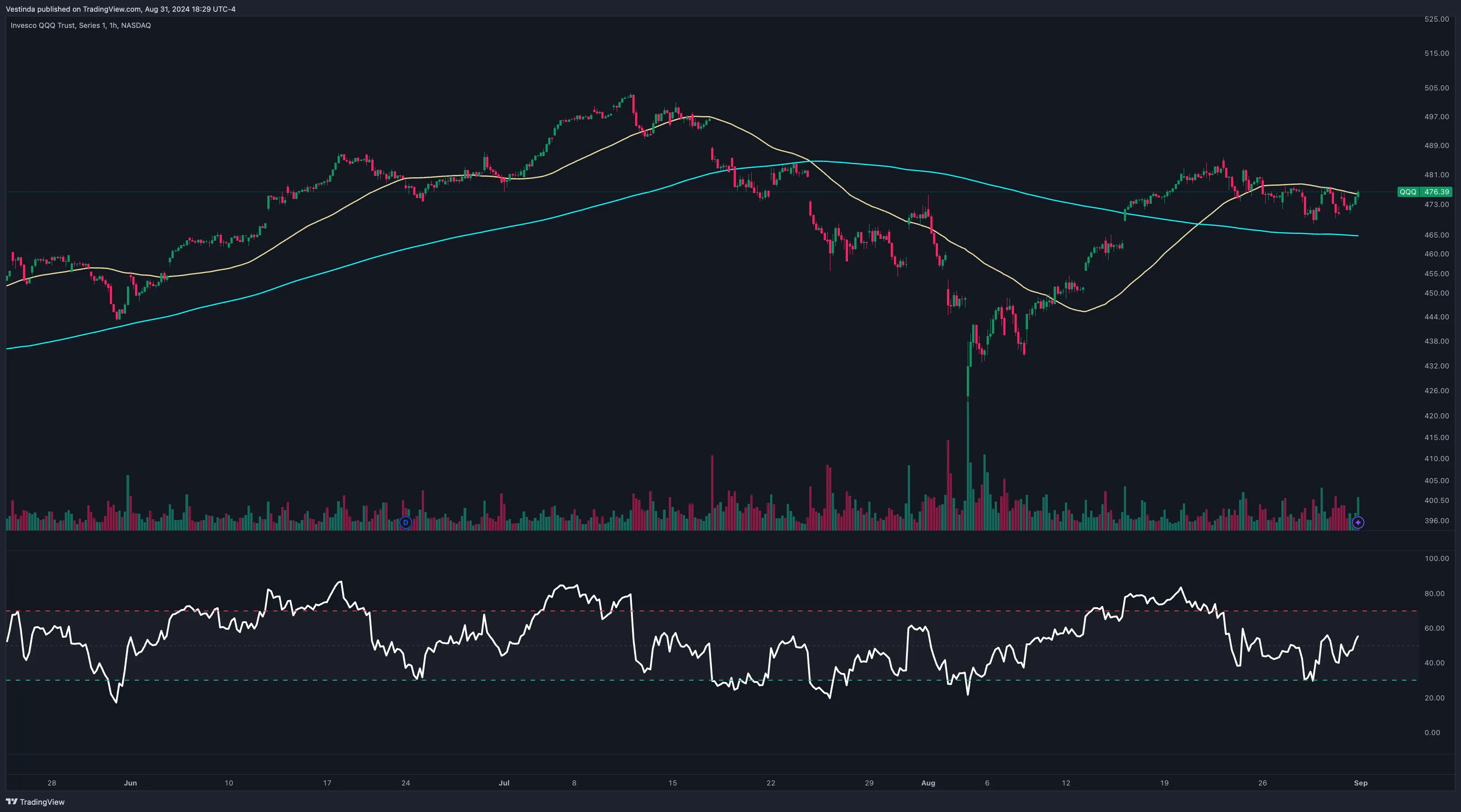
- High Liquidity: QQQ is one of the most liquid ETFs, ensuring tight bid-ask spreads and quick order execution—both crucial for successful scalping.
- Volatility: The tech-heavy Nasdaq-100 often experiences significant price swings, offering numerous opportunities for scalping.
- Market Sentiment: QQQ is highly responsive to news, earnings reports, and broader market trends, making it a dynamic ETF for traders who can react quickly to changing conditions.
Key Scalping Strategies for QQQ
Moving Average Scalping

Concept: Use short-term moving averages to identify quick entry and exit points based on price trends.
How to Implement:
- Indicators: Apply 9-period and 21-period Exponential Moving Averages (EMAs) to a 1-minute or 5-minute chart.
- Entry and Exit: Enter a long position when the 9-period EMA crosses above the 21-period EMA and exit when it crosses back below. For short positions, reverse the conditions.
- Quick Trades: Scalping involves executing multiple trades within a short period, aiming for small gains on each trade.
VWAP Scalping

Concept: The Volume Weighted Average Price (VWAP) is a key indicator for intraday traders, showing the average price of QQQ weighted by volume throughout the day.
How to Implement:
- Indicator: Apply VWAP to your intraday chart (e.g., 1-minute or 5-minute).
- Entry and Exit: Buy QQQ when the price crosses above the VWAP and sell when it crosses below. This strategy is particularly effective when QQQ is trending strongly, allowing you to capture profits from short-term price movements.
Bollinger Bands Scalping
Concept: Use Bollinger Bands to identify overbought and oversold conditions in QQQ, providing entry points for scalping trades.
How to Implement:
- Indicators: Set Bollinger Bands on a 1-minute or 5-minute chart.
- Entry and Exit: Buy QQQ when the price touches or moves below the lower Bollinger Band and sell when it reaches the middle or upper band. Reverse for short positions.
- Tight Stop-Losses: Set tight stop-losses just outside the bands to protect against sudden reversals, ensuring that losses are minimized on losing trades.
Momentum Scalping
Concept: Take advantage of QQQ’s rapid price movements during high volatility periods by trading on momentum.
How to Implement:
- Indicators: Use the Relative Strength Index (RSI) and Moving Average Convergence Divergence (MACD) to gauge momentum.
- Entry and Exit: Enter trades when RSI and MACD confirm strong momentum in one direction. Exit when momentum begins to fade or when RSI indicates overbought or oversold conditions in QQQ.
Tools and Indicators for Successful QQQ Scalping
Timeframes
- Why: Scalping requires analyzing very short timeframes, typically 1-minute or 5-minute charts, to identify quick opportunities.
- How to Use: Monitor these charts closely for fast-moving setups that align with your chosen strategy.
Volume Analysis
- Why: Volume confirms the strength of price movements, which is crucial for validating scalping signals in a high-volatility ETF like QQQ.
- How to Use: Combine volume analysis with your primary indicators (e.g., VWAP, RSI) to ensure that price movements are supported by sufficient market activity.
Stop-Loss and Take-Profit Orders
- Why: Given the fast-paced nature of scalping, it’s essential to use stop-loss and take-profit orders to manage risk and lock in profits automatically.
- How to Use: Set tight stop-losses just outside of your key levels (e.g., Bollinger Bands, VWAP) and use take-profit orders at predetermined levels to capture gains.
Risk Management for QQQ Scalping
Position Sizing
Concept: Due to QQQ’s high liquidity and volatility, it’s crucial to carefully manage your position size to avoid excessive risk.
How to Implement:
- Use a small percentage of your trading capital for each trade (e.g., 1-2%) to minimize the impact of potential losses, especially given QQQ’s price swings.
Avoid Overtrading
Concept: Scalping can be exhausting and may lead to overtrading, which can erode profits through increased transaction costs and emotional decision-making.
How to Implement:
- Set a daily trade limit and adhere to it, focusing on high-quality setups rather than frequent trading.
Monitoring Market Conditions
Concept: QQQ’s performance is closely tied to broader market trends, particularly in the technology sector. Understanding these factors is crucial for effective scalping.
How to Implement:
- Regularly check economic indicators, tech sector news, and overall market sentiment to gauge potential impacts on QQQ’s price action.
Trend Scalping in QQQ Price Fluctuations
Scalping micro and macro trends in QQQ price movements is a popular trading strategy. Traders closely monitor short-term price fluctuations, leveraging their ability to quickly enter and exit positions. By analyzing smaller timeframes, they seek to take advantage of short-lived market inefficiencies. Furthermore, they also pay attention to longer-term trends in the QQQ to capture bigger profit opportunities. This dual approach allows traders to profit from both small and significant price movements. However, it requires continuous market monitoring and quick decision-making. As price movements can be unpredictable, traders must have a solid understanding of technical analysis and utilize tools such as moving averages and trendlines. Successful scalpers meticulously manage risk, always setting stop-loss orders and adhering to strict trading plans. Overall, scalping micro and macro trends in QQQ price movements can be a lucrative trading strategy for skilled and disciplined traders.
Identifying Fakeouts in QQQ Scalping Techniques
Recognizing fakeouts is crucial when scalping the Invesco Qqq Trust (QQQ). These false breakouts can be deceiving, leading traders to enter positions in the wrong direction. The key is to closely monitor price action and volume. Look for sudden spikes in volume and large price movements. These can indicate a price breakout, but be cautious, as they may also be fakeouts. Use technical indicators like the Relative Strength Index (RSI) and Bollinger Bands to confirm price movements. Additionally, pay attention to support and resistance levels. If a breakout occurs near a significant level, it is more likely to be valid. However, always wait for confirmation before entering a trade. Remember, the goal is to maximize profits and minimize losses when scalping QQQ, so spotting and avoiding fakeouts is essential.
Maximizing QQQ Scalping with Powerful Technology
Leveraging technology has become increasingly popular in the world of trading, with QQQ Scalping Bots leading the way. These bots utilize cutting-edge algorithms and automation to quickly execute trades based on the movements of the Invesco QQQ Trust. By leveraging technology, traders can capitalize on short-term price fluctuations and maximize their profits. QQQ Scalping Bots offer real-time data analysis, enabling traders to make informed decisions within milliseconds. These bots not only save time and effort but also provide a level of precision that is nearly impossible for humans to achieve. With the ability to handle high trade volumes and execute trades at lightning speed, QQQ Scalping Bots revolutionize the trading experience, boosting efficiency and profitability for traders.
-
 Create
account -
 Build trading strategies
with no code -
 Validate
& Backtest -
 Automate
& start earning
Frequently Asked Questions
The best hour for scalping in trading typically occurs during the overlap of the Asian and European sessions, specifically between 6:00 AM to 10:00 AM GMT. This period often witnesses increased market volatility and liquidity due to the active trading sessions in both regions. Traders can take advantage of short-term price fluctuations and execute quick trades during this time. However, it's crucial to consider specific currency pairs' characteristics and news releases that may impact market movements. Additionally, individual trading strategies and preferences should also be taken into account when determining the best hour for scalping.
Scalping, the reselling of tickets at inflated prices, is generally not illegal in the United States. However, specific laws surrounding scalping vary by state and venue. Some states impose regulations on scalping, such as capping resale prices or requiring specific licensing for ticket resellers. Additionally, individual venues may have their own policies against scalping. Therefore, it is crucial to check local laws and venue regulations before engaging in ticket scalping to avoid any potential legal consequences.
Interpreting order book data in QQQ scalping involves analyzing the bid and ask sizes and prices. A larger bid size indicates buying pressure, while a higher ask size suggests selling pressure. Comparing these sizes to the price levels helps identify potential support and resistance levels for scalping. Traders should also observe the bid-ask spread and any significant changes in those levels, which can indicate increased volatility or liquidity. Moreover, keeping an eye on the order flow and the presence of large orders can provide additional insights for executing scalp trades efficiently.
Yes, it is possible to scalp QQQ (PowerShares QQQ Trust) on a mobile device. Several trading platforms offer mobile apps with advanced features that allow you to perform intraday scalping strategies. With a mobile device, you can access real-time market data, make quick trades, set stop-loss orders, and monitor your positions on the go. It is crucial to choose a reliable trading app that provides a user-friendly interface and robust execution capabilities for scalping purposes. Always ensure you have a stable internet connection and follow the market closely to execute profitable scalping trades efficiently.
Conclusion
In conclusion, QQQ Scalping is a popular trading strategy that involves making multiple quick trades to take advantage of small price fluctuations in the Invesco QQQ Trust. Traders leverage advanced technology and algorithms to capitalize on these short-term movements and generate profits. By closely monitoring price action, utilizing technical analysis tools, and managing risk, skilled and disciplined traders can potentially achieve lucrative results. Additionally, recognizing and avoiding fakeouts, as well as leveraging QQQ Scalping Bots, can further enhance the effectiveness of this trading strategy. Overall, QQQ Scalping offers traders the opportunity to maximize profits in the stock market.

Successful traders rely on backtesting to be profitable.
Be like them with our
Free Backtesting Guide