
-
 Create
account -
 Build trading strategies
with no code -
 Validate
& Backtest -
 Connect exchange
& start earning
Quantitative Strategies & Backtesting results for SOL
Here are some SOL trading strategies along with their past performance. You can validate these strategies (and many more) for free on Vestinda across thousands of assets and many years of historical data.
Quantitative Trading Strategy: Play the swings and profit when markets are trending up on SOL
Based on the backtesting results, the trading strategy implemented from April 1, 2023, to October 1, 2023, displayed promising performance. The strategy showcased a profit factor of 1.87, indicating a favorable proportion between its gains and losses. An impressive annualized return on investment (ROI) of 52.53% was achieved, reflecting the strategy's ability to generate substantial profits over the specified period. The average holding time for trades stood at 2 days and 9 hours, indicating that the strategy relied on relatively short-term positions. With an average of 0.72 trades per week, the frequency of trading activity remained moderate. Out of a total of 19 closed trades, 57.89% were profitable, demonstrating a respectable success rate. Furthermore, the return on investment reached 26.4%, confirming the strategy's profitability. Notably, the strategy outperformed the buy-and-hold approach, generating excess returns of 13.1%. These backtesting results suggest that the trading strategy implemented during this period was effective in generating profits and outperforming passive investment strategies.

 SOLEUR

Choose another period and try again.
Quantitative Trading Strategy: Lock and keep profits on SOL
Based on the backtesting results statistics for the trading strategy, over the period from February 26, 2021, to October 8, 2023, the strategy has shown promising performance. The profit factor of 1.89 indicates that the strategy generated a solid profit relative to its losses. The annualized return on investment (ROI) stands at an impressive 277.98%, demonstrating high profitability. On average, each trade was held for 6 weeks and 5 days, highlighting the strategy's focus on medium-term positions. With an average of 0.05 trades per week, the strategy maintained a low-frequency approach. Despite the relatively low number of closed trades (8), the strategy delivered a remarkable 731.53% return on investment. Winning trades accounted for 50% of the total, showcasing a balanced performance. Moreover, the strategy outperformed a simple buy and hold approach, generating excess returns of 386.88%. These statistics support the strategy's potential effectiveness and profitability in the given period.
 SOLUSDT
Choose another period and try again.
SOLUSDT (Solana) Backtesting: A Comprehensive Guide for Traders
Introduction
Backtesting is a critical tool for traders seeking to refine their strategies and improve performance. Solana (SOL), a highly volatile and liquid cryptocurrency, provides an ideal environment for backtesting trading methods. This guide walks you through the fundamentals of backtesting, effective SOL strategies, and tips for achieving actionable insights to optimize your trading approach.
What is Backtesting?
- Definition: Backtesting involves applying a trading strategy to historical price data to evaluate its effectiveness.
- Purpose:
- Identify strengths and weaknesses in a trading approach.
- Optimize parameters such as stop-loss levels, take-profits, and indicator settings.
- Build confidence in strategy performance before live trading.
Why Backtest Trading Strategies for SOL?
- High Volatility: Solana’s price swings provide ample opportunities to test various strategies.
- Dynamic Market Trends: Backtesting allows traders to adapt strategies to both trending and range-bound markets.
- Risk Mitigation: Evaluate potential drawdowns and refine risk management techniques.
Steps to Backtest SOL Trading Strategies
1. Define Your Strategy
Example: Use an EMA crossover (20-period and 50-period EMAs) to identify trends.
Entry/Exit Rules:
- Enter long when the 20 EMA crosses above the 50 EMA.
- Exit or short when the 20 EMA crosses below the 50 EMA.

2. Select Historical Data
Use platforms like TradingView or Binance for reliable SOL price history.
Focus on relevant timeframes based on your strategy (e.g., 3min for intraday or daily for swing trading).
3. Test and Record Results
Apply your strategy to historical data and log outcomes, including:
- Win/loss ratio
- Maximum drawdown
- Average profit per trade
4. Analyze Performance Metrics
Assess strategy effectiveness using:
- Sharpe Ratio: Measures risk-adjusted returns.
- Profit Factor: Ratio of total profits to total losses.
- Max Drawdown: Largest peak-to-trough decline during testing.
Effective SOL Trading Strategies to Backtest
1. Breakout Trading with Bollinger Bands
Setup: Use Bollinger Bands (20-period SMA, 2 standard deviations) to identify volatility-based breakouts.
Entry/Exit Rules:
- Enter long when SOL price closes above the upper band with increased volume.
- Exit when price returns to the middle band or below.
Optimization Tip: Combine with RSI to confirm breakout momentum.
2. Mean Reversion with RSI
Setup: Apply RSI with a 14-period setting.
Entry/Exit Rules:
- Enter long when RSI falls below 30 and starts rising.
- Exit or short when RSI exceeds 70 and begins to decline.
Optimization Tip: Use Fibonacci retracement levels for additional precision.
3. Trend-Following with MACD
Setup: Apply MACD (12, 26, 9) to detect bullish or bearish trends.
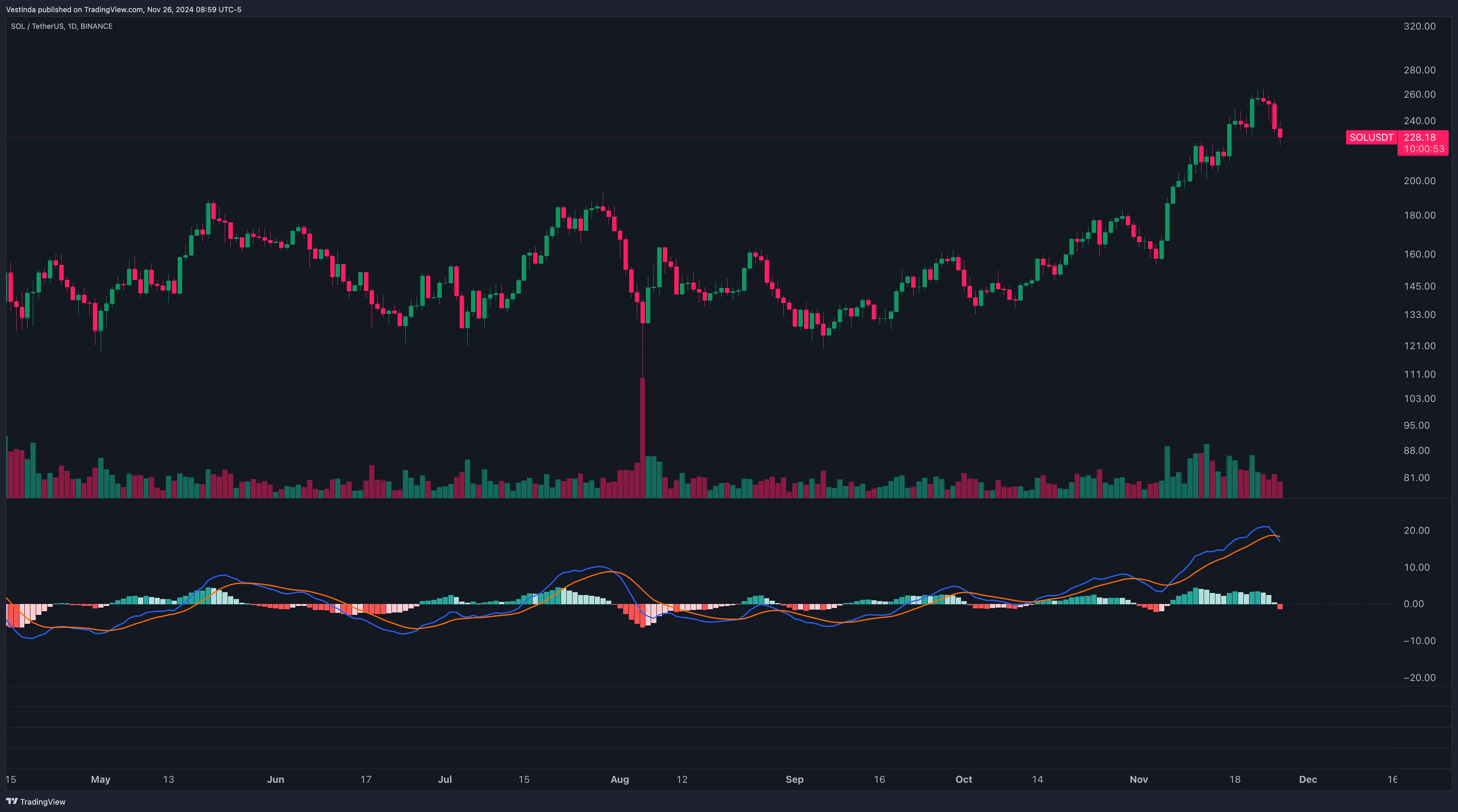
Entry/Exit Rules:
- Enter long on bullish MACD crossovers.
- Exit or short on bearish MACD crossovers.
Optimization Tip: Adjust MACD settings for quicker responses during volatile markets.
Backtesting Tools for SOL Strategies
1. Trading Platforms
- TradingView: Ideal for manual backtesting with customizable charts.
- Vestinda: Access SOL historical data for detailed analysis.

2. Algorithmic Tools
- Python with Backtrader or QuantConnect for automated backtesting.
- Crypto-specific platforms like CoinMarketCap for historical price tracking.
3. Backtesting
- Track trades, calculate win rates, and visualize performance metrics.
Best Practices for SOL Backtesting
- Test Across Different Market Conditions: Evaluate strategies in bull, bear, and sideways markets to ensure robustness.
- Incorporate Fees and Slippage: Account for trading fees and potential execution delays to reflect real-world conditions.
- Iterate and Optimize: Refine strategy parameters based on backtesting results to improve performance.
Conclusion
Backtesting is an invaluable step in developing and optimizing trading strategies for Solana (SOL). By using tools like Bollinger Bands, RSI, and MACD, and employing robust backtesting practices, traders can gain evidence-based insights to enhance their approach. With consistent testing and iteration, you can confidently navigate SOL’s dynamic market and achieve sustainable success.
Mastering Solana Backtesting: A Step-by-Step Tutorial
- Retrieve historical price data for SOL from a reliable source.
- Choose a specific time period to backtest, such as one year.
- Select a backtesting platform or software that supports SOL.
- Write and implement a backtesting strategy using the historical price data.
- Analyze the results of the backtest to evaluate the strategy's performance.
- Make any necessary adjustments to the strategy based on the analysis.
SOL Backtesting: Unveiling Seasonality Insights
Seasonality effects can be crucial in backtesting strategies for SOL. By analyzing historical data, traders can identify patterns and trends that occur at specific times of the year or during certain seasons. These patterns can provide valuable insights into how to adjust trading strategies to capitalize on these recurring opportunities. Shorter sentences help concisely highlight key points about seasonality effects, emphasizing the importance of understanding historical patterns and trends. In contrast, longer sentences can provide more detailed explanations of how traders can utilize this knowledge to optimize their trading strategies and maximize profits. With SOL being a rapidly growing cryptocurrency, exploring seasonality effects becomes increasingly important for traders seeking an edge in the market.
SOL Options: Effective Backtesting Strategies Unveiled
Backtesting is a key element for successful options trading on the SOL network. By simulating trades using historical market data, traders can assess the viability of their strategies before risking real capital. It involves running a series of hypothetical trades based on specific entry and exit conditions. Short sentences help to highlight important points during the backtesting process. Traders should aim to test their strategies across different market conditions and timeframes to gain a comprehensive understanding of their performance. Longer sentences can provide additional context and explain the benefits of implementing backtesting in SOL options trading. Overall, backtesting empowers traders by improving their decision-making abilities and helping them refine and optimize their strategies.
Optimal Historical Data Selection for SOL Backtesting
Selecting historical data for SOL backtesting is crucial for accurate analysis and informed decision-making. It is essential to choose a diverse range of data that encompasses various market conditions and trading scenarios. A thorough understanding of the SOL ecosystem and its historical patterns is necessary to identify relevant data sets. The selection process should include data from different time frames, including both bull and bear markets, to assess the performance of the strategy in different market cycles. Moreover, it is important to consider the level of granularity needed for the analysis, whether it is daily, hourly, or even minute-level data. By selecting the right historical data, traders can gain valuable insights into the performance of their SOL strategies and optimize their decision-making process.
Decoding SOL Backtesting Slippage
Understanding Slippage in SOL Backtesting
Slippage is an important concept to grasp when conducting backtesting for SOL trading strategies. It refers to the difference between the expected price of a trade and the actual executed price. Slippage can occur due to various factors, such as market volatility, liquidity issues, and delays in order execution.
In backtesting, it is crucial to account for slippage as it affects the accuracy and reliability of the results. Ignoring slippage can lead to unrealistic profit expectations and misinterpretation of the strategy's performance.
To accurately assess the impact of slippage, historical data should be used to simulate realistic trading conditions. This includes incorporating bid-ask spreads and implementing execution delays. By factoring in slippage, backtest results can provide a more accurate representation of real-world trading scenarios for SOL, enabling traders to make informed decisions.






Frequently Asked Questions
To backtest a SOL (Support and Resistance, Overall Trend, and Levels) strategy using trendline analysis, follow these steps. First, identify the trend by drawing trendlines connecting higher highs or lower lows. Then, mark key support and resistance levels on the chart. Next, apply entry and exit rules based on trendline breaks, market conditions, or other indicators. Use historical price data to simulate trades and calculate performance metrics such as return, drawdown, and win/loss ratio. Finally, analyze the results to refine the strategy or make necessary adjustments.
To backtest a SOL (Systematic Options Trading) strategy with geopolitical risk considerations, follow these steps. Firstly, collect historical options and geopolitical data for the desired time period. Analyze how geopolitical events affected market trends and option prices. Next, create a set of rules incorporating geopolitical risk factors into your SOL strategy. Test the strategy by applying these rules to the historical data and measure its performance. Evaluate the strategy's risk-adjusted returns, drawdowns, and overall profitability. Refine and optimize the strategy based on the results and repeat the backtesting process until desired results are achieved.
To backtest a SOL (Systematic Options Limiter) strategy with risk parity principles, follow these steps:
1. Select a historical time period for testing and gather relevant data.
2. Develop a SOL strategy involving the systematic buying and selling of options.
3. Determine risk allocation principles based on risk parity, aiming to evenly distribute risk across different assets.
4. Calculate risk parity weights for each asset using metrics like volatility or expected returns.
5. Apply these weights to allocate capital across the different options in the SOL strategy.
6. Execute the strategy on historical data, simulating trades and monitoring portfolio performance.
7. Evaluate the backtest results, analyzing metrics such as returns, volatility, drawdowns, and risk-adjusted measures.
8. Adjust and refine the strategy if necessary based on the backtest outcomes.
To backtest a SOL strategy with on-chain analytics, follow these steps:
1. Identify relevant on-chain data for SOL transactions, such as transaction volume, liquidity, or token movements.
2. Extract historical data from the Solana blockchain using appropriate tools or APIs.
3. Define the parameters and rules for your strategy, including entry/exit signals, risk management, or performance metrics.
4. Apply these rules to the extracted data to simulate trading decisions and calculate profits/losses.
5. Evaluate the strategy's performance by comparing it against benchmarks or alternative strategies. Use visualization techniques to analyze results effectively.
One of the best software for backtesting trading strategies is MetaTrader, particularly its Strategy Tester feature. This software is widely used by traders and offers a comprehensive platform for developing, testing, and optimizing trading strategies with historical data. Its user-friendly interface, extensive indicators, and flexible settings make it ideal for backtesting various trading approaches. With MetaTrader's Strategy Tester, traders can evaluate the performance and reliability of their strategies, identify potential flaws, and refine their trading techniques. Overall, MetaTrader is a reliable and efficient tool for backtesting trading strategies.
Conclusion
In conclusion, SOL backtesting is an essential tool for evaluating the viability of cryptocurrency trading strategies. By simulating trades using historical data, traders can assess the performance of their strategies and make more informed decisions. It is crucial to consider factors such as seasonality effects and slippage to optimize trading strategies and maximize profits. Selecting diverse historical data and analyzing it accurately can provide valuable insights into the performance of SOL strategies. By utilizing backtesting software and platforms, traders can refine and improve their strategies for successful options trading on the SOL network.

Successful traders rely on backtesting to be profitable.
Be like them with our
Free Backtesting Guide