-
 Create
account -
 Build trading strategies
with no code -
 Validate
& Backtest -
 Automate
& start earning
Quant Strategies & Backtesting results for MSTR
Here are some MSTR trading strategies along with their past performance. You can validate these strategies (and many more) for free on Vestinda across thousands of assets and many years of historical data.
Quant Trading Strategy: Detrended Price Oscillations with Ichimoku Base and Shadows on MSTR
Based on the backtesting results statistics for the trading strategy conducted from November 6, 2022, to November 6, 2023, the strategy has shown promising performance. The profit factor stands at an impressive 1.95, indicating that the strategy has generated profitable trades. The annualized return on investment (ROI) is an outstanding 54.47%, highlighting the strategy's ability to deliver significant returns over a one-year period. On average, the holding time for trades spans approximately 4 days and 2 hours. With an average of 0.4 trades per week, the strategy maintains a conservative approach. 21 trades were closed during this period, with a winning trades percentage of 33.33%. These results suggest a potential opportunity for further optimization and refinement, while still exhibiting a promising overall performance.
 MSTR
MSTR

Choose another period and try again.
Quant Trading Strategy: Play the swings and profit when markets are trending up on MSTR
During the backtesting period from November 6, 2022, to November 6, 2023, a trading strategy demonstrated a profit factor of 0.65, indicating that for every dollar risked, 65 cents were gained. However, the annualized return on investment (ROI) for this strategy stood at -22.52%. On average, positions were held for approximately 5 days and 5 hours before being closed. With an average of 0.38 trades per week, the strategy executed a total of 20 closed trades. The overall winning trades percentage was 55%. These statistics suggest that while profitability was moderate, the strategy experienced a negative annualized ROI over the tested period.
MSTR
Choose another period and try again.
Profitable Day Trading with MSTR: A Step-By-Step Guide
- Understand the basics of day trading and the stock market.
- Research and select Microstrategy Class A (MSTR) as your trading asset.
- Monitor MSTR's price movement and volume regularly using technical analysis tools.
- Identify profitable entry and exit points based on your analysis.
- Implement a disciplined trading strategy, setting stop-loss and take-profit levels.
- Practice risk management by only risking a small portion of your trading capital.
- Continuously learn and adapt your trading strategy based on market conditions and results.
MSTR MicroStrategy Day Trading: Strategies & Tips for Success
Introduction
MicroStrategy (MSTR) is a well-known business intelligence company that has gained additional attention for its significant investments in Bitcoin. This combination of tech and cryptocurrency exposure makes MSTR a volatile and exciting stock for day traders. In this guide, we’ll explore effective day trading strategies and tips specifically for MSTR, helping you maximize your trading performance and achieve consistent success.
Why Day Trade MSTR?
- High Volatility: MSTR is known for its sharp price movements, largely driven by its Bitcoin holdings and tech sector performance, offering day traders numerous opportunities to capture short-term gains.
- Liquidity: While not as liquid as some large-cap stocks, MSTR typically provides enough trading volume to allow for quick order execution with minimal slippage.
- Market Sentiment: MSTR’s price is influenced by both its business fundamentals and Bitcoin’s price movements, creating unique opportunities for traders who can anticipate market sentiment shifts.
Key Day Trading Strategies for MSTR
Breakout Trading
Concept: Identify key levels of support and resistance and trade the breakout when the price moves beyond these levels.
How to Implement:
- Chart Patterns: Focus on patterns like triangles, rectangles, and flags that signal potential breakouts.
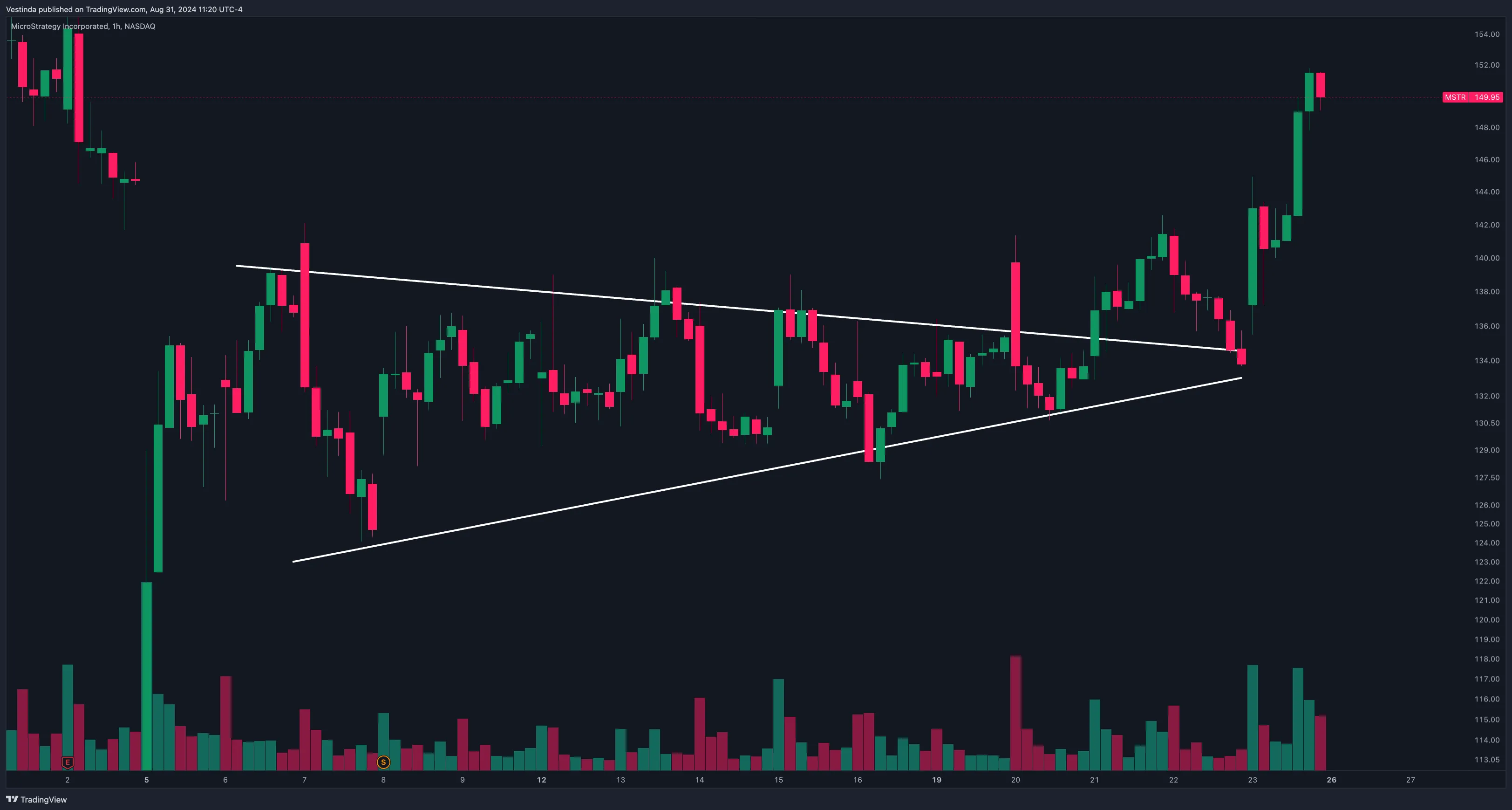
- Volume Confirmation: Use volume as a confirming indicator; a breakout with strong volume suggests the move is likely to continue.
- Entry and Exit: Enter the trade when the price breaks out of the pattern, and set a stop-loss just below the breakout level. Exit the trade when the price reaches the next significant resistance or support level.
Momentum Trading
Concept: Trade based on the momentum of price movements, looking to capitalize on quick, strong moves in one direction.
How to Implement:

- Indicators: Use indicators like the Relative Strength Index (RSI) and Moving Average Convergence Divergence (MACD) to gauge momentum.
- Entry and Exit: Enter trades when momentum indicators confirm a strong move in one direction. Exit the trade as momentum begins to fade or when the price approaches a key support or resistance level.
Scalping
Concept: Focus on making numerous small trades throughout the trading day to capture minor price fluctuations.
How to Implement:
- Timeframes: Use 1-minute or 5-minute charts to identify quick entry and exit points.
- Indicators: Use a combination of moving averages (e.g., 9-period EMA and 21-period EMA) and Bollinger Bands to guide your scalping decisions.
- Entry and Exit: Enter trades when the price crosses key levels on short timeframes, aiming to exit within minutes, capturing small profits on each trade.
VWAP Trading
Concept: The Volume Weighted Average Price (VWAP) is a key indicator for day traders, showing the average price of a security weighted by volume, which helps in identifying the true average price over the trading day.
How to Implement:

- Indicator: Apply VWAP to a 1-minute or 5-minute chart.
- Entry and Exit: Buy MSTR when the price crosses above the VWAP from below, and sell when it crosses below the VWAP from above. This strategy is particularly effective in trending markets.
Tools and Indicators for Successful MSTR Day Trading
Moving Averages
Why: Moving averages smooth out price data, helping you identify trends and potential entry/exit points.
How to Use:
- Apply short-term moving averages (e.g., 9-period and 21-period EMAs) to identify trends on intraday charts. Use crossovers as signals for entering and exiting trades.
Bollinger Bands
Why: Bollinger Bands help identify overbought and oversold conditions, providing entry points during periods of high volatility.
How to Use:
- Enter trades when the price touches the lower band in an uptrend or the upper band in a downtrend. Exit when the price moves back toward the middle band.
RSI (Relative Strength Index)
Why: RSI measures the magnitude of recent price changes to evaluate overbought or oversold conditions.
How to Use:
- Look for RSI levels below 30 (oversold) for potential buying opportunities, and above 70 (overbought) for potential selling opportunities.
Risk Management for MSTR Day Trading
Position Sizing
Concept: Determine the size of each trade based on your overall risk tolerance and the distance to your stop-loss level.
How to Implement:
- Use a percentage of your trading capital (e.g., 1-2%) for each trade, ensuring that losses are kept within manageable limits.
Stop-Loss Orders
Concept: Use stop-loss orders to protect your capital and limit potential losses.
How to Implement:
- Set stop-loss levels below key support levels (for long positions) or above resistance levels (for short positions) to automatically exit trades that move against you.
Take-Profit Orders
Concept: Set take-profit levels to lock in gains when the price reaches a predetermined target.
How to Implement:
- Place take-profit orders at significant resistance levels in an uptrend or support levels in a downtrend to secure profits before the price reverses.
Tips for Successful MSTR Day Trading
Focus on Key Market Hours
Why: The first and last hours of the trading day often provide the most liquidity and volatility, offering the best opportunities for day traders.
How to Implement:
- Concentrate your trading efforts during these peak hours to capture the most significant price movements.
Stay Informed
Why: MSTR’s price can be significantly impacted by news related to Bitcoin, technology trends, and company-specific announcements. Staying informed allows you to anticipate market moves.
How to Implement:
- Monitor news sources, earnings reports, and Bitcoin price movements that may affect MicroStrategy’s stock price.
Avoid Overtrading
Why: Overtrading can lead to poor decision-making and increased transaction costs, which can erode profits.
How to Implement:
- Set a daily trade limit and stick to it, focusing on quality trades over quantity.
Trending Day Trading Approaches (MSTR)
There are several popular day trading strategies that traders often use to maximize their profits. One common strategy is momentum trading, where traders focus on buying stocks that are gaining momentum and selling stocks that are losing momentum. Another popular strategy is scalping, where traders make multiple small trades throughout the day to capitalize on small price changes. Range trading is also a popular strategy that involves identifying key levels of support and resistance and trading within that range. Breakout trading is another common strategy, where traders aim to enter a trade when a stock breaks out of a well-defined price range. Finally, some traders use news trading, where they take positions based on the release and interpretation of important news events. Overall, these strategies can be effective for day traders looking to profit in the short term. For example, MSTR's recent rally prompted momentum traders to buy and profit from its upward momentum.
Understanding MSTR: Uncovering Microstrategy's Essence
MSTR, short for Microstrategy Class A, is a powerful business intelligence software platform. It helps companies transform their data into actionable insights. With its user-friendly interface and robust analytics capabilities, MSTR allows businesses to make data-driven decisions. The software offers a wide range of features, including data visualization, dashboards, and predictive analytics. MSTR supports various data sources, enabling users to consolidate and analyze data from different systems. Businesses can create customized reports and share them with stakeholders for better collaboration. Designed for scalability and performance, MSTR can handle large volumes of data efficiently. With its advanced security features, organizations can ensure the confidentiality and integrity of their data. Overall, MSTR empowers businesses to harness the power of data and gain a competitive edge in today's data-driven world.
MSTR Day Trading Strategy Blueprint
Developing a MSTR day trading plan is crucial for success in the market.
To begin, analyze the historical data and trends of MSTR to identify patterns and potential entry and exit points. Consider factors such as volume, price movements, and news events that can impact the stock.
Next, set clear objectives and determine your risk tolerance and maximum loss limit. Establishing these guidelines helps to manage emotions and make rational decisions when trading.
Additionally, develop a systematic approach to trade execution, including setting stop-loss orders and profit targets. This will help minimize losses and lock in gains.
Regularly review and adjust your trading plan to adapt to changing market conditions. Stay disciplined and follow your plan consistently. Remember, consistency and risk management are key to successful day trading in MSTR.
-
100,000 available assets New
-
years of historical data
-
practice without risking money

Frequently Asked Questions
Making $100 a day trading can be challenging for many individuals. It requires a combination of skill, knowledge, and a disciplined approach to the market. Traders must constantly analyze and monitor market trends, make calculated decisions, and manage risks effectively. Success depends on various factors, such as market volatility, trading strategy, capital, and experience. While it is achievable for some seasoned traders, it may pose significant difficulties for beginners or those without the necessary expertise. Continuous learning, practice, and a realistic approach to expectations are crucial in pursuing consistent profitability in trading.
The 11am rule in trading refers to a common guideline that suggests waiting until 11am before making any significant trading decisions. This approach emphasizes giving the market time to settle and provides an opportunity to observe any morning volatility and discern genuine trends from temporary fluctuations. By waiting until this time, traders can avoid knee-jerk reactions to early morning market movements and make more informed decisions based on a clearer picture of the day's market conditions. The 11am rule helps prevent impulsive actions and encourages a more calm and calculated approach to trading.
There is no definitive answer to this question as successful day trading outcomes vary greatly depending on various factors. While some professional and experienced day traders manage to make consistent profits through careful analysis and strategy, the majority of day traders struggle to consistently generate income and may even incur significant losses. It requires a deep understanding of the market, rigorous risk management, and constant adaptation to changing conditions. Therefore, it is crucial to approach day trading with caution and extensive knowledge to have the potential to make money in this highly volatile and risky endeavor.
Day trading involves buying and selling financial instruments within a short time frame, aiming to profit from short-term price fluctuations. While it may share some characteristics with gambling, day trading is not purely gambling. It requires careful analysis, technical skills, knowledge, and risk management. Successful day traders utilize strategies, research, and market analysis to make informed decisions, reducing reliance on chance. However, improper planning or emotional decision-making can result in losses, resembling gambling. Therefore, day trading can be considered as a blend of strategic decision-making and elements of gambling, depending on the approach and discipline of the individual trader.
No, day trading itself is not illegal. Day trading refers to the practice of buying and selling financial instruments within the same trading day with the aim of profiting from short-term price fluctuations. However, specific regulations and requirements vary by country and jurisdiction. Some countries may impose restrictions, such as minimum account balances or pattern day trading rules, but these are regulatory measures aimed at protecting investors rather than making day trading illegal. It is essential for traders to understand and comply with the rules and regulations in their specific jurisdiction to avoid any legal issues.
Conclusion
In conclusion, MSTR day trading offers exciting opportunities for both experienced traders and beginners looking to learn about trading. By understanding the basics of day trading, utilizing effective strategies and tools, and developing a solid trading plan, traders can navigate the volatile MSTR market and maximize their profits. Factors such as volume analysis, momentum trading, scalping, range trading, breakout trading, and news trading all play important roles in successful MSTR day trading. Additionally, MSTR's powerful business intelligence software platform allows businesses to make data-driven decisions and gain a competitive edge in today's data-centric world. So, if you're interested in exploring the world of day trading and specifically in trading MSTR, this article has provided valuable insights and guidance to get you started.

Successful traders rely on backtesting to be profitable.
Be like them with our
Free Backtesting Guide