-
 Create
account -
 Build trading strategies
with no code -
 Validate
& Backtest -
 Connect exchange
& start earning
Quant Strategies & Backtesting results for QQQ
Here are some QQQ trading strategies along with their past performance. You can validate these strategies (and many more) for free on Vestinda across thousands of assets and many years of historical data.
Quant Trading Strategy: Bollinger Bands (Low Up) and RSI on QQQ
Based on the backtesting results for a trading strategy conducted from November 20, 2022, to November 20, 2023, the annualized Return on Investment (ROI) has been recorded at an impressive 18.2%. The strategy has demonstrated consistent success, with an average holding time of 6 weeks per trade. Despite a low frequency of trades, with an average of only 0.03 per week, the strategy has managed to achieve outstanding results. Throughout the testing period, a total of 2 trades were closed, with each yielding a remarkable 100% success rate. These statistics reveal the strategy's ability to consistently generate positive returns and showcase its potential for future application.
 QQQ
QQQ

Choose another period and try again.
Quant Trading Strategy: ATR Breakout Strategy on QQQ
Based on the backtesting results statistics for a trading strategy from November 20, 2016, to November 20, 2023, several key metrics can be observed. The strategy exhibits a profit factor of 1.25, indicating that, on average, the profit generated by winning trades is 1.25 times larger than the loss incurred by losing trades. The annualized return on investment (ROI) stands at 1.7%, which indicates a modest but consistent growth in capital over the analyzed period. The average holding time for trades is relatively long at 9 weeks, suggesting a tendency to focus on longer-term opportunities. With an average of 0.05 trades per week, the strategy is relatively conservative in terms of frequency. Out of the 19 closed trades, approximately 47.37% were winning trades, while the overall return on investment reached 12.15%.
QQQ
Choose another period and try again.
QQQ (Invesco QQQ Trust) Day Trading: Tips and Strategies for Success
Introduction
The Invesco QQQ Trust (QQQ) is one of the most heavily traded exchange-traded funds (ETFs), offering exposure to the Nasdaq-100 Index, which includes some of the most prominent technology and growth companies. Due to its liquidity and volatility, QQQ is a popular choice for day traders looking to capitalize on short-term price movements. In this guide, we’ll explore effective day trading tips and strategies specifically for QQQ, helping you maximize your trading performance and achieve consistent success.
Why Day Trade QQQ?
- High Liquidity: QQQ is one of the most liquid ETFs, ensuring tight bid-ask spreads and quick order execution, which are crucial for day trading.
- Volatility: The technology-heavy Nasdaq-100 index often experiences significant price swings, providing numerous opportunities for day traders.
- Accessibility: QQQ’s popularity means it’s widely covered by analysts and traders, giving you access to abundant research, insights, and trading tools.
Key Day Trading Strategies for QQQ
Breakout Trading
Concept: Identify key levels of support and resistance and trade the breakout when the price moves beyond these levels.
How to Implement:

- Chart Patterns: Focus on patterns like triangles, rectangles, and flags that signal potential breakouts.
- Volume Confirmation: Use volume as a confirming indicator; a breakout with strong volume suggests the move is likely to continue.
- Entry and Exit: Enter the trade when the price breaks out of the pattern, and set a stop-loss just below the breakout level. Exit the trade when the price reaches the next significant resistance or support level.
Momentum Trading
Concept: Trade based on the momentum of price movements, looking to capitalize on quick, strong moves in one direction.
How to Implement:
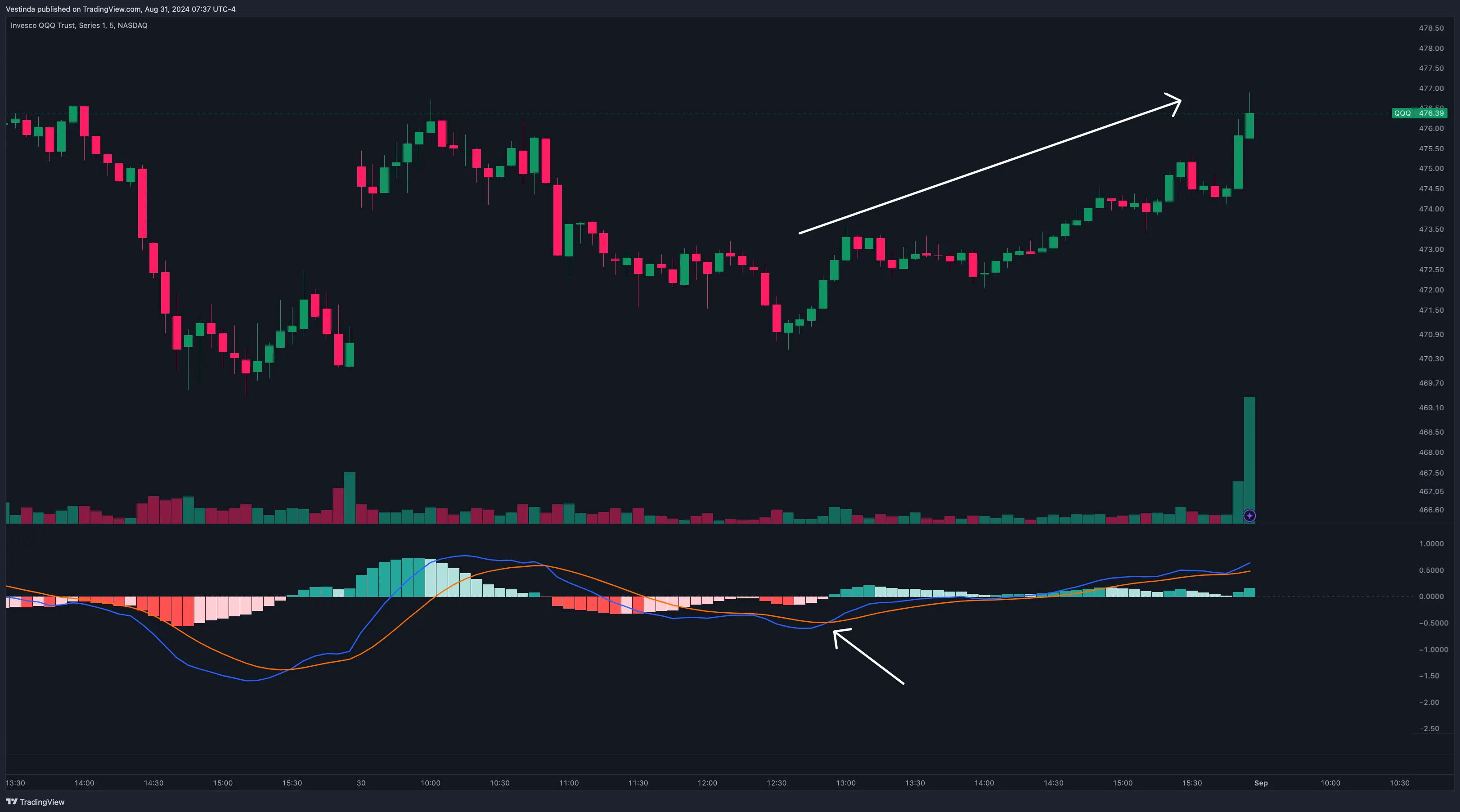
- Indicators: Use indicators like the Relative Strength Index (RSI) and Moving Average Convergence Divergence (MACD) to gauge momentum.
- Entry and Exit: Enter trades when momentum indicators confirm a strong move in one direction. Exit the trade as momentum begins to fade or when the price approaches a key support or resistance level.
Scalping
Concept: Focus on making numerous small trades throughout the trading day to capture minor price fluctuations.
How to Implement:
- Timeframes: Use 1-minute or 5-minute charts to identify quick entry and exit points.
- Indicators: Use a combination of moving averages (e.g., 9-period EMA and 21-period EMA) and Bollinger Bands to guide your scalping decisions.
- Entry and Exit: Enter trades when the price crosses key levels on short timeframes, aiming to exit within minutes, capturing small profits on each trade.
VWAP Trading
Concept: The Volume Weighted Average Price (VWAP) is a key indicator for day traders, showing the average price of a security weighted by volume, which helps in identifying the true average price over the trading day.
How to Implement:
- Indicator: Apply VWAP to a 1-minute or 5-minute chart.
- Entry and Exit: Buy QQQ when the price crosses above the VWAP from below, and sell when it crosses below the VWAP from above. This strategy is particularly effective in trending markets.
Tools and Indicators for Successful QQQ Day Trading
Moving Averages
Why: Moving averages smooth out price data, helping you identify trends and potential entry/exit points.
How to Use:
Apply short-term moving averages (e.g., 9-period and 21-period EMAs) to identify trends on intraday charts. Use crossovers as signals for entering and exiting trades.
Bollinger Bands
Why: Bollinger Bands help identify overbought and oversold conditions, providing entry points during periods of high volatility.
How to Use:
Enter trades when the price touches the lower band in an uptrend or the upper band in a downtrend. Exit when the price moves back toward the middle band.
RSI (Relative Strength Index)
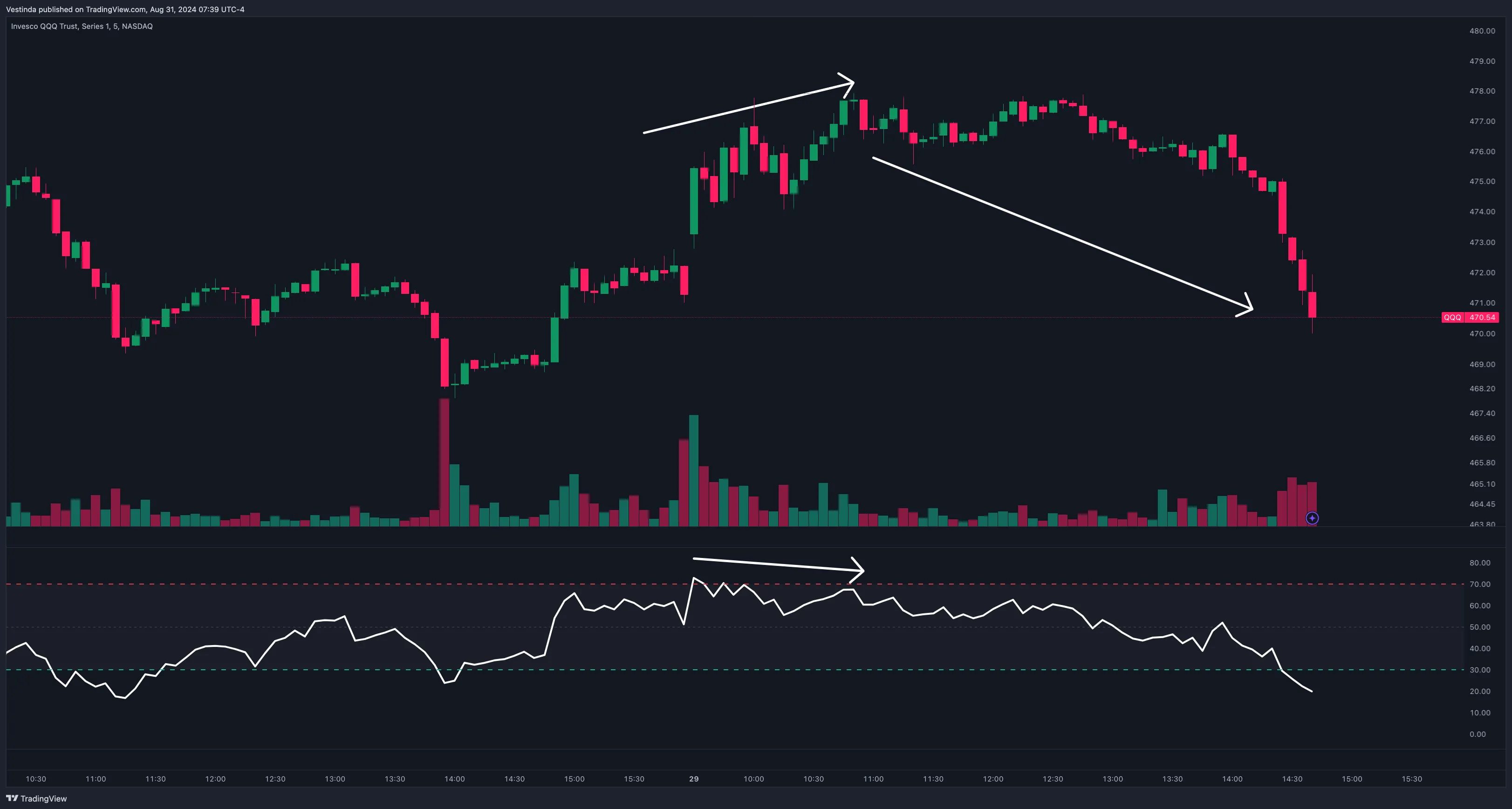
Why: RSI measures the magnitude of recent price changes to evaluate overbought or oversold conditions.
How to Use:
Look for RSI levels below 30 (oversold) for potential buying opportunities, and above 70 (overbought) for potential selling opportunities.
Risk Management for QQQ Day Trading
Position Sizing
Concept: Determine the size of each trade based on your overall risk tolerance and the distance to your stop-loss level.
How to Implement:
Use a percentage of your trading capital (e.g., 1-2%) for each trade, ensuring that losses are kept within manageable limits.
Stop-Loss Orders
Concept: Use stop-loss orders to protect your capital and limit potential losses.
How to Implement:
Set stop-loss levels below key support levels (for long positions) or above resistance levels (for short positions) to automatically exit trades that move against you.
Take-Profit Orders
Concept: Set take-profit levels to lock in gains when the price reaches a predetermined target.
How to Implement:
Place take-profit orders at significant resistance levels in an uptrend or support levels in a downtrend to secure profits before the price reverses.
Tips for Successful QQQ Day Trading
Focus on Peak Trading Hours
Why: The first and last hours of the trading day often provide the most liquidity and volatility, offering the best opportunities for day traders.
How to Implement:
Concentrate your trading efforts during these peak hours to capture the most significant price movements.
Avoid Overtrading
Why: Overtrading can lead to poor decision-making and increased transaction costs, which can erode profits.
How to Implement:
Set a daily trade limit and stick to it, focusing on quality trades over quantity.
Stay Informed
Why: News and events can have a significant impact on QQQ’s price, so staying informed is crucial for making timely trading decisions.
How to Implement:
Monitor news sources, earnings reports, and economic indicators that may affect the Nasdaq-100 index and, by extension, QQQ.
Creating an Efficient QQQ Day Trading Strategy
Developing a QQQ day trading plan requires careful analysis and strategizing. Firstly, traders should conduct thorough research on the QQQ and its underlying assets to gain a comprehensive understanding of market trends. Next, they should establish clear entry and exit points, incorporating both profit targets and stop losses into their plan. Additionally, it is essential to employ technical analysis tools such as moving averages and trend lines to identify potential entry and exit opportunities. Traders must also take into account market volatility and adjust their plan accordingly. Finally, it is crucial to regularly review and refine the trading plan based on performance and market conditions, ensuring its adaptability to changing circumstances. By developing a detailed day trading plan, traders can increase their chances of success in the QQQ market.
Essential QQQ Trading Skills
To be a successful day trader, you need a specific skill set. The ability to quickly analyze technical indicators and charts is crucial. You must also have a deep understanding of market trends and patterns. Being able to make split-second decisions is essential, as day trading requires fast-paced decision-making. Effective risk management skills are necessary to protect your capital. You should have a high tolerance for stress and the ability to remain calm under pressure. Discipline and self-control are critical in sticking to your trading plan. Adaptability is key, as market conditions can change rapidly. Finally, having a strong knowledge of the QQQ and other traded instruments is imperative for informed trading decisions.
Quantifying Trade Volumes: QQQ Day Trading Insights
Volume analysis plays a crucial role in day trading the Invesco Qqq Trust (QQQ). By analyzing the volume of shares bought and sold, traders can gauge the strength of market moves. High volume indicates widespread interest and active participation, making it more likely for a trend to continue. Conversely, low volume can signal weak interest, potentially indicating a reversal or consolidation. Traders can use volume analysis to confirm breakouts and identify potential entry or exit points. For example, a sharp increase in volume accompanying a price breakout suggests a strong move underway. By contrast, if a breakout occurs on low volume, it may lack conviction and result in a false signal. Therefore, incorporating volume analysis into your QQQ day trading strategy can provide valuable insights for making informed trading decisions.
-
Track your
Crypto Portfolio -
Copy Crypto trading
strategies -
Build trading strategies
with no code
-
Backtest trading strategies
on Crypto, Forex, Stocks, etc. -
Demo Trading
Risk-free Paper Trading -
Automate trading strategies
with Live Trading
Frequently Asked Questions
To begin trading on QQQ as a beginner, one can follow a simple process. Firstly, open a brokerage account with a reputable firm. Next, deposit funds into the account. Then, research and select a trading platform that offers QQQ trading. Once the platform is set up, beginners can start studying market trends and conducting analysis. It is important to develop a trading strategy and set a budget. Finally, beginners can start executing trades on QQQ by buying or selling shares based on their analysis and strategy. Regularly monitoring the market and updating the trading strategy is crucial for success.
Day traders often fail to become millionaires due to several factors. Firstly, trading requires extensive knowledge, experience, and expertise, which takes time and effort to develop. Additionally, day trading is highly unpredictable, and even experienced traders can suffer significant losses. Many traders struggle with emotional decision-making and fall victim to impulsive trades. Moreover, the costs associated with frequent trading, such as commissions and taxes, can eat into potential profits. Overall, while some day traders may achieve success, the combination of market uncertainties, psychological challenges, and financial constraints makes it difficult for the majority to become millionaires.
Yes, it is possible to make $100 a day with ETFs (Exchange-Traded Funds) depending on the market conditions, the investment amount, and the strategy employed. ETFs offer a diverse range of investment options covering various sectors, commodities, and indices, allowing for potential daily gains. However, the market can be volatile, and returns are not guaranteed. It requires careful research, appropriate risk management, and a well-executed trading plan to consistently generate $100 profit each day. Success ultimately depends on one's knowledge, experience, and ability to adapt to market fluctuations.
Day trading can be a high-risk and complex strategy, and whether it is smart or not depends on various factors. It requires extensive knowledge, experience, and constant monitoring of the market. While some individuals may find success in day trading and make significant profits, the majority of day traders actually lose money. Moreover, day trading often incurs high transaction costs and taxes. It is crucial to thoroughly understand the risks involved and have a solid trading plan before engaging in day trading. For most people, long-term investing based on research and fundamental analysis is a more prudent approach.
The easiest assets to day trade are often those with high liquidity and volatility. Stocks of large companies are commonly traded due to their high trading volume, making it easier to buy and sell quickly. Additionally, currencies such as the US dollar and euro are popular among day traders as they tend to have significant fluctuations. Commodities like crude oil and gold also provide ample opportunities for day trading due to their price volatility. Choosing an asset that is actively traded and has a track record of frequent price movements can increase the chances of successful day trading.
Conclusion
In conclusion, QQQ (Invesco Qqq Trust) day trading offers an exciting opportunity for both beginners and experienced day traders. By learning about trading and implementing effective strategies, traders can take advantage of the volatility in QQQ and make profitable trades. Utilizing day trading signals, analyzing intraday chart patterns, and using the right tools and software are crucial for success. It is important to understand the psychological aspect of day trading and explore techniques such as scalping. Additionally, developing a well-researched and adaptable trading plan, honing specific skills, and incorporating volume analysis can greatly enhance trading performance in the QQQ market.

Successful traders rely on backtesting to be profitable.
Be like them with our
Free Backtesting Guide