Sophisticated backtesting is not only possession of high-esteemed hedge funds anymore.
Impressive Team and support, Backtesting engine with detailed reports, The Strategy builder.

Great purchase!
I have always manually invested in stocks and cryptocurrencies, but after studying Vestinda, I must say it has enormous potential.

Mature platform for trading
Pro: Easy to use, Nice UX, A lot of customization for strategies, Back testing is an awesome tool, can check any strategy in history.

Algorithmic Strategies & Backtesting results for ALGO
Here are some ALGO trading strategies along with their past performance. You can validate these strategies (and many more) for free on Vestinda across thousands of assets and many years of historical data.
Algorithmic Trading Strategy: PSAR and EMA Crossover or Confirmation on ALGO
Based on the backtesting results from June 22, 2019, to November 23, 2023, the trading strategy yielded promising statistics. The profit factor stood at 1.18, showcasing a profitable approach. An annualized return on investment of 17.12% reaffirmed its potential for consistent growth. On average, each trade was held for around 1 week and 1 day, indicating a short-term approach. With an average of 0.21 trades per week, the strategy displayed a controlled and selective trading style. Out of a total of 49 closed trades, 32.65% were winners, highlighting a mixed success rate. Comparatively, this strategy outperformed the buy and hold approach, generating excess returns of 2444.56%.

 ALGOUSDT

Choose another period and try again.
Algorithmic Trading Strategy: OrderBlocks Last O/H/L with Median Price and SL on ALGO
The backtesting results for the trading strategy during the period from June 22, 2019, to November 22, 2023, show promising statistics. The profit factor was 2.29, indicating that the strategy was able to generate significant profits relative to the losses incurred. The annualized return on investment (ROI) stood at a modest but positive 1.05%. On average, positions were held for 4 hours and 15 minutes, and there were only 0.03 trades per week, suggesting a selective and patient approach. With a winning trades percentage of 57.14%, the strategy demonstrated a decent level of accuracy. Most notably, it outperformed the buy and hold approach, generating excess returns of 1469.05%.
ALGOUSDT
Choose another period and try again.
ALGO (Algorand) Trading Signals: Expert Tips for Profitable Trading
Introduction
Trading signals provide actionable insights into market trends, helping traders make informed decisions. For ALGO (Algorand), trading signals based on reliable indicators can significantly enhance profitability. This guide delves into expert strategies for generating and interpreting trading signals to boost your Algorand trading success.
What Are Trading Signals?
Trading signals are predefined triggers based on technical indicators or patterns that suggest when to buy, sell, or hold a cryptocurrency. These signals can be derived from various sources, including:
- Technical Indicators: Tools like RSI, MACD, and Bollinger Bands.
- Volume Analysis: Insights from metrics like VWAP and Chaikin Money Flow.
- Trend Analysis: Using moving averages or trendlines.
Benefits of Trading Signals for ALGO
- Precision: Guides entry and exit points with clear data-driven insights.
- Time Efficiency: Reduces the need for constant market monitoring.
- Enhanced Strategy Development: Combines signals with automated trading for improved outcomes.
Top Indicators for ALGO Trading Signals
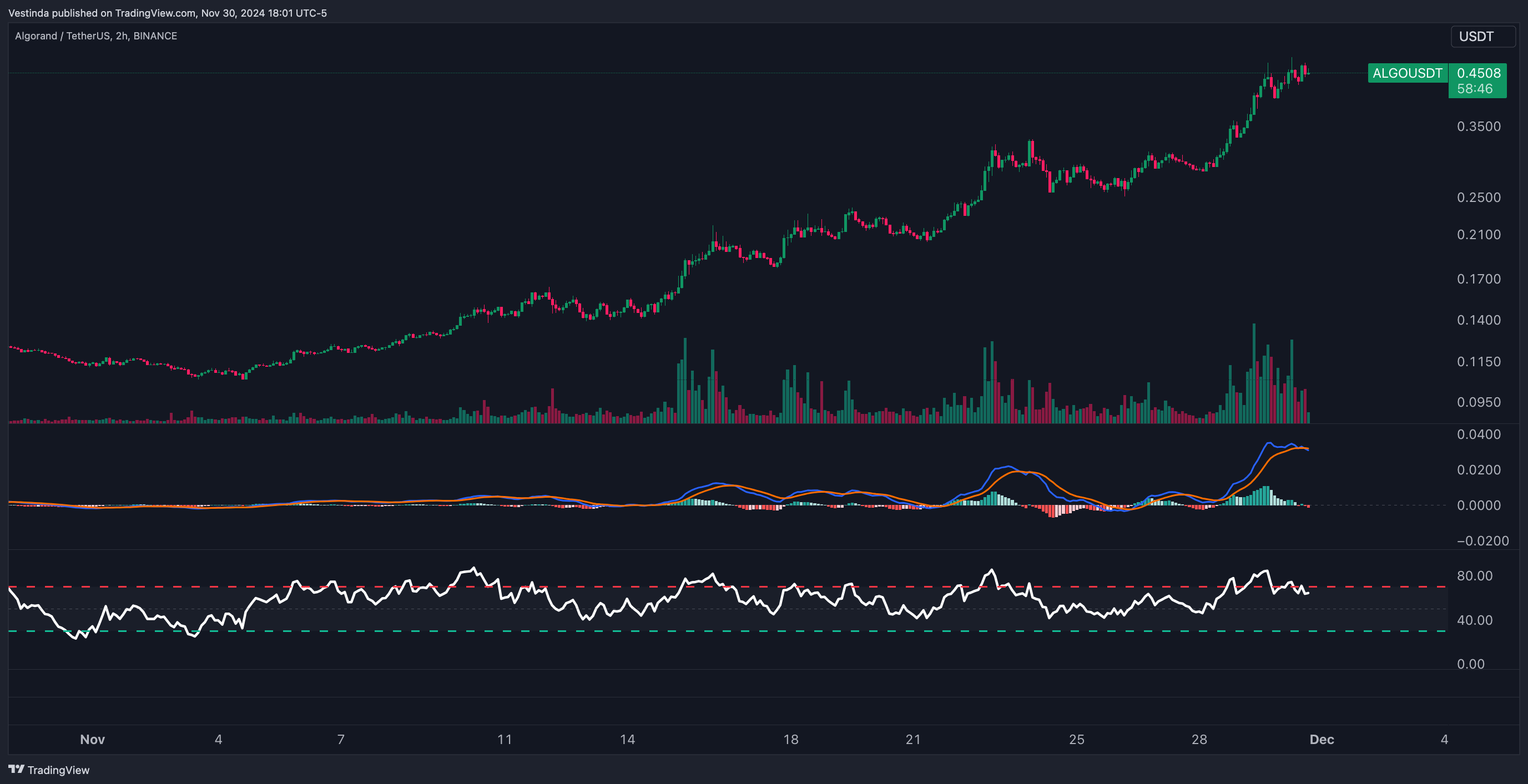
1. MACD + RSI: Momentum Confirmation
How It Works:
Combines momentum (MACD) with overbought/oversold conditions (RSI).
Setup:
- MACD (12, 26, 9) to identify trend strength and direction.
- RSI (14) to gauge buying and selling pressure.
Signal Rules:
- Buy Signal: When the MACD line crosses above the signal line, and RSI is above 50.
- Sell Signal: When the MACD line crosses below the signal line, or RSI drops below 50.
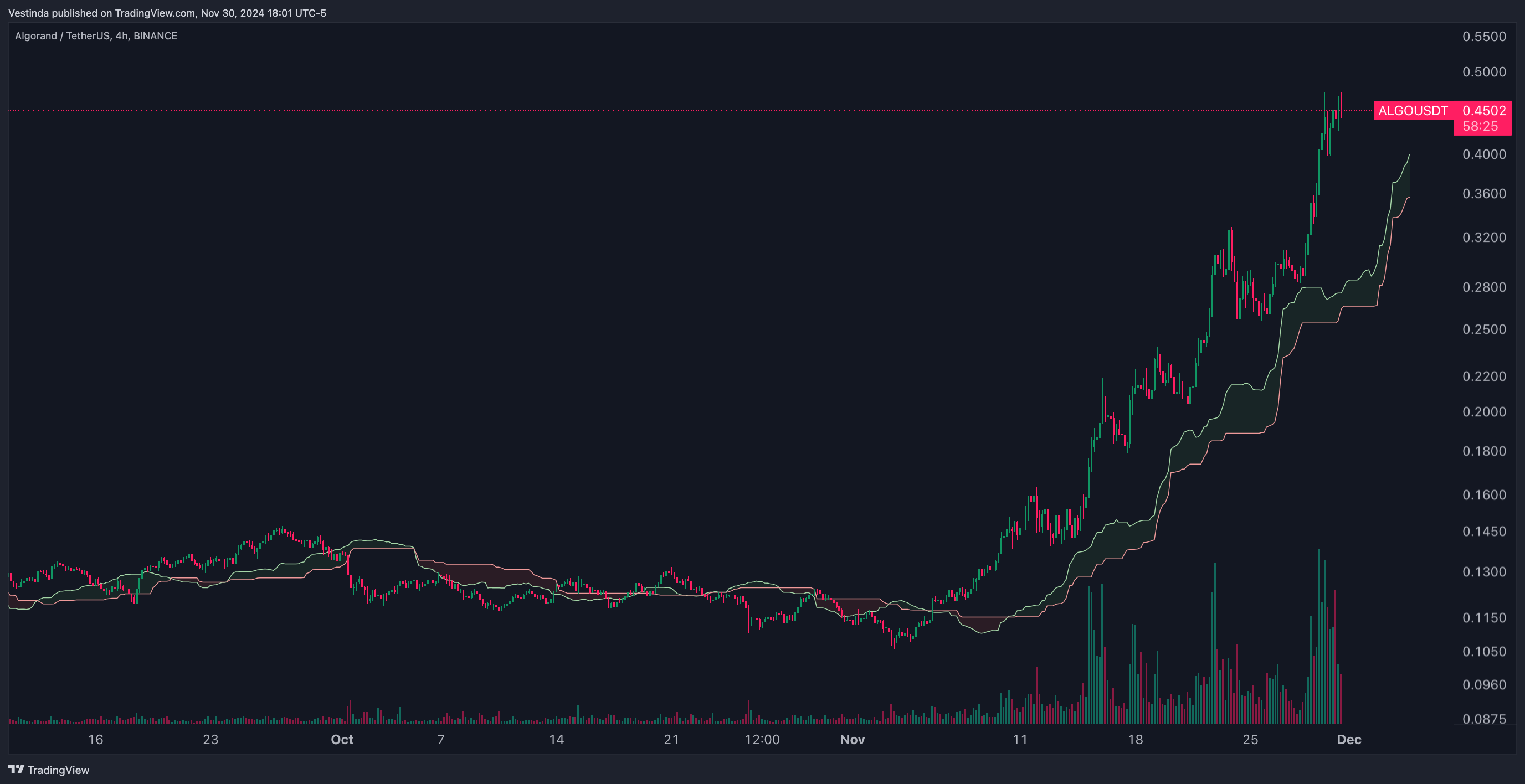
2. Ichimoku Cloud: Trend Identification
How It Works:
Analyzes trend direction, support/resistance, and momentum.
Setup:
- Use the full Ichimoku setup to visualize cloud zones.
Signal Rules:
- Buy Signal: When price breaks above the cloud and the conversion line crosses above the baseline.
- Sell Signal: When price drops below the cloud, indicating a reversal.
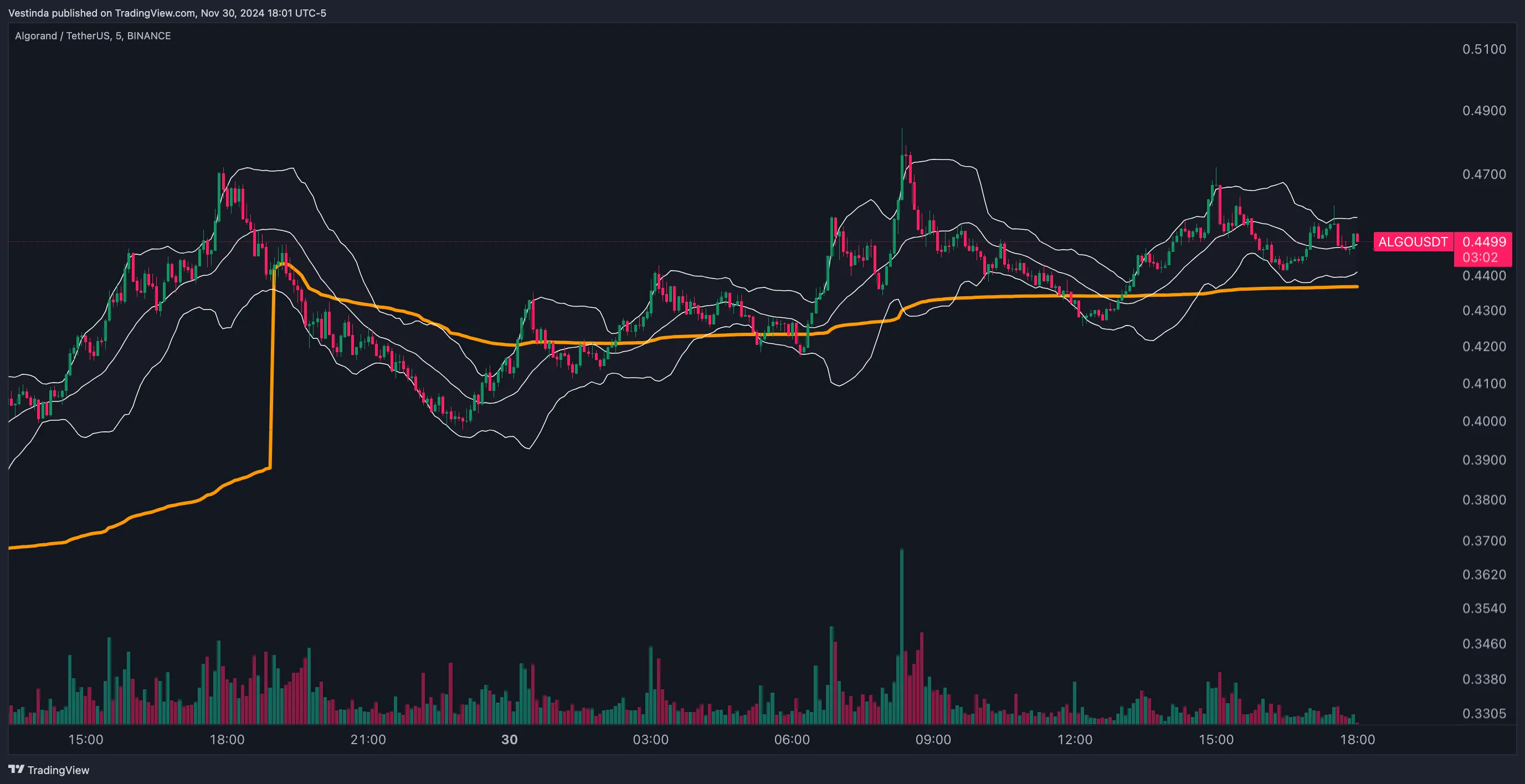
3. Bollinger Bands + VWAP: Breakout Strategy
How It Works:
Identifies potential breakouts using volatility and volume-weighted prices.
Setup:
- Bollinger Bands (20, 2) to track price deviations.
- VWAP to confirm breakout direction.
Signal Rules:
- Buy Signal: When price closes above the upper Bollinger Band, supported by price trading above VWAP.
- Sell Signal: When price closes below the lower Bollinger Band or VWAP.
How to Use Trading Signals Effectively
- Combine Signals: Use multiple indicators to confirm signals before acting. Example: Use MACD and RSI together for stronger momentum confirmation.
- Backtest Strategies: Test signal-based strategies on historical ALGO data to validate performance.
- Implement Automation: Use trading bots to execute signals consistently and efficiently.
Risk Management with Trading Signals
- Dynamic Stop-Loss: Set stop-loss levels based on ATR or volatility bands.
- Position Sizing: Risk only a small percentage (1-2%) of your portfolio per trade.
- Avoid Signal Overload: Focus on high-probability signals rather than acting on every indicator change.
Advantages of Trading Signals for ALGO
- Increased Accuracy: Reduces guesswork in trading decisions.
- Adaptability: Can be tailored to different market conditions and timeframes.
- Scalability: Applicable to multiple trading pairs and strategies.
Common Pitfalls to Avoid
- Ignoring Market Context: Always consider broader trends and news affecting Algorand.
- Over-Reliance on a Single Indicator: Combine multiple indicators for well-rounded insights.
- Neglecting Regular Updates: Adapt signal parameters to match current market conditions.
Conclusion
Trading signals are a powerful tool for maximizing profitability in ALGO trading. By leveraging a combination of indicators like MACD, RSI, Ichimoku Cloud, and VWAP, traders can create robust strategies tailored to their goals. Coupled with disciplined risk management, these signals pave the way for consistent success in Algorand’s dynamic market.
ALGO Trading Signal User Guide
- Choose a reputable source of ALGO trading signals.
- Sign up for a subscription or access to the trading signals.
- Familiarize yourself with the signal provider's instructions and recommendations.
- Keep track of the recommended buy or sell signals for ALGO.
- Use the signals to inform your ALGO trading decisions.
- Monitor the market and consider other relevant factors before acting on the signals.
Crucial Role of Stable ALGO Trading Signals
In ALGO trading, reliable signals play a crucial role in ensuring optimal performance. These signals, which convey important market information, guide trading decisions and inform algorithms. Without reliable signals, ALGO trading can become ineffective and prone to errors. By providing accurate data on price movements, volume, and trends, these signals help algorithms swiftly react to changing market conditions. They enable ALGO traders to make informed decisions and capture profitable opportunities. Moreover, reliable signals minimize the risks associated with trading, as algorithms can promptly adjust their strategies based on the received information. In the fast-paced world of ALGO trading, where milliseconds matter, dependable signals are essential for achieving success and maximizing returns. Ultimately, their significance lies in optimizing the performance and profitability of ALGO trading strategies.
ALGO Signal Services: Maximizing Algorand Trading Profits
ALGO signal providers offer crypto traders reliable insights and market analysis for Algorand. These providers use algorithmic trading strategies and advanced technical indicators to deliver accurate trading signals. Subscribers receive real-time notifications about buy/sell opportunities and market trends. ALGO signal providers use historical data and predictive analysis models to generate signals, helping traders make informed decisions. With their expertise, these providers aim to maximize profits and minimize potential risks for their subscribers. By leveraging the power of automation and AI, ALGO signal providers offer a valuable resource for traders in the Algorand ecosystem. Traders can access these signals through various platforms and have the flexibility to customize their trading strategies based on their individual preferences and risk tolerance.
Fibonacci Analysis in ALGO Trading Signals
Fibonacci retracement is a popular tool in ALGO signal analysis. It helps identify potential levels of support and resistance based on a sequence of numbers, known as the Fibonacci sequence. ALGO traders often use Fibonacci retracement levels, such as 38.2%, 50%, and 61.8%, to determine entry and exit points for their trades. This analysis method assumes that markets tend to retrace a portion of their previous move before continuing in the same direction. By plotting these retracement levels on a price chart, traders can anticipate possible price reversals or continuation patterns. Fibonacci retracement is widely used in ALGO signal analysis to make informed trading decisions and capitalize on market trends.
Live Tracking of ALGO Signal Activity
Real-time monitoring of ALGO signals is essential for investors to stay up-to-date with market trends. By tracking ALGO signals in real-time, investors can make informed decisions quickly and efficiently. With the volatile nature of the cryptocurrency market, timely information is crucial. Real-time monitoring allows investors to take advantage of opportunities and minimize risks. By analyzing ALGO signals as they happen, investors can identify patterns and make strategic moves accordingly. This real-time data provides valuable insights into market behavior and helps in formulating trading strategies. Additionally, it enables investors to react swiftly to any sudden changes or developments in the ALGO ecosystem. Overall, real-time monitoring of ALGO signals is an invaluable tool for investors looking to stay ahead in the ever-changing world of cryptocurrencies.
-
100,000 available assets New
-
years of historical data
-
practice without risking money

Frequently Asked Questions
Yes, it is possible to obtain trading signals for specific sectors within the cryptocurrency market, such as tech or healthcare. Various financial platforms and services offer specialized signal providers who analyze market trends and provide signals tailored to specific sectors. These signals can help traders make informed decisions regarding their investments within the chosen sector. However, it is important to conduct thorough research and exercise caution while relying on signals, as they are not foolproof and should be used as one of many tools in the trading process.
To avoid false ALGO trading signals, it is important to employ a combination of strategies. Firstly, diversify your data sources and use multiple indicators to confirm signals before taking any action. Additionally, backtest your algorithms thoroughly to ensure they perform well in various market conditions. Incorporate risk management techniques such as setting stop loss orders to limit potential losses. Regularly monitor and analyze your algorithms' performance to identify any discrepancies or inconsistencies. Lastly, stay updated with market news and events that may affect your trading strategies and adjust them accordingly to minimize false signals.
Yes, there are platforms and services that provide ALGO trading signals for specific market sectors. These signals are generated using advanced algorithms that analyze market data, trends, and patterns. By applying specific criteria, these algorithms can identify potential trading opportunities in specific sectors and generate signals suggesting when to buy or sell. Subscribing to such services can help traders make informed decisions and potentially improve their trading performance in specific market sectors.
Managing emotions when following trading signals can be challenging, but it's crucial for successful trading. Firstly, maintaining discipline is essential. Stick to your trading strategy and avoid making impulsive decisions based on emotions. Secondly, establish a risk management plan to limit potential losses and protect your capital. Remember that losses are a part of trading and not every trade will be profitable. Thirdly, take breaks if you feel overwhelmed or stressed. Clear your mind and refocus. Finally, keep a trading journal to objectively evaluate your emotions and learn from past experiences. Emotions should never dictate trading decisions; instead, rely on a systematic approach based on analysis and strategy.
When using ALGO trading signals, it is crucial to effectively handle changes in market sentiment. Firstly, closely monitor news, economic indicators, and market trends to identify shifts in sentiment. Stay adaptable and be ready to adjust your trading strategy accordingly. Implement stop-loss orders to limit potential losses in case of sudden sentiment reversals. Additionally, regularly reassess and fine-tune your ALGO algorithms to align with current market conditions. Continuously review performance metrics to ensure that your signals are delivering accurate information in real-time. By staying informed, flexible, and proactive, you can effectively navigate changes in market sentiment when using ALGO trading signals.
Conclusion
In conclusion, ALGO Trading Signals are a vital resource for investors in the cryptocurrency market. These signals provide valuable insights and guidance specifically tailored for ALGO (Algorand) trading. By utilizing these algorithmic trading signals, investors can make more informed decisions and take advantage of market opportunities in real-time. It is crucial to choose a reputable source of ALGO trading signals and familiarize yourself with the signal provider's instructions. By tracking the recommended buy or sell signals for ALGO and using them to inform your trading decisions, you can stay ahead of the game and maximize your potential profits. Real-time monitoring of ALGO signals is also essential for staying up-to-date with market trends and making timely and strategic moves. Overall, ALGO Trading Signals optimize the performance and profitability of ALGO trading strategies.

Successful traders rely on backtesting to be profitable.
Be like them with our
Free Backtesting Guide