
-
Track your
Crypto Portfolio -
Copy Crypto trading
strategies -
Build trading strategies
with no code
-
Backtest trading strategies
on Crypto, Forex, Stocks, etc. -
Demo Trading
Risk-free Paper Trading -
Automate trading strategies
with Live Trading
Algorithmic Strategies & Backtesting results for BTC
Here are some BTC trading strategies along with their past performance. You can validate these strategies (and many more) for free on Vestinda across thousands of assets and many years of historical data.
Algorithmic Trading Strategy: ZLEMA Crossover with Increased Price Variance on BTC
Based on the backtesting results statistics for the trading strategy from December 14, 2018, to December 14, 2023, several key metrics can be observed. The strategy exhibited a profit factor of 1.04, indicating that for every unit of risk taken, a small profit was generated. The annualized return on investment (ROI) was 0.56%, implying a modest growth rate over the five-year period. On average, trades were held for approximately 1 week and 3 days, with an average of 0.08 trades per week. The strategy executed a total of 23 closed trades, with a winning trades percentage of 34.78%. Overall, the strategy yielded a return on investment of 2.8%.

 BTCUSDT

Choose another period and try again.
Algorithmic Trading Strategy: Mass Index Crossover with RSI Entry on BTC
The backtesting results of the trading strategy from December 10, 2018, to December 10, 2023, reveal promising statistics. The profit factor stands impressive at 2.01, indicating that the strategy generated $2.01 in profit for every $1 risked. The annualized ROI is substantial, reaching 18.99%, implying a noteworthy return on investment over the considered period. On average, positions were held for approximately 6 weeks and 3 days, exhibiting a longer-term approach. With an average of 0.04 trades per week, a conservative trading frequency is observed. Despite a limited number of 12 closed trades, a high winning trades percentage of 58.33% is achieved, underscoring an overall successful trading strategy.
BTCUSDT
Choose another period and try again.
BTC (Bitcoin) Trading Signals: Expert Tips for Success
Introduction
Trading signals provide valuable guidance for navigating Bitcoin's volatile market. Derived from technical indicators, market trends, or algorithms, these signals help traders make informed decisions. This guide explores expert strategies for interpreting and utilizing Bitcoin trading signals effectively to achieve consistent success.
What Are Bitcoin Trading Signals?
- Definition: Alerts or triggers generated based on predefined technical, fundamental, or algorithmic conditions, indicating potential buy or sell opportunities.
- Sources of Signals:
- Indicator-Based Signals: Generated by tools like RSI, MACD, or Bollinger Bands.
- Pattern-Based Signals: Triggered by price action patterns such as breakouts or trend reversals.
- AI-Powered Signals: Advanced signals derived from machine learning algorithms.
Key Strategies for Bitcoin Trading Signals
1. Momentum-Based Trading with RSI and MACD
Concept: Use RSI to detect overbought or oversold conditions and MACD to confirm momentum shifts.

Execution Rules:
- Enter long positions: When RSI indicates oversold conditions, and MACD shows a bullish crossover.
- Exit or short: When RSI indicates overbought conditions, and MACD shows a bearish crossover.
- Enhancement: Combine with volume analysis for additional confirmation of momentum strength.
2. Breakout Trading with Bollinger Bands
Concept: Identify breakout opportunities during periods of low volatility using Bollinger Bands.
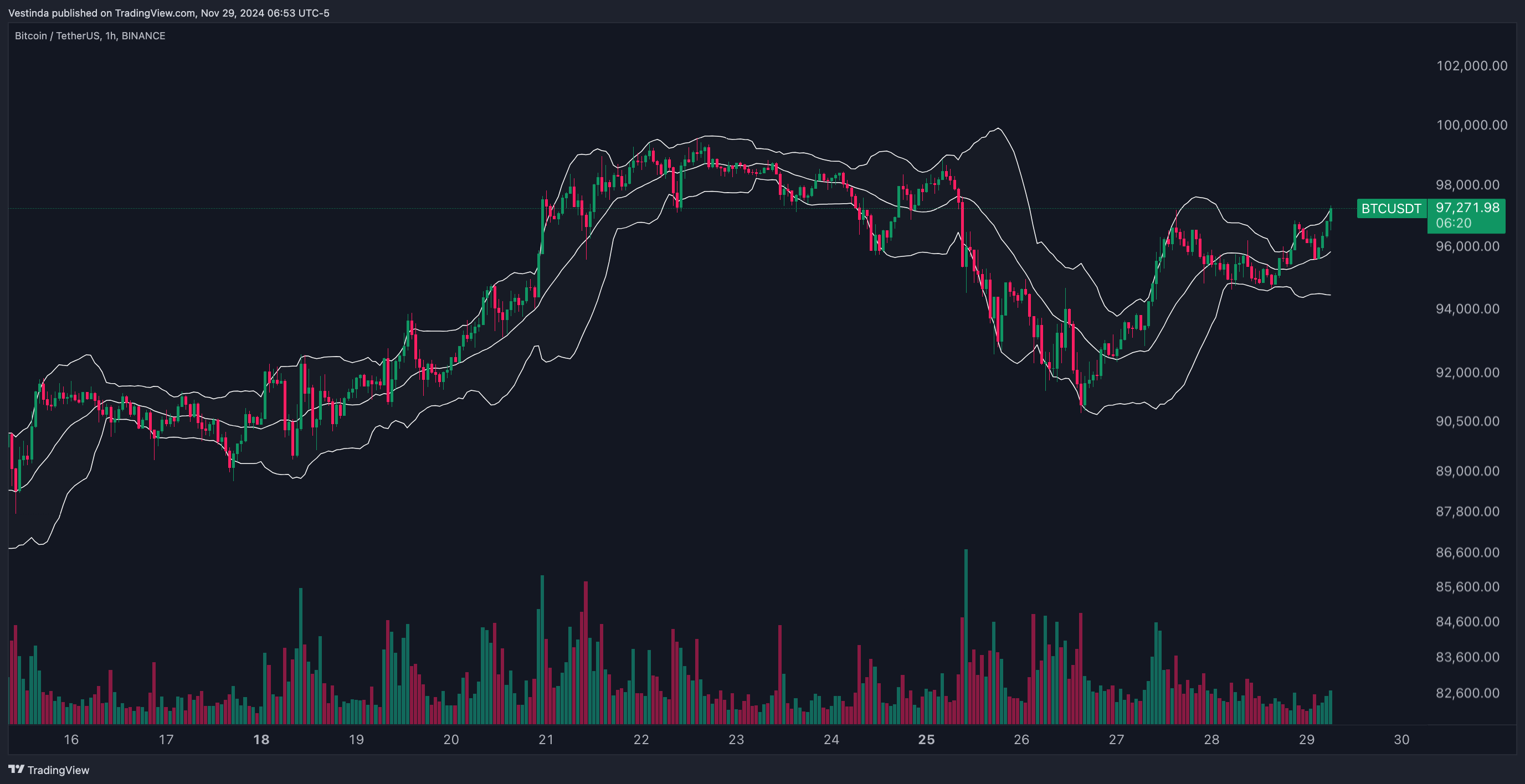
Execution Rules:
- Enter trades: When the price closes above or below the bands, confirmed by a spike in trading volume.
- Enhancement: Use stop-loss orders inside the bands to protect against false breakouts and capture reversals.
3. Trend-Following Strategy with Moving Averages
Concept: Follow Bitcoin’s directional movement using moving average crossovers.
Execution Rules:
- Enter long: When a short-term EMA crosses above a long-term EMA, signaling an uptrend.
- Exit or short: When the short-term EMA crosses below the long-term EMA, indicating a downtrend.
- Enhancement: Combine moving averages with trend indicators like Supertrend for greater accuracy.
4. Support and Resistance Signal Alignment
Concept: Leverage signals that align with key support or resistance levels for stronger trade setups.

Execution Rules:
- Enter long: Near support levels with bullish confirmation signals.
- Enter short: Near resistance levels with bearish confirmation signals.
- Enhancement: Use Fibonacci retracement levels to identify additional areas of interest.
Tips for Effective Signal Usage
- Combine Indicators for Reliability: Use multiple indicators to validate signals and reduce false positives. Example: Confirm a bullish MACD crossover with RSI exiting oversold territory.
- Customize Signals for Your Timeframe: Scalpers can focus on shorter timeframes for quick signals, while swing traders may prefer daily charts for broader trends.
- Leverage Alerts and Automation: Set alerts for specific conditions, such as RSI thresholds or moving average crossovers, to ensure timely execution.
- Backtest Strategies: Test your signal-based strategies on historical data to evaluate performance and refine conditions.
Risk Management Best Practices
- Set Clear Stop-Loss Levels: Define your maximum acceptable loss for each trade to protect your capital.
- Use Position Sizing: Adjust trade sizes based on the risk level and volatility of the market.
- Diversify Strategies: Employ multiple signal-based strategies to hedge against varying market conditions.
Conclusion
Bitcoin trading signals offer a structured way to navigate the market, helping traders identify high-probability setups and avoid emotional decision-making. By combining multiple indicators, aligning signals with key levels, and implementing robust risk management practices, traders can enhance their strategy's effectiveness and consistency.
BTC Trading Signals: User-Friendly Step-By-Step Tutorial
- Choose a reputable and reliable trading signal provider for BTC.
- Sign up for an account with the selected trading signal provider.
- Ensure to connect your BTC trading account with the signal provider.
- Receive BTC trading signals through email, SMS, or a designated platform.
- Analyze the provided trading signals and their accompanying recommendations.
- Execute BTC trades based on the analyzed trading signals and recommendations.
- Regularly monitor the performance of the executed trades and adjust strategies accordingly.
Live BTC Signal Monitoring for Real-time Insights
Real-time monitoring of BTC signals is crucial for successful trading in the volatile cryptocurrency market. By analyzing price movements, volume, and market sentiment, traders can make informed decisions. BTC signals provide valuable insights into the market's direction and help identify profitable entry and exit points. These signals can be generated using various technical indicators and algorithms that analyze historical data. Real-time monitoring allows traders to capitalize on sudden price swings and execute trades promptly. It helps them stay ahead of the market and minimize losses. Additionally, real-time monitoring helps traders identify trends and patterns that can influence future price movements. By staying vigilant and constantly analyzing BTC signals, traders increase their chances of making profitable trades.
Decoding Bitcoin: Volume Analysis for Powerful Signals
Volume analysis is a crucial tool for understanding BTC price movements. By studying the volume of Bitcoin trades, traders can gain insights into market sentiment. High volume during an uptrend suggests bullishness, indicating strong buying interest. Conversely, low volume in a downtrend signals a lack of selling pressure. Volume analysis can also help identify trend reversals. For instance, a sudden increase in volume after a prolonged downtrend could indicate a potential shift in market sentiment. When combined with other technical indicators, volume analysis can provide valuable confirmation for BTC signals. However, it's important to note that volume analysis alone is not sufficient for making trading decisions. Traders should consider other factors such as price patterns and fundamental analysis to make well-informed decisions.
Assessing Bitcoin Trading Signals' Effectiveness
Evaluating the performance of BTC trading signals is crucial for traders. These signals are generated using various indicators and algorithms to predict market movements. Traders can assess the effectiveness of these signals by comparing them with actual market outcomes. Regularly tracking the accuracy and profitability of the signals can help determine their reliability over time. Factors like win-rate, average return on investment, and drawdown should be considered. It is also important to note that past performance is not a guarantee of future results. Traders should analyze multiple signals from different sources to minimize the risk of relying solely on one provider. Ultimately, thorough evaluation can enhance decision-making and potentially lead to more successful trading.
Sophisticated backtesting is not only possession of high-esteemed hedge funds anymore.
Impressive Team and support, Backtesting engine with detailed reports, The Strategy builder.

Great purchase!
I have always manually invested in stocks and cryptocurrencies, but after studying Vestinda, I must say it has enormous potential.

Mature platform for trading
Pro: Easy to use, Nice UX, A lot of customization for strategies, Back testing is an awesome tool, can check any strategy in history.

Frequently Asked Questions
Yes, you can get trading signals for specific technical patterns. Various online platforms and trading software offer tools and indicators that can generate signals based on technical patterns such as candlestick formations, moving average crossovers, or chart patterns. These signals can help you identify potential buy or sell opportunities in the market. It is important to note that while these signals can be useful, they should not be the sole basis for making trading decisions. It is always recommended to conduct further research and analysis before taking any trades.
Yes, trading signals can be automated. With advancements in technology, sophisticated algorithms and artificial intelligence can analyze market data and generate trading signals automatically. Automated trading systems can then execute trades based on these signals without the need for human intervention. This automation allows for faster trade execution, minimizes emotions-driven decisions, and can operate continuously, even when traders are not available. However, it is important to note that automated trading systems do come with risks and require careful monitoring and adjustment to ensure their effectiveness and profitability.
To adapt BTC trading signals for changes in market structure, it is essential to stay updated with current market trends and indicators. Analyze the market structure regularly, identify any significant changes, and adjust your trading strategy accordingly. Consider incorporating new technical indicators, monitoring trading volume, and observing price patterns to capture evolving market dynamics. Additionally, diversifying your portfolio and using risk management techniques can help mitigate potential losses during volatile periods. Flexibility and constant evaluation of market conditions are crucial to adapting and optimizing your BTC trading signals.
To find trustworthy reviews of BTC signal services, start by checking reputable websites and forums dedicated to cryptocurrencies. Look for reviews from real users with detailed insights and experiences. Consider joining online communities or social media groups focused on Bitcoin trading, where members often share their honest opinions on various signal services. Additionally, seek recommendations from trusted individuals within the crypto community who have experience with signal services. Remember, thorough research and analysis are crucial to ensure the credibility and reliability of the reviews you come across.
Conclusion
BTC Trading Signals provide traders with valuable insights into the cryptocurrency market, helping them make informed decisions. By following these signals, traders can increase their chances of success in the volatile world of BTC trading. Real-time monitoring is crucial for capitalizing on market opportunities and minimizing losses. Volume analysis is a useful tool for understanding market sentiment and identifying trend reversals. Evaluating the performance of trading signals is essential for determining their reliability and effectiveness. By analyzing multiple signals from different sources, traders can enhance their decision-making and potentially achieve more profitable trades.

Successful traders rely on backtesting to be profitable.
Be like them with our
Free Backtesting Guide