
-
 Create
account -
 Build trading strategies
with no code -
 Validate
& Backtest -
 Automate
& start earning
Algorithmic Strategies & Backtesting results for ADA
Here are some ADA trading strategies along with their past performance. You can validate these strategies (and many more) for free on Vestinda across thousands of assets and many years of historical data.
Algorithmic Trading Strategy: Keltner Channel and ZLEMA Trend-Following on ADA
Based on the backtesting results statistics for the trading strategy from November 20, 2018, to November 20, 2023, impressive insights can be extracted. The strategy has demonstrated a profit factor of 1.43, indicating that for every dollar risked, the strategy generated $1.43 in profit. The annualized return on investment (ROI) stands at a remarkable 108.81%, showcasing the strategy's ability to generate substantial returns over the chosen time frame. On average, trades were held for approximately 1 week and 4 days, suggesting a medium-term approach. Despite a relatively low average of 0.18 trades per week, the strategy managed to execute 48 closed trades. Notably, the strategy achieved a notable return on investment of 544.07%, while winning trades represented only 25% of the total.

 ADAUSDT

Choose another period and try again.
Algorithmic Trading Strategy: Template - Ichimoku Base Line on ADA
The backtesting results for the trading strategy from March 15, 2020, to March 15, 2021, reveal promising statistics. With a profit factor of 1.73, the strategy has shown a consistent ability to generate profitable trades. The annualized return on investment stands at an impressive 602.34%, highlighting the strategy's potential for delivering substantial gains. On average, each position is held for approximately 5 days and 19 hours, indicating a longer-term approach. The strategy boasts an average of 0.78 trades per week, suggesting a disciplined and selective trading approach. With 41 closed trades, the strategy has demonstrated a reasonable sample size. Moreover, 51.22% winning trades emphasize its ability to make profitable decisions more often than not.
ADAUSDT
Choose another period and try again.
ADA (Cardano) Day Trading: Strategies and Tips
Introduction
Cardano (ADA) is one of the most actively traded cryptocurrencies, offering substantial opportunities for day traders due to its volatility and high trading volume. Day trading involves opening and closing positions within the same day, aiming to capitalize on short-term price movements. This guide provides effective strategies, key indicators, and practical tips to enhance your day trading performance with ADA.
Why Day Trade ADA?
- High Liquidity: ADA’s significant trading volume ensures tight spreads and fast order execution.
- Price Volatility: Frequent price movements create ample opportunities for short-term gains.
- 24/7 Market: The crypto market operates continuously, offering flexibility in trading hours.
Core Day Trading Strategies for ADA
1. Momentum Trading with Moving Averages
Concept: Use moving averages to identify and trade momentum in ADA’s price action.
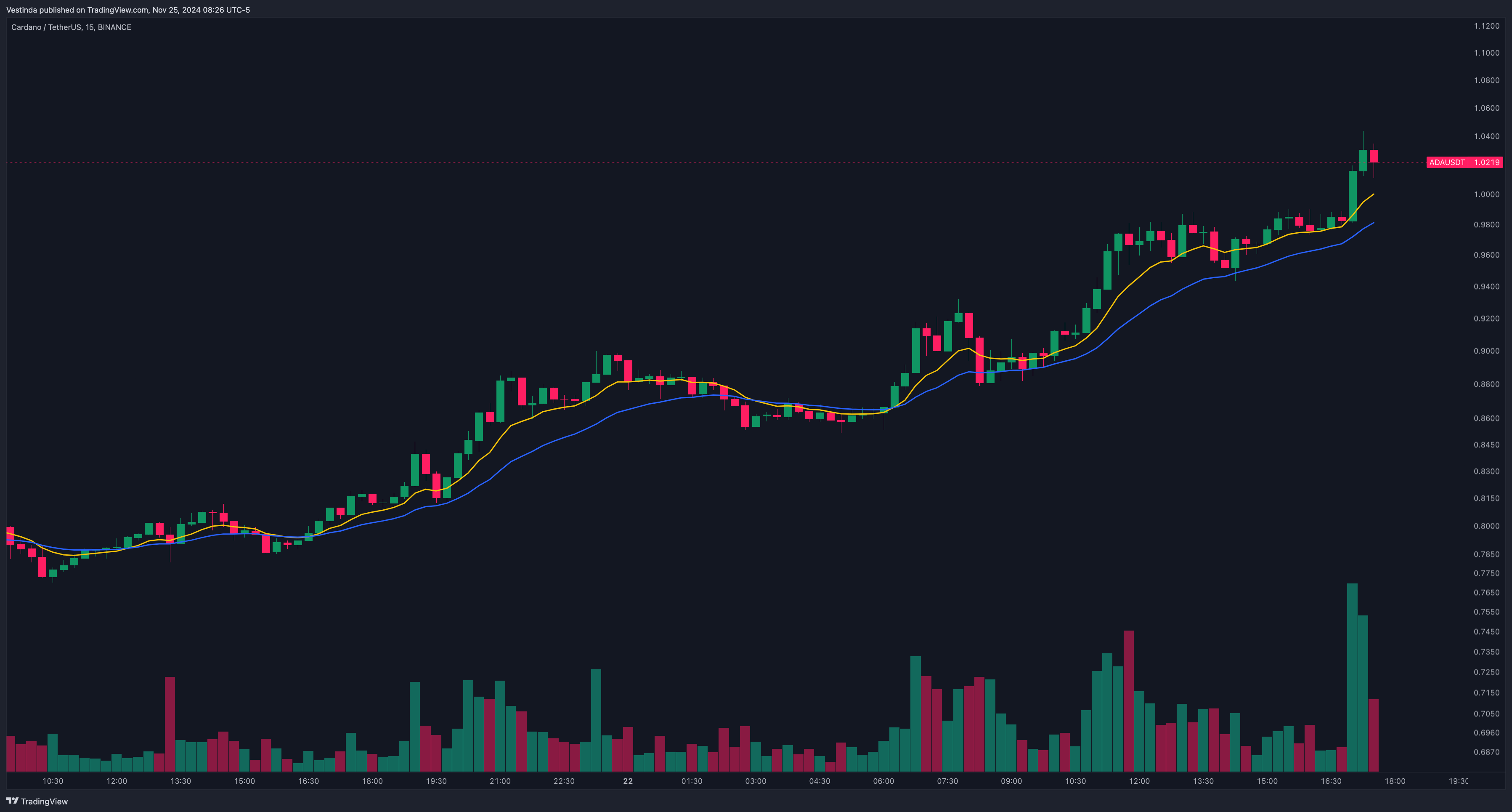
Why It Works: Moving averages provide clear entry and exit signals by smoothing out price fluctuations.
How to Implement:
- Indicator Setup: Apply a 9-period EMA (short-term) and a 21-period EMA (medium-term) on a 15-minute chart.
- Entry and Exit: Enter long when the 9 EMA crosses above the 21 EMA and exit or short when it crosses below.
- Optimization Tip: Test different EMA periods to align with ADA’s intraday volatility.
2. Scalping with Bollinger Bands
Concept: Execute multiple quick trades based on price interaction with Bollinger Bands.
Why It Works: Bollinger Bands highlight overbought and oversold conditions, helping traders capture rapid price reversals.
How to Implement:
- Indicator Setup: Use Bollinger Bands with a 20-period SMA and two standard deviations.
- Entry and Exit: Buy when ADA touches the lower band and shows reversal signs; sell when it reaches the middle or upper band.
- Optimization Tip: Combine Bollinger Bands with candlestick patterns for better precision.
3. Breakout Strategy Using Support and Resistance
Concept: Trade ADA breakouts from key support or resistance levels, capturing strong price moves.
Why It Works: Breakouts often signify the start of new trends, offering high-reward opportunities.
How to Implement:
- Indicator Setup: Identify horizontal support and resistance levels using recent price highs and lows.
- Entry and Exit: Enter long on a breakout above resistance with high volume; short on a breakdown below support.
- Optimization Tip: Use stop-loss orders just outside the breakout levels to manage risk.
Combining Indicators for Enhanced Day Trading
1. MACD + RSI for Momentum Confirmation
How It Works: Use MACD to detect momentum shifts and RSI to confirm overbought or oversold conditions.
Example: Enter long when MACD shows a bullish crossover and RSI is below 30 (oversold); short on bearish setups.
Optimization Tip: Adjust MACD and RSI settings for faster signals on shorter timeframes.
2. Supertrend + Volume Analysis
How It Works: Use Supertrend to identify the prevailing trend and volume spikes to confirm trade entries.

Example: Enter long when Supertrend signals a bullish trend and volume increases significantly; short on bearish signals with similar volume confirmation.
Optimization Tip: Test different Supertrend sensitivity settings for greater responsiveness to ADA’s price action.
Risk Management for ADA Day Trading
1. Set Daily Loss Limits
Concept: Protect your account by capping daily losses to a fixed percentage of your total capital (e.g., 2%).
How to Implement: Stop trading for the day if losses reach your predetermined limit.
2. Tight Stop-Loss Orders
Concept: Use stop-losses to minimize losses on individual trades.
How to Implement: Place stop-loss orders just below recent lows (for longs) or above recent highs (for shorts).
Optimization Tip: Adjust stop-loss levels based on ADA’s intraday volatility.
3. Risk/Reward Ratios
Concept: Aim for a risk/reward ratio of at least 1:2 to ensure profitability over time.
How to Implement: Set take-profit levels at twice the distance of your stop-loss from the entry point.
Backtesting and Live Analysis
1. Backtest Strategies on Historical Data
Purpose: Evaluate the effectiveness of your strategies on ADA’s past price movements.
How to Implement: Focus on win rate, drawdown, and average trade return to refine strategy parameters.
2. Monitor Live Market Conditions
Purpose: Adapt your strategy to real-time price action and market trends.
How to Implement: Use tools like TradingView or other charting platforms to track ADA’s intraday movements.
Conclusion
Day trading Cardano (ADA) offers exciting opportunities to profit from its short-term price movements. By employing strategies like momentum trading, scalping, and breakouts, and combining them with robust risk management, traders can achieve consistent results. Regular backtesting and live monitoring ensure strategies remain effective in ADA’s dynamic market.
Maximizing Day Trading Profits in Cardano (ADA)
- Start by thoroughly researching and understanding the fundamentals of ADA and Cardano.
- Get familiar with different technical analysis indicators and strategies used in day trading.
- Open a trading account with a reputable exchange and ensure you have sufficient capital.
- Develop a well-defined trading plan, including entry and exit points, risk management, and profit targets.
- Utilize stop-loss orders to protect yourself from significant losses and set realistic profit targets.
- Practice disciplined trading, sticking to your strategy and avoiding impulsive decisions.
- Continuously monitor the ADA market, keeping an eye on news and market trends that can impact prices.
- Regularly review your trades, analyzing both successful and unsuccessful trades for improvement.
ADA Day Trading: Essential Toolset Explained
Day trading tools are essential for traders looking to capitalize on short-term market fluctuations. These tools provide real-time data and analysis, helping traders make informed decisions and execute trades effectively.
ADA, or Cardano, has several tools that can assist day traders in their strategies. These include advanced charting platforms, market scanners, and news aggregators. With these tools, traders can identify trends, find profitable opportunities, and stay updated with market news that may impact their trades.
Additionally, ADA offers technical analysis indicators, which help traders analyze price patterns, identify support and resistance levels, and generate trading signals. Alongside these tools, ADA also provides risk management features, such as stop-loss orders and take-profit levels, allowing traders to control their potential losses and lock in profits.
Overall, day trading tools, including those offered by ADA, play a crucial role in enhancing trading efficiency, increasing profitability, and minimizing risks.
Dangers in ADA Day Trading
Day trading, especially in cryptocurrencies like ADA, comes with numerous risks. The volatility of the market can lead to significant financial loss. The fast pace and constant monitoring required can also cause mental and emotional stress. Additionally, day trading requires a high level of knowledge and expertise to make successful trades. Without proper understanding of market trends and analysis, traders may make poor decisions. Furthermore, day trading often involves high transaction fees and commissions, which can eat into potential profits. It is crucial for traders to carefully consider these risks and be prepared for potential losses before engaging in day trading activities.
Understanding Day Trading (ADA)
Day trading refers to the buying and selling of financial instruments within a single trading day. It is a short-term trading strategy that aims to profit from small price fluctuations. Traders typically use technical analysis and chart patterns to make quick trading decisions. Day traders often engage in high-volume trades to take advantage of small price changes. This strategy requires constant monitoring of the market and quick decision-making. Day trading can be done in various markets, including stocks, options, futures, and cryptocurrencies like ADA. However, it is important to note that day trading involves significant risks, including the potential for substantial financial losses. Traders should have sufficient knowledge, skills, and discipline to be successful in this fast-paced trading approach.
-
Track your
Crypto Portfolio -
Copy Crypto trading
strategies -
Build trading strategies
with no code
-
Backtest trading strategies
on Crypto, Forex, Stocks, etc. -
Demo Trading
Risk-free Paper Trading -
Automate trading strategies
with Live Trading
Frequently Asked Questions
Day trading can be a high-risk activity that requires extensive knowledge, experience, and careful decision-making. It involves buying and selling financial instruments within a single trading day, aiming to profit from short-term price fluctuations. While potential gains might seem attractive, the reality is that most day traders fail to consistently make profits and often incur significant losses. It requires constant monitoring of markets, sharp analytical skills, and effective risk management strategies. For the majority of retail investors, day trading is not recommended as a long-term investment strategy. Rather, focusing on long-term investments with a diversified portfolio tends to provide more sustainable and reliable returns.
Yes, it is possible to make money through day trading. Day trading involves buying and selling financial instruments within the same day to profit from short-term price fluctuations. Successful day trading requires knowledge, skill, discipline, and careful risk management. Some traders have achieved significant profits through day trading, while others have experienced losses. It is important to note that day trading can be highly volatile and risky, and individuals should thoroughly research and understand the market and its associated risks before engaging in day trading.
Day trading can be both appealing and risky. While it offers potential for significant profits, it requires substantial knowledge, skills, and constant monitoring. Many day traders experience losses due to volatile markets, high competition, and emotional trading. It demands significant time commitment and may cause stress and burnout. Novice traders often fall victim to scams and misleading promises. However, with proper education, discipline, and risk management, some individuals have found success in day trading. Ultimately, its suitability depends on an individual's experience, personality traits, and financial goals. It is advisable to carefully evaluate the risks and potential rewards before engaging in day trading.
Some problems with day trading include the high level of risk involved, as it requires making rapid decisions based on short-term market fluctuations. The potential for significant financial losses is a major concern, especially for inexperienced traders. Day trading also demands constant monitoring of the market, which can be mentally and emotionally exhausting. Furthermore, transaction costs, such as commissions and fees, can significantly eat into profits. Lastly, successfully day trading requires extensive knowledge, skill, and discipline, which may take considerable time and effort to develop. Consequently, many individuals fail to achieve sustainable profits and may end up losing substantial amounts of money.
The 3 trading rule refers to a risk management strategy in which traders limit their exposure by adhering to three key principles. First, they ensure that no more than 3% of their total trading capital is used on any single trade. Secondly, they set a stop-loss order on each trade to limit potential losses. Lastly, they maintain a maximum of 3 open positions at any given time to diversify their portfolio and minimize risk. This rule helps traders maintain discipline, manage their risk effectively, and increase their chances of long-term success in the financial markets.
Conclusion
In conclusion, ADA day trading is an enticing opportunity for beginners looking to enter the world of day trading. By learning about ADA day trading strategies and signals, utilizing day trading software and tools, and understanding the psychology of trading, beginners can navigate the volatility of ADA and crypto markets. Day trading tools offered by ADA, such as advanced charting platforms and market scanners, are essential for making informed decisions and maximizing profits. However, it is important to be aware of the risks involved in day trading, including potential financial losses and the need for constant monitoring and decision-making. With proper knowledge and discipline, ADA day trading can be a rewarding venture.

Successful traders rely on backtesting to be profitable.
Be like them with our
Free Backtesting Guide