
-
100,000 available assets New
-
years of historical data
-
practice without risking money

Quantitative Strategies & Backtesting results for SOL
Here are some SOL trading strategies along with their past performance. You can validate these strategies (and many more) for free on Vestinda across thousands of assets and many years of historical data.
Quantitative Trading Strategy: Follow the trend on SOL
Based on the backtesting results statistics for the trading strategy from November 18, 2020, to December 8, 2023, several noteworthy findings emerge. The strategy exhibits a profit factor of 2.04, indicating that the total profit outweighs the total loss by this factor. The annualized return on investment (ROI) stands at an impressive 949.03%, suggesting significant profitability over the observed period. On average, trades are held for approximately one week, and the strategy generates an average of 0.37 trades per week. Out of a total of 60 closed trades, around 31.67% were profitable. Overall, the return on investment reached an impressive 2875.84%. These backtesting results indicate the potential effectiveness and profitability of the trading strategy during the specified period.

 SOLUSDT

Choose another period and try again.
Quantitative Trading Strategy: Lock and keep profits on SOL
Based on the backtesting results statistics for the trading strategy from February 26, 2021, to December 17, 2023, the profit factor achieved was 1.9, indicating a favorable outcome. The annualized return on investment stood impressively at 272.43%, showcasing the strategy's profitability over the defined period. The average holding time for trades was approximately 6 weeks and 5 days, reflecting the strategy's medium-term approach. With an average of 0.05 trades per week, the strategy demonstrated a patient and selective investment approach. The total number of closed trades was 8, demonstrating a restrained trading frequency. Moreover, the strategy managed to generate a robust return on investment of 756.75%, surpassing the market's buy and hold strategy by 59.47%, manifesting its superior performance.
SOLUSDT
Choose another period and try again.
SOL (Solana) Algorithmic Trading: Strategies and Tips
Introduction
Algorithmic trading has emerged as a vital tool for traders seeking efficiency and consistency in their strategies. For Solana (SOL), a cryptocurrency known for its speed and scalability, algorithmic trading can unlock substantial opportunities. This guide dives into practical strategies and tips tailored to SOL, helping traders craft automated approaches that optimize profitability and minimize risks.
Why Algorithmic Trading for SOL?
- Dynamic Price Action: Solana’s frequent price movements provide ample opportunities for automated strategies.
- Consistent Execution: Algorithms remove emotional biases and execute trades precisely based on predefined rules.
- 24/7 Market: SOL’s always-active trading environment ensures round-the-clock opportunities.
Core Algorithmic Trading Strategies for SOL
1. Trend-Following Strategy with Moving Averages
Concept: Capture long-term trends by using moving average crossovers.
Setup: Apply a 20-period EMA (short-term) and a 100-period EMA (long-term).

Execution Rules:
- Buy Signal: When the 20 EMA crosses above the 100 EMA.
- Sell Signal: When the 20 EMA crosses below the 100 EMA.
Optimization Tip: Adjust EMA periods based on your preferred timeframe (e.g., shorter for intraday, longer for swing trades).
2. Breakout Strategy for Key Levels
Concept: Take advantage of price breaking through significant support or resistance levels.
Setup: Identify recent highs and lows over a 20-period range.
Execution Rules:
- Buy Signal: Enter long when SOL breaks above resistance with increased momentum.
- Sell Signal: Enter short when SOL breaks below support with confirming volume.
Optimization Tip: Use trailing stops to secure profits during volatile breakouts.
3. Mean Reversion Strategy with RSI
Concept: Trade price reversals from overbought or oversold levels.
Setup: Apply a 14-period RSI to measure price momentum.
Execution Rules:
- Buy Signal: When RSI drops below 30 and starts rising.
- Sell Signal: When RSI exceeds 70 and begins to decline.
Optimization Tip: Combine RSI signals with key support and resistance levels for higher accuracy.
4. Momentum Strategy with MACD
Concept: Use the MACD to detect shifts in bullish or bearish momentum.
Setup: Apply MACD (12, 26, 9) and monitor for signal line crossovers.
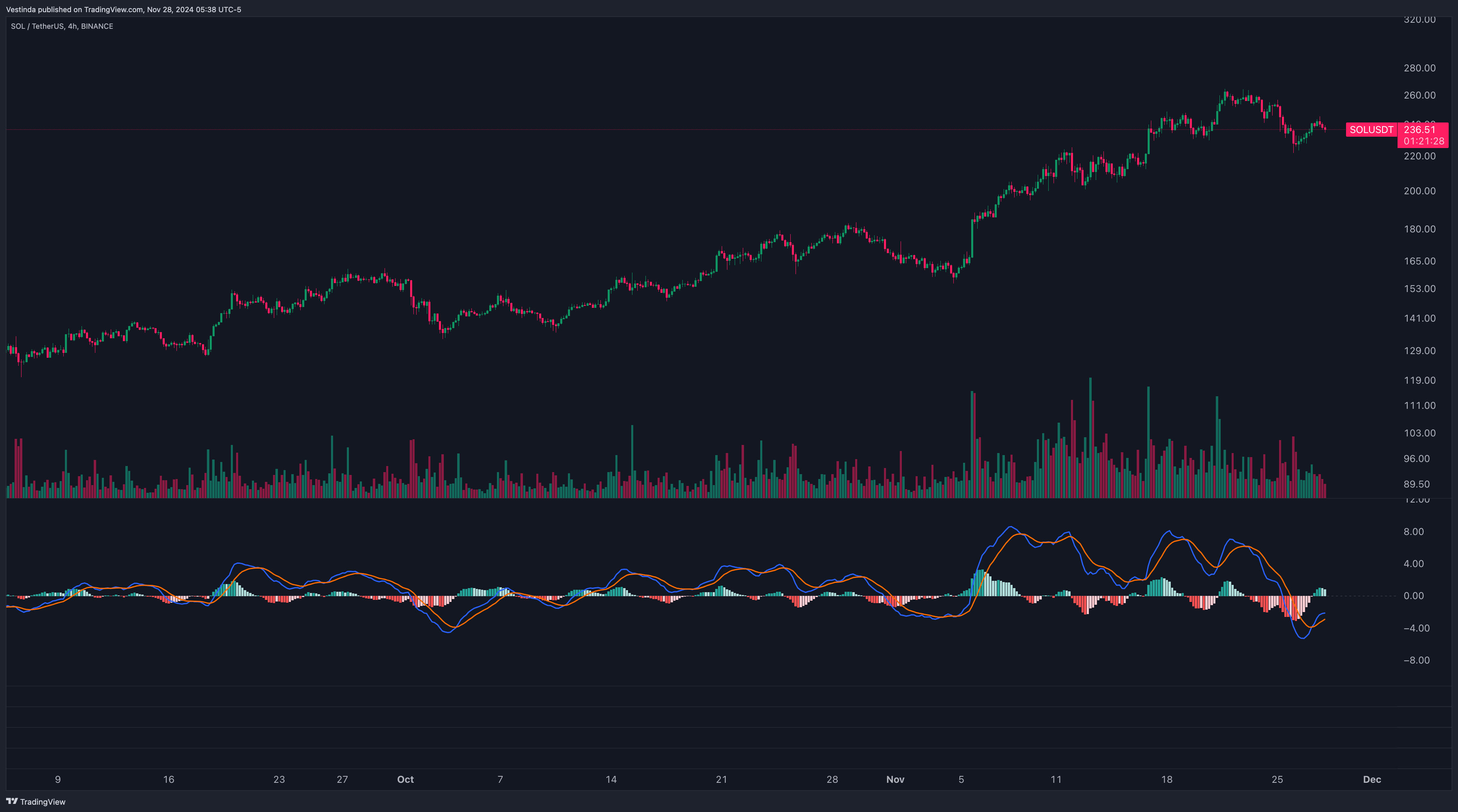
Execution Rules:
- Buy Signal: When MACD line crosses above the signal line and histogram turns positive.
- Sell Signal: When MACD line crosses below the signal line and histogram turns negative.
Optimization Tip: Adjust MACD settings for quicker signals in shorter timeframes.
How to Create an Algorithmic Trading Strategy for SOL
1. Define Clear Entry and Exit Rules
Example Rules:
- Entry Rule: Enter long when RSI is below 30 and MACD shows a bullish crossover.
- Exit Rule: Exit when RSI exceeds 70 or MACD shows a bearish crossover.
2. Optimize Parameters
Test different indicator periods and settings to find the best fit for Solana’s volatility and timeframe.
3. Backtest Your Strategy
Use historical SOL data to evaluate performance and refine the rules.
Focus on metrics such as: win rate, average trade profit, and maximum drawdown.
4. Implement Risk Management
Limit position sizes to a fixed percentage of your portfolio (e.g., 1-2%). Set stop-loss and take-profit levels for each trade to protect capital and lock in gains.
Risk Management Tips for Algorithmic Trading
1. Position Sizing
Adjust trade sizes based on market conditions and strategy performance. Start small when testing new strategies.
2. Stop-Loss Placement
Place stop-loss orders at recent swing highs or lows to minimize potential losses.
3. Diversification
Use multiple strategies across different timeframes to hedge against market risks.
4. Regular Performance Review
Continuously monitor and adjust your strategies based on live market performance.
Examples of Algorithmic Trading in Action
Example 1: Trend-Following Setup
Scenario: SOL is trading at $20, and the 20 EMA crosses above the 100 EMA.
Action: Enter long with a target at $25 and a stop-loss at $18.
Example 2: Breakout Strategy
Scenario: SOL breaks above a resistance level at $22 with a surge in volume.
Action: Enter long with a trailing stop to capture extended gains.
Conclusion
Algorithmic trading for Solana offers traders a structured approach to navigating its dynamic market. By implementing strategies such as trend-following, breakout trading, mean reversion, and momentum analysis, traders can create systems that capitalize on SOL’s price movements. Backtesting, risk management, and regular optimization ensure consistent performance and long-term success in Solana’s vibrant ecosystem.
Algorithmic Trading with SOL: Step-by-Step Manual
- Create an account on a cryptocurrency exchange platform that supports SOL.
- Research and analyze different algorithmic trading strategies to determine the most suitable one.
- Select a reliable algorithmic trading software or platform that supports SOL trading.
SOL-based Trading and DeFi: Advancing Algorithmic Solutions
Algorithmic trading is a strategy that uses predefined rules to execute trades automatically. With DeFi, this strategy is integrated into blockchain networks like SOL. SOL is a high-performance blockchain platform that enables fast and low-cost transactions. By combining algorithmic trading with SOL, users can leverage the platform's scalability and speed to execute trades more efficiently. This integration allows for the development of decentralized trading applications that can autonomously execute trades without the need for intermediaries. As a result, users can enjoy increased transparency, reduced costs, and improved trading efficiency. SOL's integration with algorithmic trading in DeFi opens up new possibilities for traders and developers, paving the way for a more innovative and decentralized financial system.
SOL-Algo: Tailoring ML Tactics for Solana Trading
Machine learning strategies can be effectively adapted for SOL algorithmic trading on the Solana blockchain platform. By leveraging the power of machine learning, traders can make data-driven decisions in real-time, improving their trading outcomes. Machine learning algorithms can analyze large volumes of historical data to identify patterns and trends, helping traders predict future market movements. These algorithms can also continuously learn and evolve, adapting to changing market conditions. Machine learning strategies enable traders to automate their trading processes, reducing the need for manual intervention. This not only saves time but also eliminates emotional biases that can often hinder trading performance. SOL algorithmic trading powered by machine learning has the potential to enhance trading efficiency, increase profitability, and minimize risks.
SOL Strategy Performance Evaluation
Evaluating the performance of SOL algorithmic trading strategies is crucial for maximizing profits. The first step is analyzing historical data to identify trends and patterns. Then, backtesting the strategies using this data helps determine their effectiveness. Monitoring real-time performance and making necessary adjustments is essential. Evaluating risk management strategies is equally important to ensure the strategies are stable over time. Additionally, tracking key performance indicators such as Average Annual Return (AAR) and Maximum Drawdown (MDD) provides valuable insights. Comparing the performance of different strategies and benchmarking them against industry standards helps assess their competitiveness. Finally, regularly reviewing and updating the strategies based on market conditions ensures their continued success. Overall, evaluating SOL algorithmic trading strategies enables informed decision-making for investors.
SOL Data: Feeds and Sources for Algorithmic Trading
Data Feeds and Sources for SOL Algorithmic Trading
To enable efficient and profitable algorithmic trading on the Solana network, access to accurate and reliable data feeds is crucial. Traders rely on real-time, high-quality data to execute trades swiftly and make informed decisions. These data feeds provide information on trading pairs, order books, trade histories, and market depth, among other critical metrics. Several platforms and APIs offer data feeds and sources for SOL algorithmic trading. These include decentralized exchanges (DEXs) like Serum, centralized exchanges (CEXs) such as Binance and FTX, and blockchain analytics platforms like Pyth Network. Additionally, there are informational websites, social media channels, and data providers that offer valuable insights into the Solana ecosystem. By leveraging these diverse data sources and feeds, algorithmic traders can optimize their strategies and gain a competitive edge in the SOL trading landscape.
-
 Create
account -
 Build trading strategies
with no code -
 Validate
& Backtest -
 Connect exchange
& start earning
Frequently Asked Questions
Algorithmic trading refers to the use of computer programs and mathematical models to execute trading decisions. In the context of alternative data, algorithmic trading combines the analysis of non-traditional data sources, such as social media, satellite imagery, or weather patterns, with automated trading strategies. These strategies use the insights obtained from alternative data to identify market opportunities and execute trades at high speed and efficiency. By incorporating alternative data, algorithmic trading aims to gain a competitive edge by uncovering unique insights and making informed trading decisions based on these unconventional sources of information.
Yes, artificial intelligence (AI) can be used for algorithmic trading. AI techniques such as machine learning and deep learning can analyze vast amounts of financial data, identify patterns, and make predictions about future market movements. These AI models can be integrated into algorithmic trading systems to automate trading decisions, improve accuracy, and adapt to changing market conditions. By leveraging AI, traders can gain a competitive edge by quickly processing and responding to market information, potentially leading to better trading outcomes.
When choosing a data source for algorithmic trading, it is crucial to consider several factors. Firstly, ensure the data is reliable and accurate, as any inconsistencies can adversely affect trading decisions. Consider the frequency and timeliness of the data, as real-time data is often preferred. Additionally, the breadth of data is important to cover various markets and instruments. Evaluate the cost of the data source, as the expenses should be justifiable based on the potential trading profits. Lastly, consider the compatibility and ease of integration with your trading platform. By carefully assessing these factors, you can select a suitable data source for effective algorithmic trading.
Algorithmic traders handle black swan events by incorporating risk management mechanisms into their strategies. They might use stop-loss orders, volatility filters, or position-sizing rules to limit exposure during extreme market conditions. These traders also continuously monitor news feeds and economic indicators to detect signs of potential black swan events. Additionally, they may use machine learning algorithms to adapt and adjust their trading models in real-time. While it is not possible to predict black swan events, these strategies help algorithmic traders mitigate risks and minimize potential losses during such unforeseen market disruptions.
Some of the best algorithmic trading platforms for beginners are Quantopian, MetaTrader, and ProRealTime. Quantopian offers a user-friendly interface with extensive educational resources and a community of algorithmic traders to connect with. MetaTrader is a popular platform widely used for algorithmic trading, with a simple interface and a wide range of technical indicators and trading robots available. ProRealTime is another beginner-friendly platform that offers customizable indicators and backtesting features. These platforms provide a good starting point for beginners to learn and experiment with algorithmic trading strategies.
Conclusion
In conclusion, SOL Algorithmic Trading is a powerful method that combines the efficiency and speed of automated trading with the scalability and low-cost transactions of the Solana blockchain network. By utilizing algorithmic trading tools and strategies, traders can optimize their trading performance on SOL and capitalize on profitable opportunities. Additionally, the integration of machine learning can further enhance trading outcomes by making data-driven decisions in real-time. Evaluating the performance of SOL algorithmic trading strategies and accessing reliable data feeds are crucial for maximizing profits. With access to accurate data and the right tools, algorithmic traders can gain a competitive edge in the SOL trading landscape.

Successful traders rely on backtesting to be profitable.
Be like them with our
Free Backtesting Guide