Sophisticated backtesting is not only possession of high-esteemed hedge funds anymore.
Impressive Team and support, Backtesting engine with detailed reports, The Strategy builder.

Great purchase!
I have always manually invested in stocks and cryptocurrencies, but after studying Vestinda, I must say it has enormous potential.

Mature platform for trading
Pro: Easy to use, Nice UX, A lot of customization for strategies, Back testing is an awesome tool, can check any strategy in history.

Algorithmic Strategies & Backtesting results for NVDA
Here are some NVDA trading strategies along with their past performance. You can validate these strategies (and many more) for free on Vestinda across thousands of assets and many years of historical data.
Algorithmic Trading Strategy: Smart Money Concept LuxAlgo - Demand and Supply zones on NVDA
Based on the backtesting results from November 24, 2017, to October 11, 2023, the trading strategy demonstrated a promising profit factor of 1.5. This indicates that for every unit risked, the strategy generated 1.5 units of profit. The annualized ROI of 6.51% showcases a steady growth rate, implying a positive return on investments over time. The average holding time was approximately 10 weeks and 3 days, indicating a longer-term approach. Despite a relatively low average of 0.04 trades per week, the strategy still managed to close 14 trades in total. With a winning trades percentage of 57.14%, the strategy showcased a favorable success rate. Overall, the return on investment for the period amounted to an impressive 38.29%.
 NVDA
NVDA

Choose another period and try again.
Algorithmic Trading Strategy: Template - LONG DEMA and Bollinger Bands on NVDA
Based on the backtesting results from November 20, 2022, to November 20, 2023, the trading strategy exhibited a high profit factor of 13.45. This indicates that for every unit of risk taken, the strategy generated an impressive 13.45 units of profit. The annualized ROI for this period amounted to an outstanding 154.14%, reflecting the strategy's ability to consistently deliver substantial returns on investment. On average, each position was held for approximately 7 weeks and 3 days, suggesting a patient approach to trading. The strategy executed an average of 0.09 trades per week, indicating a selective but effective trading frequency. With a winning trades percentage of 60%, out of a total of 5 closed trades, the strategy demonstrated a promising success rate.
NVDA
Choose another period and try again.
NVDA (Nvidia) Day Trading: Strategies, Tips & Analysis
Introduction
Nvidia (NVDA) is a leading technology company known for its graphics processing units (GPUs) and AI technologies. NVDA is a popular stock for day trading due to its high volatility and liquidity. This guide will cover effective day trading strategies, essential tips, and in-depth analysis to help you trade NVDA successfully.
Why Day Trade NVDA?
- High Volatility: NVDA's price movements provide numerous trading opportunities within a single trading session.
- Liquidity: High trading volume ensures efficient order execution and narrow bid-ask spreads.
- News Sensitivity: NVDA often reacts significantly to news, earnings reports, and industry developments, creating trading opportunities.
Essential Indicators for Day Trading NVDA
Moving Averages (MA)
Simple Moving Average (SMA) and Exponential Moving Average (EMA)
Usage: Identify short-term trends and potential entry/exit points.
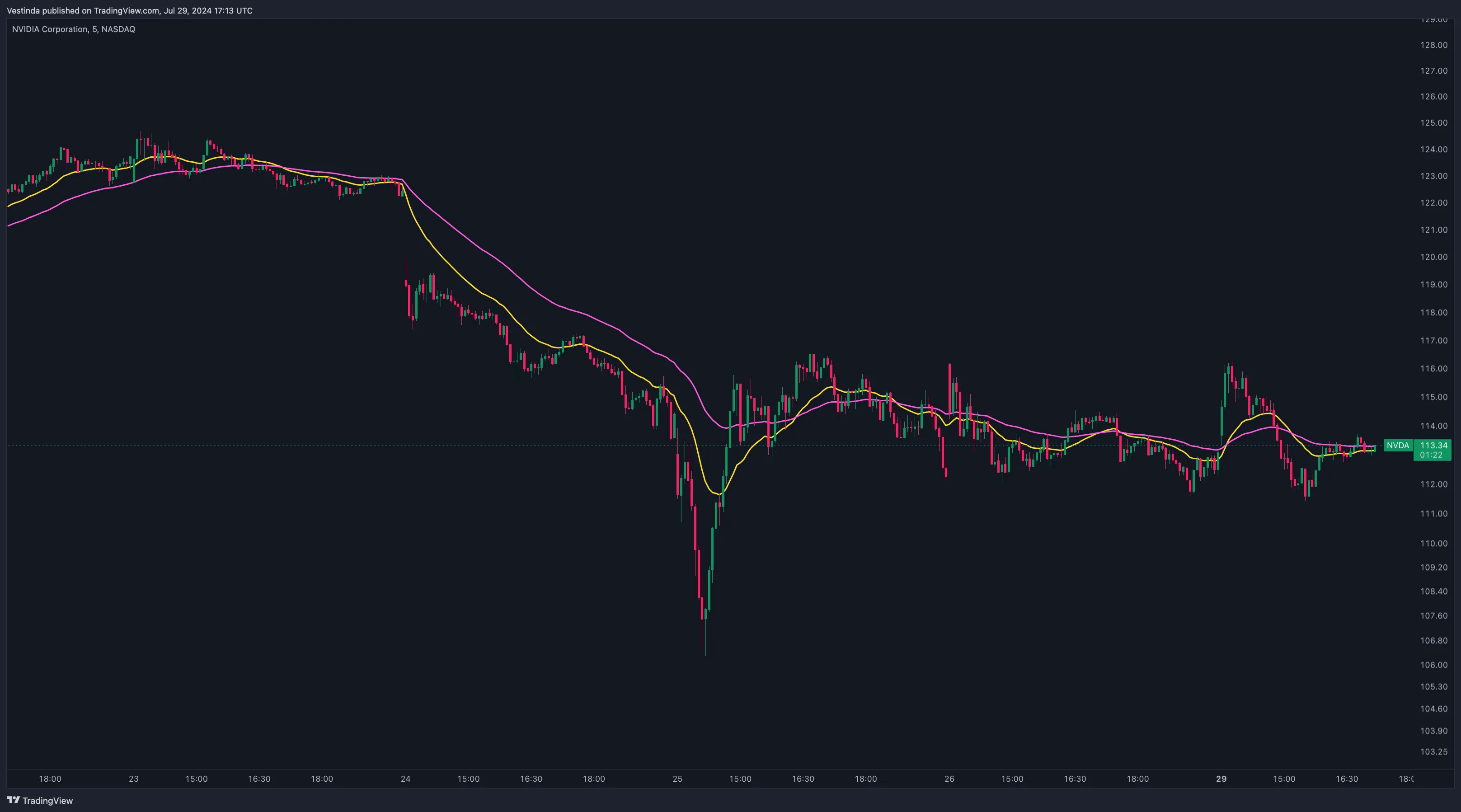
Example Setup: 9-day EMA for short-term trends and 21-day EMA for medium-term trends.
Relative Strength Index (RSI)
Usage: Identify overbought or oversold conditions.
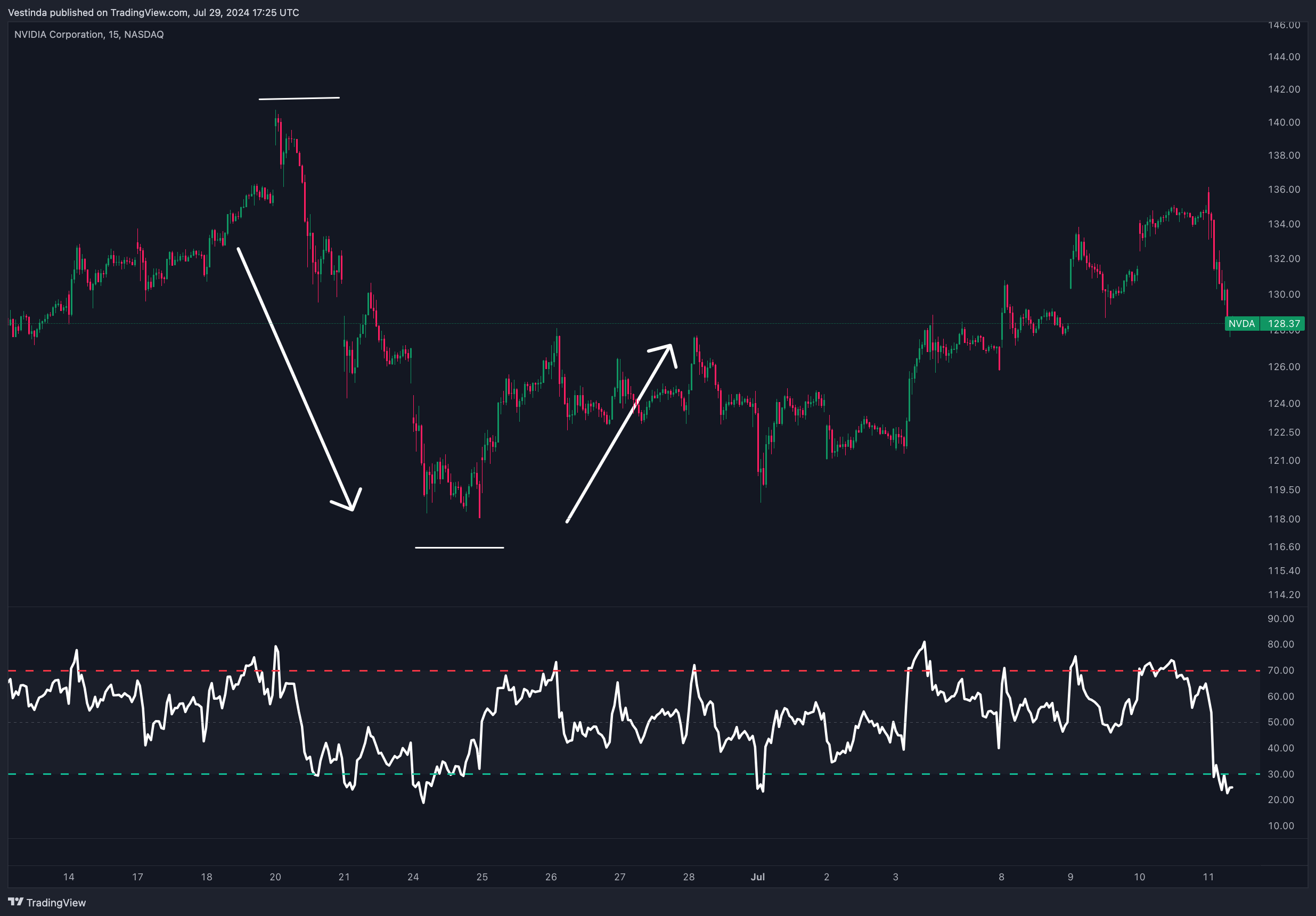
Example Setup: RSI above 70 indicates overbought conditions (sell signal), RSI below 30 indicates oversold conditions (buy signal).
Moving Average Convergence Divergence (MACD)
Usage: Identify momentum and trend changes.

Example Setup: MACD line crossing above the signal line (buy signal), MACD line crossing below the signal line (sell signal).
Bollinger Bands
Usage: Identify volatility and potential breakout points.

Example Setup: Price touching the upper band indicates overbought conditions, price touching the lower band indicates oversold conditions.
Best Timeframes for Day Trading NVDA
1-Minute Chart
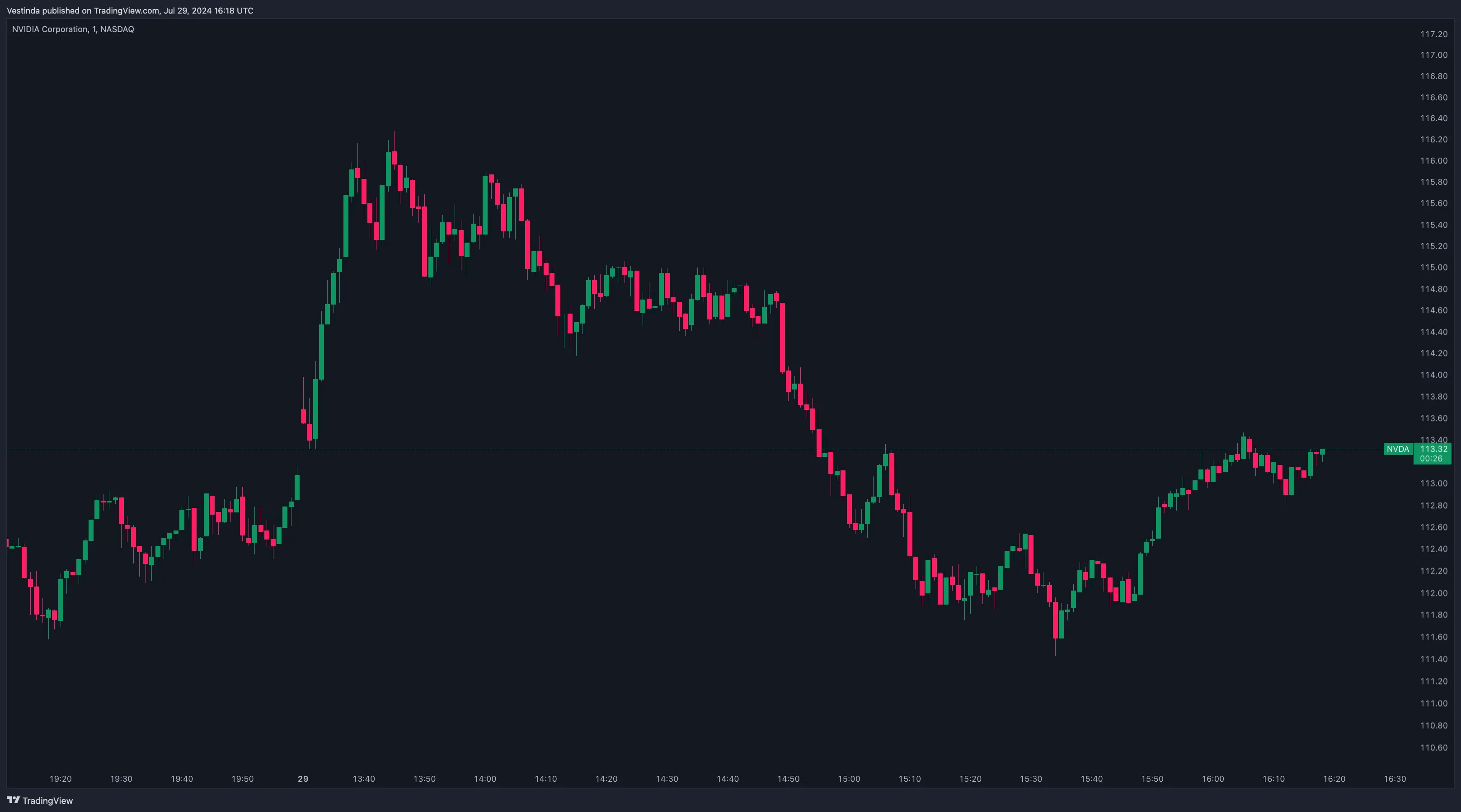
Ideal for high-frequency trading and capturing small price movements. Useful for scalping strategies.
5-Minute Chart
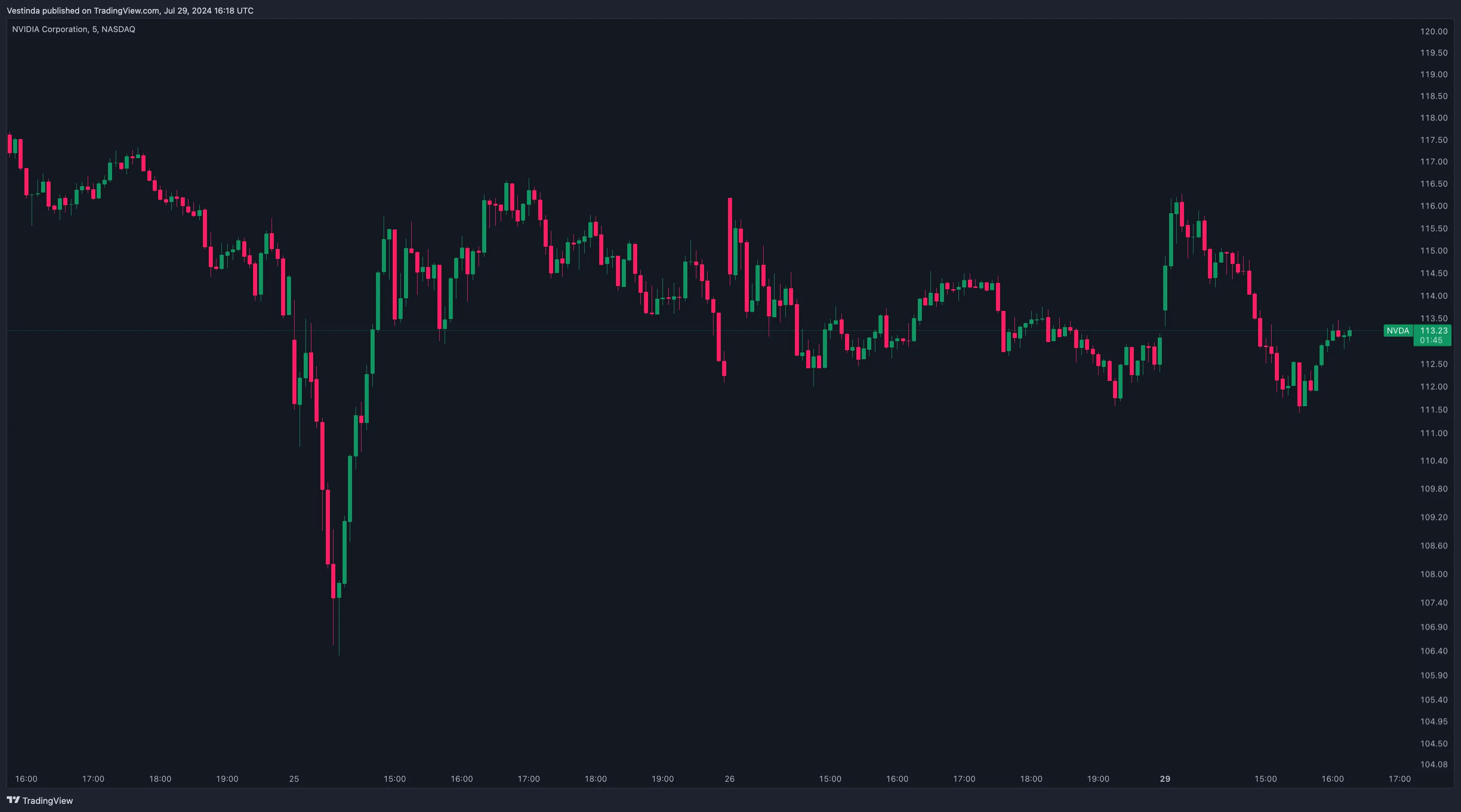
Provides a balance between capturing price movements and managing trade execution. Commonly used by day traders for identifying short-term trends.
15-Minute Chart

Helps in identifying larger price patterns and more significant trends within the trading day. Useful for confirming signals from shorter timeframes.
Day Trading Strategies for NVDA
Scalping
Concept: Make multiple small trades to capture minor price movements.
Setup:
- Use the 1-minute chart to identify short-term trends.
- Enter and exit trades quickly, holding positions for a few seconds to minutes.

Example: Buy when the 9-day EMA crosses above the 21-day EMA on the 1-minute chart, and sell when the opposite occurs.
Momentum Trading
Concept: Trade based on the strength of current price trends.
Setup:
- Use the 5-minute chart to identify strong price movements.
- Look for confirmation from volume spikes and RSI.

Example: Buy when the price breaks above a resistance level with high volume, and RSI is above 50.
Reversal Trading
Concept: Trade potential reversals at key support or resistance levels.
Setup:
- Use the 15-minute chart to identify overbought or oversold conditions using RSI and Bollinger Bands.
- Enter trades when price action confirms a reversal (e.g., bullish/bearish candlestick patterns).
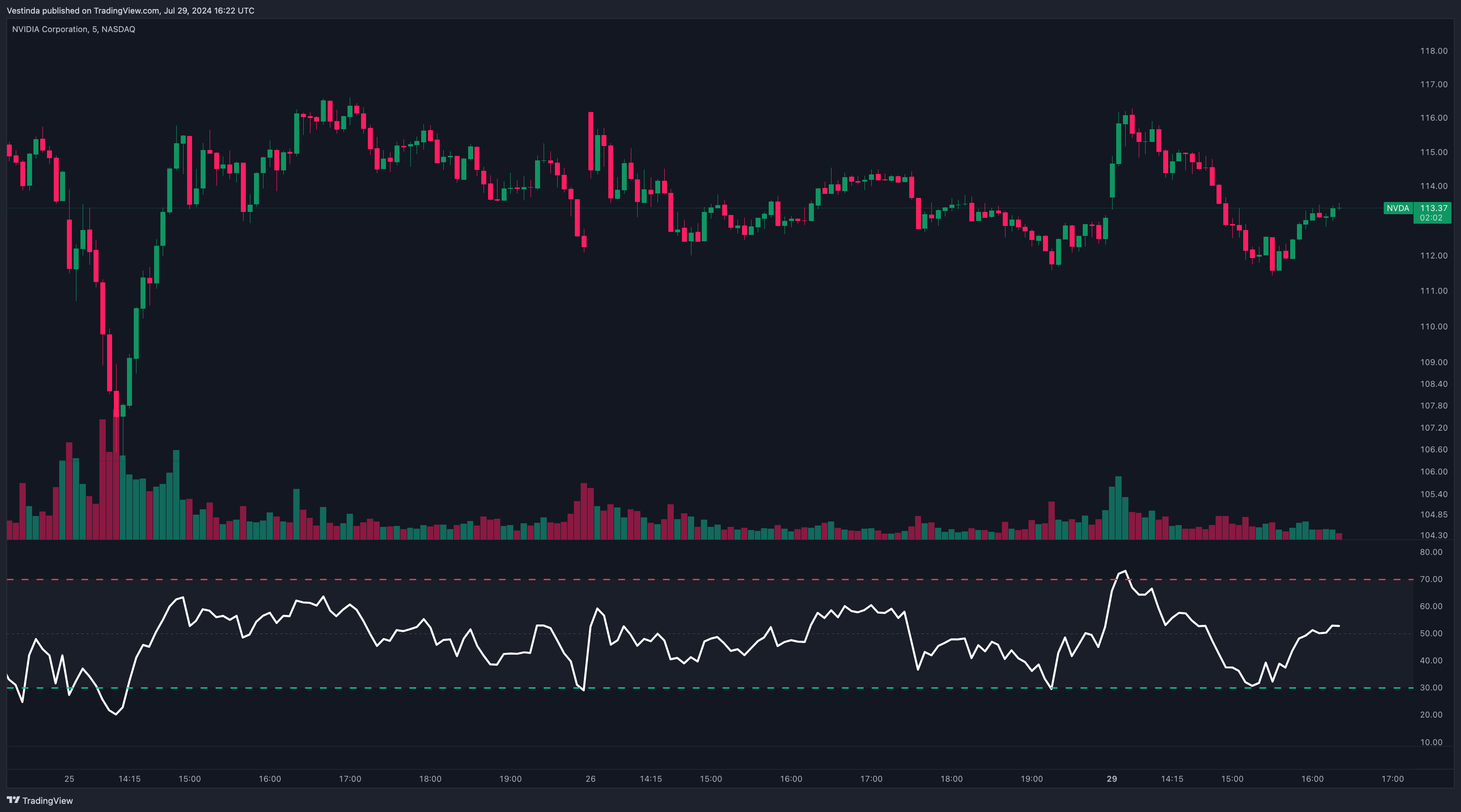
Example: Sell when NVDA reaches a key resistance level and RSI is above 70.
Risk Management
Set Stop-Loss Orders
- Place stop-loss orders to limit potential losses (e.g., 1-2% below entry price).
- Adjust stop-loss levels as the trade moves in your favor.
Set Take-Profit Orders
- Define take-profit levels to secure gains (e.g., 2-3% above entry price).
- Use trailing stop-loss orders to lock in profits as the price moves in your favor.
Limit Position Size
- Avoid risking more than a small percentage of your trading capital on a single trade.
- Diversify trades to spread risk.
Tips for Successful Day Trading of NVDA
Stay Informed
- Keep up with news and developments related to Nvidia and the tech industry.
- Monitor earnings reports, product launches, and industry trends.
Use Pre-Market Analysis
Analyze pre-market trading activity to gauge market sentiment and identify potential trading opportunities.
Keep a Trading Journal
- Document your trades, including entry and exit points, reasons for the trade, and outcomes.
- Review your journal regularly to identify patterns and improve your strategy.
Be Disciplined
- Stick to your trading plan and avoid impulsive decisions.
- Follow your risk management rules strictly.
Tools for Day Trading NVDA
TradingView
Features: Advanced charting tools, numerous indicators, and custom script capabilities.
Usage: Use TradingView for detailed technical analysis and to monitor your day trades.
Vestinda
Features: User-friendly platform for creating, backtesting, and deploying automated trading strategies.
Usage: Use Vestinda to automate your day trading strategies and backtest them with historical data to optimize performance.

Example: Create a strategy that buys NVDA when the 9-day EMA crosses above the 21-day EMA and backtest it over the past month.
Other Platforms
Consider other platforms like Thinkorswim or MetaTrader for additional analysis and trading capabilities.
Conclusion
Day trading NVDA can be highly rewarding due to its volatility and liquidity. By using the right indicators and strategies, you can capitalize on intraday price movements and manage risk effectively. Whether you're scalping, trading momentum, or catching reversals, always ensure you have a solid risk management plan in place.
Additional Resources
- Tools: Platforms like TradingView and Vestinda for advanced charting, automation, and backtesting.
- Further Reading: Books and articles on technical analysis and day trading strategies.
- Video Tutorials: Step-by-step guides on setting up and optimizing trading strategies.
Mastering Day Trading Profits with NVDA
- Start by researching and understanding the basics of stock market trading.
- Study and analyze Nvidia's stock market trends and financial reports.
- Develop a trading strategy and set clear entry and exit points.
- Practice with a demo trading account to gain experience and test your strategy.
- Trade with a small amount of capital to mitigate risk.
- Continuously monitor and evaluate your trades to learn from successes and failures.
- Keep emotions in check and stick to your predetermined strategy.
- Seek guidance and remain adaptable by following market news and expert opinions.
Day Trading Hazards: Potential Pitfalls of NVDA
Day trading can be risky, particularly for inexperienced traders. The fast-paced nature of day trading can lead to impulsive decisions and potential losses.
The volatility of the stock market means that prices can fluctuate rapidly, resulting in significant gains or losses in a short period.
Emotional decision making can cloud judgment and lead to poor trading choices.
Margin trading, where traders borrow money to increase their buying power, can amplify losses if the market goes against them.
While day trading can be profitable, it requires discipline, knowledge, and a thorough understanding of the market.
For example, day traders need to stay updated on news that could impact a stock's performance.
They also need to be aware of regulatory changes that may affect their trading strategies.
Therefore, day traders should carefully consider the risks before diving into this type of trading.
One should remember that there have been cases of significant losses, such as the infamous $4 billion loss by a rogue trader from the French bank Société Générale in 2008, or the $30 million loss suffered by an individual day trader after wrongly betting on the drop of NVDA stock in 2020.
Trading vs. Investing: Strategies for Market Opportunities
Day trading and investing are two distinct strategies for profiting in financial markets.
Day trading involves short-term buying and selling of securities to take advantage of small price fluctuations.
Traders monitor market trends, employ technical analysis, and make quick decisions, aiming for quick profits.
On the other hand, investing focuses on the long-term growth potential of a company or asset.
Investors perform in-depth research, analyze fundamentals, and hold stocks for extended periods.
While day traders seek short-term gains, investors aim for long-term wealth accumulation.
It's worth noting that day trading requires intense focus, discipline, and up-to-date information.
Investing, in contrast, demands patience, a strong understanding of the market, and a long-term mindset.
Whether you choose day trading or investing, do your due diligence and assess your risk tolerance.
Remember that NVDA, short for Nvidia, blew up the market with its excellent long-term growth potential.
Hotspots for Day Traders: Top Trading Markets
Day trading is a highly popular form of trading that involves opening and closing positions within the same day. One of the most popular markets for day trading is the foreign exchange market, also known as forex. The forex market is the largest and most liquid market in the world, offering traders a wide range of currency pairs to trade. Another popular market for day traders is the stock market, particularly the U.S. stock market. Stocks offer traders the opportunity to profit from the fluctuations in the prices of individual companies. In addition, day traders also frequently trade in the futures market, where they can trade contracts for commodities, indices, or even cryptocurrencies like Bitcoin. For those looking for more volatile options, day trading in options or CFDs (contract for difference) is also quite popular.
When it comes to specific stocks, some of the most popular ones among day traders include NVDA (Nvidia). Nvidia is a technology company that specializes in designing graphics processing units (GPUs) and is widely traded due to its reputation and potential for volatility.
The Debate Surrounding Day Trading Practices
Day trading, the practice of buying and selling stocks within a single day, has long been a subject of controversy in the financial world. This trading strategy raises concerns for several reasons. Firstly, critics argue that day trading is akin to gambling, as traders rely on short-term market fluctuations rather than long-term investment strategies. The rapid buy-sell approach is seen by some as unstable and unpredictable. Secondly, day trading requires extensive knowledge and expertise, which may be beyond the reach of inexperienced investors. Success in day trading often depends on sophisticated tools and platforms, making it difficult for beginners to compete. Additionally, the high volatility of short-term trading can result in significant financial losses, putting individuals with little capital at risk. Finally, some experts argue that day trading contributes to market inefficiencies and increased stock market manipulation, which can negatively impact market stability. Overall, the controversy surrounding day trading stems from its potential risks and the perception of it being a speculative and unpredictable endeavor.
-
 Create
account -
 Discover profitable
strategies -
 Connect exchange
& start earning
Frequently Asked Questions
The amount of money day traders make can vary greatly and is dependent on various factors including experience, strategy, market conditions, and risk tolerance. While some day traders may achieve substantial profits, it is crucial to note that a significant number of traders do not make consistent returns and may suffer losses. It is estimated that only a small percentage of day traders consistently earn substantial income. Therefore, predicting an average or specific amount is challenging. Investing time in market research, developing a sound strategy, and practicing risk management can increase the chances of success as a day trader.
The 3 trading rule, also known as the PDT (Pattern Day Trader) rule, is a regulation imposed by the U.S. Securities and Exchange Commission. It states that individuals with less than $25,000 in their brokerage account are limited to making only three day trades within a rolling five-business-day period. Day trades refer to opening and closing positions in the same trading day. If an account exceeds this limit, the trader will be flagged as a pattern day trader, subject to additional restrictions and potential penalties. This rule aims to protect inexperienced traders from excessive risk-taking but can limit the flexibility and opportunities for active trading.
To start day trading, it is essential to educate yourself about the fundamental principles and strategies involved. Begin by researching and understanding the stock market, its terminologies, and different trading methods. Develop a trading plan that includes setting goals, defining risk tolerance, and establishing a budget. Utilize demo accounts or paper trading to practice strategies without real money. Once you feel confident, select a reliable online brokerage platform and open a trading account. Start with small investments and gradually increase as you gain experience. Continually learn from mistakes, analyze market data, and adapt your strategies to become a successful day trader.
Day trading NVDA can be a potentially profitable venture due to the stock's volatility and liquidity. However, it is important to note that day trading is a high-risk strategy that requires advanced knowledge, experience, and constant monitoring of the market. NVDA's strong fundamentals and growth potential make it an attractive option for traders. Nevertheless, day trading is not suitable for everyone, as it involves significant risks and can result in substantial losses. It is crucial to carefully assess your risk tolerance, financial goals, and develop a well-researched trading plan before engaging in day trading NVDA or any other stock.
The average earnings of day traders can vary significantly depending on various factors such as experience, strategy, market conditions, and risk tolerance. While some successful day traders may make substantial profits, it is important to note that the majority struggle to consistently generate profits. According to a study by the Brazilian Securities Commission, around 97% of day traders suffered losses, with their average monthly earnings well below the minimum wage. Therefore, it is crucial for aspiring day traders to understand the risks involved and thoroughly educate themselves before pursuing this profession.
Conclusion
In conclusion, NVDA (Nvidia) day trading is a dynamic and exciting field that offers opportunities for both beginners and experienced day traders. With the right knowledge, strategies, and tools, traders can navigate the intricacies of day trading NVDA (Nvidia) and make informed decisions. However, it's important to remember that day trading can be risky, especially for inexperienced traders. Emotional decision-making, market volatility, and potential losses are all factors to consider. It requires discipline, knowledge, and a thorough understanding of the market. Whether you choose day trading or long-term investing, assess your risk tolerance and make informed decisions based on your financial goals.

Successful traders rely on backtesting to be profitable.
Be like them with our
Free Backtesting Guide