
-
 Create
account -
 Build trading strategies
with no code -
 Validate
& Backtest -
 Connect exchange
& start earning
Algorithmic Strategies & Backtesting results for NSEI
Here are some NSEI trading strategies along with their past performance. You can validate these strategies (and many more) for free on Vestinda across thousands of assets and many years of historical data.
Algorithmic Trading Strategy: Follow the trend on NSEI
Based on the backtesting results statistics from November 2, 2022, to November 2, 2023, the trading strategy exhibited promising outcomes. The strategy boasted a profit factor of 2.49, indicating that for every dollar risked, the strategy generated $2.49 in profit. With an annualized return on investment (ROI) of 6.76%, the strategy proved to be lucrative, surpassing the buy and hold strategy by 1.64%. The average holding time for trades was approximately 6 weeks, implying that the strategy aimed for medium-term positions. Despite a lower number of trades, with only 0.09 trades per week, the strategy managed to close 5 successful trades, constituting a 40% winning trades percentage. Overall, the backtesting results suggest that this trading strategy has the potential to yield consistent profits.
 NSEI
NSEI

Choose another period and try again.
Algorithmic Trading Strategy: Long Term Investment on NSEI
During the period from November 2, 2022 to November 2, 2023, the backtesting results for a trading strategy showcased a profit factor of 0.21, suggesting that for every dollar invested, only $0.21 was earned. The annualized return on investment (ROI) stood at -5.41%, indicating a negative growth rate. On average, positions were held for approximately 8 weeks, indicating a patient trading strategy. With an average of only 0.05 trades per week, the frequency of trading was relatively low. A total of 3 trades were closed during this period. The winning trades percentage reached 33.33%, implying that only a third of the trades were profitable.
NSEI
Choose another period and try again.
Nifty 50 Scalping: A Step-By-Step Tutorial
- Choose a suitable trading platform for scalping NSEI.
- Analyze NSEI's price patterns and identify potential scalpable opportunities.
- Set up your trading charts with suitable timeframes and technical indicators.
- Define your risk management strategy, including stop-loss and take-profit levels.
- Place scalp trades with precise entry and exit points based on your analysis.
- Continuously monitor market conditions and adjust your scalp trades as necessary.
NIFTY 50 Scalping: Fibonacci Retracement Levels
Fibonacci retracement levels are powerful tools for identifying potential support and resistance zones, which can help traders pinpoint precise entry and exit points in their scalping strategy. These levels are derived from the Fibonacci sequence and are typically set at 23.6%, 38.2%, 50%, 61.8%, and 100%.
When applied to a price chart, such as the NIFTY making a price swing down, traders place Fibonacci levels from the high to the low of the swing. The expectation is for the price to retrace upwards, aiming for significant levels like the 50% Fib level.

In this chart, NIFTY makes a downward price swing, and Fibonacci levels are plotted to anticipate the retracement. As the price moves up from the swing low, traders look for it to reach the 50% Fib level.
This level often acts as a strong resistance point where the price may face difficulty moving higher, making it an ideal target for setting take-profit orders. Additionally, traders may place stop-loss orders just below the 50% level to protect against adverse movements.
Practical Application
To utilize Fibonacci retracement levels effectively:
- Identify the Swing: Determine the most recent high and low points on the chart.
- Draw the Retracement Levels: Use a Fibonacci retracement tool to draw levels from the swing high to the swing low.
- Monitor Price Action: Observe how the price interacts with the Fibonacci levels. Look for signs of reversal or continuation at key levels.
- Set Entries and Exits: Place entry orders at or near significant Fibonacci levels and set stop-loss orders slightly beyond these levels to manage risk.
- Use in Conjunction with Other Indicators: Enhance the reliability of Fibonacci retracement by combining it with other technical indicators like moving averages or MACD.
To enhance the reliability of Fibonacci retracement, combine it with other technical indicators like moving averages or the MACD. For example, a bullish divergence on the MACD alongside a Fibonacci retracement to the 50% level can provide a strong signal for potential upward movement.
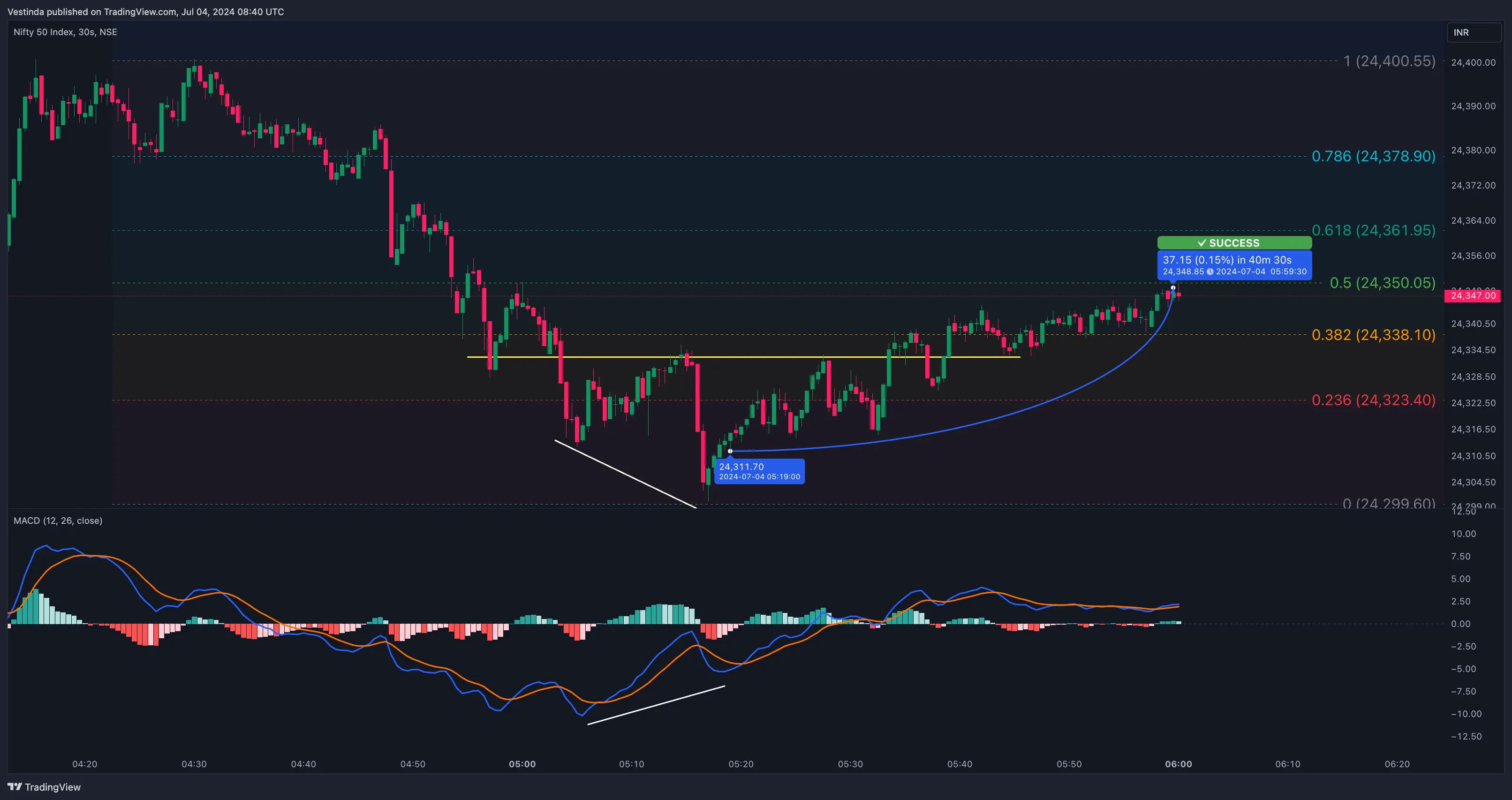
This convergence of signals helps confirm the strength and validity of the retracement level, increasing the likelihood of a successful trade. By using multiple indicators together, traders can make more informed decisions and reduce the risk of false signals.
Optimal Nifty 50 Time Frame for Scalping
When it comes to choosing the right time frame for NSEI scalping, it is important to consider the trading style and goals of the individual. Shorter time frames, such as the 30-second, 1-minute or 5-minute charts, are commonly used for scalping.
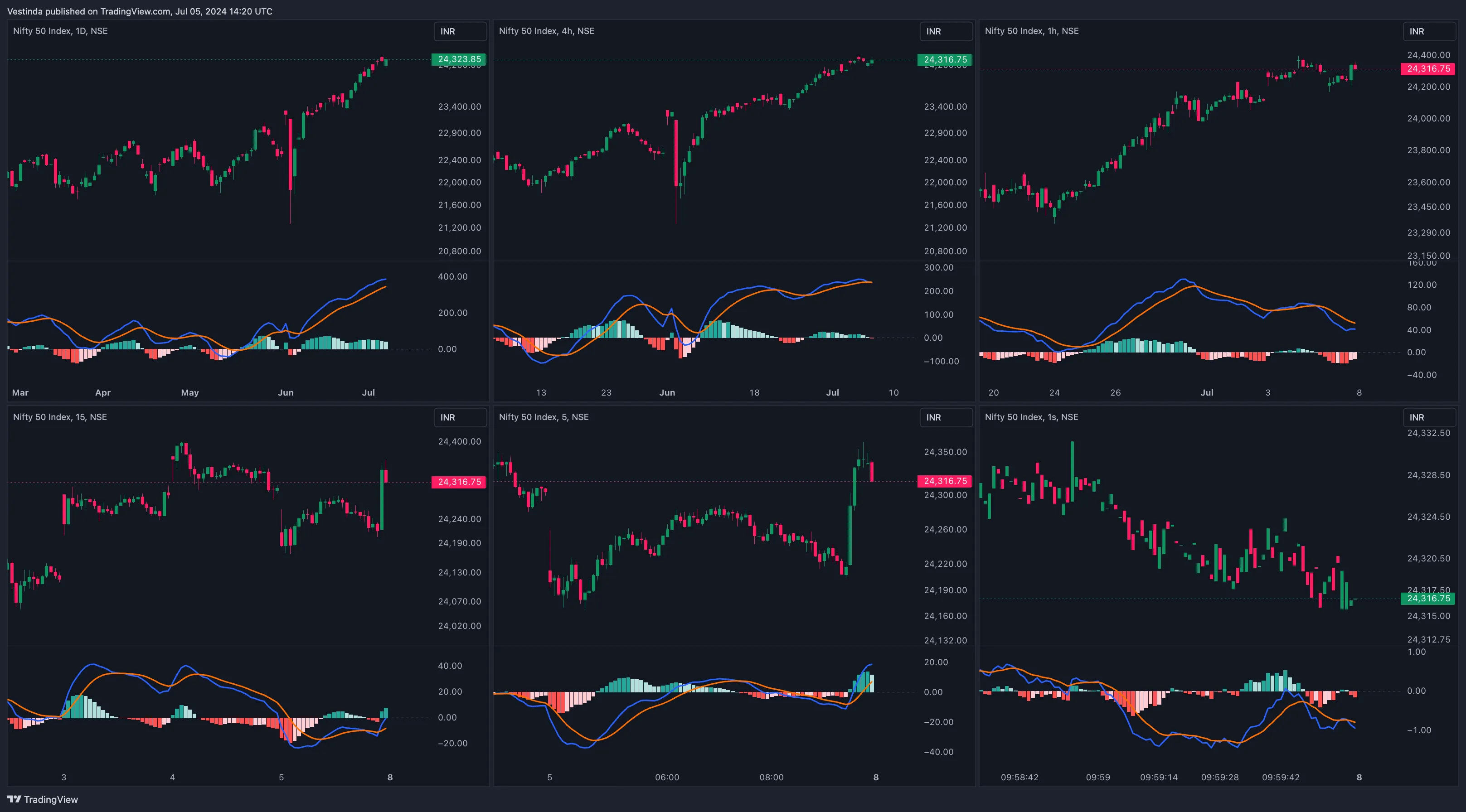
These time frames allow traders to take advantage of quick price movements and make multiple trades throughout the day. On the other hand, longer time frames like the 15-minute or 1-hour charts may be suitable for traders who prefer a more patient approach and are willing to hold positions for a longer period. It is important to note that regardless of the time frame, traders should have a solid understanding of technical analysis and market dynamics to make informed decisions. Ultimately, it is up to the trader to choose the time frame that aligns with their own trading strategy and preferences.
News and Events' Influence on Nifty 50 Scalping
News and events have a significant impact on NSEI scalping, affecting traders' strategies. The release of important economic data can cause volatility in the market, presenting opportunities for scalpers to make quick profits. For example, an unexpected decline in GDP could lead to a sharp drop in stock prices, creating potential gains for scalpers who accurately predict and react to the news. However, it's important to note that news and events can also result in increased uncertainty and risk. For instance, a sudden political announcement or global event can trigger market turmoil, making scalping more challenging as prices fluctuate rapidly. Therefore, scalpers must stay updated and analyze news carefully to identify profitable scalping opportunities while managing the associated risks.
-
Track your
Crypto Portfolio -
Copy Crypto trading
strategies -
Build trading strategies
with no code
-
Backtest trading strategies
on Crypto, Forex, Stocks, etc. -
Demo Trading
Risk-free Paper Trading -
Automate trading strategies
with Live Trading
Frequently Asked Questions
In order to handle slippage in NSEI scalping, one can adopt a few strategies. Firstly, it is important to set realistic expectations and be prepared for potential slippage. Secondly, traders can choose to trade highly liquid stocks to minimize slippage. Additionally, one may utilize limit orders instead of market orders to have more control over the execution price. It's also advisable to closely monitor the market depth and order book to anticipate and respond to any potential slippage. Finally, having a proper risk management plan in place can help mitigate the impact of slippage on overall trading performance.
The best pair for scalping depends on various factors including market conditions, liquidity, and trading strategy. However, major currency pairs like EUR/USD, GBP/USD, and USD/JPY are commonly preferred due to their high liquidity and tight spreads. Traders often choose pairs with low volatility and strong trends as they facilitate quick execution of trades and smaller price movements for profit generation. Additionally, it is essential to consider personal preferences and trading expertise while selecting a pair for scalping, ensuring a comfortable and profitable trading experience.
Scalpers are able to act swiftly due to a combination of factors. Firstly, they utilize specialized software and bots that can quickly search for and purchase tickets or limited products online. These automated tools can simulate human behavior at an extraordinary speed. Additionally, scalpers often have insider information, connections, or access to pre-sales, enabling them to secure tickets before the general public. Moreover, scalpers operate in organized networks, with multiple individuals working in parallel to snatch up tickets as soon as they become available. This coordinated effort allows them to exploit any time advantage they might have, ultimately making them incredibly fast in acquiring sought-after items.
Slippage can have a significant impact on the profitability of scalping strategies on the NSEI. Scalping involves taking advantage of small price movements, and slippage occurs when the actual execution price differs from the expected price. In the case of high slippage, scalpers may end up with smaller profits or even losses due to wider spreads and difficulty in quickly entering and exiting positions. To maintain profitability, scalpers must carefully manage slippage by using efficient execution strategies, monitoring liquidity levels, and minimizing order sizes.
RSI (Relative Strength Index) is a momentum oscillator commonly used in technical analysis. While it can provide valuable insights for scalping strategies, its effectiveness for scalping NSEI (National Stock Exchange of India) depends on various factors. RSI helps identify overbought and oversold conditions, potential trend reversals, and market strength. When combined with other indicators and proper risk management, it can be beneficial for scalpers trading NSEI. However, it is important to consider other factors such as market volatility, liquidity, and the specific trading rules that apply to NSEI. Scalpers should thoroughly assess RSI's performance within their strategy before relying solely on it for trading decisions.
Conclusion
In conclusion, NSEI scalping is a trading strategy that focuses on capitalizing on short-term opportunities in the Indian stock market. Traders can automate the process using techniques such as NSEI automated scalping, algorithmic scalping, or AI scalping bots. Indicators play a crucial role in NSEI scalping, providing valuable insights and helping traders make informed decisions. Choosing the right time frame is important, and traders should consider their trading style and goals. Lastly, news and events can impact NSEI scalping, presenting both opportunities and risks that traders need to carefully analyze and manage. Overall, NSEI scalping requires a combination of technical analysis, market monitoring, and risk management to generate consistent returns.

Successful traders rely on backtesting to be profitable.
Be like them with our
Free Backtesting Guide