-
Track your
Crypto Portfolio -
Copy Crypto trading
strategies -
Build trading strategies
with no code
-
Backtest trading strategies
on Crypto, Forex, Stocks, etc. -
Demo Trading
Risk-free Paper Trading -
Automate trading strategies
with Live Trading
Quant Strategies & Backtesting results for GME
Here are some GME trading strategies along with their past performance. You can validate these strategies (and many more) for free on Vestinda across thousands of assets and many years of historical data.
Quant Trading Strategy: Keltner Breakout Strategy on GME
The backtesting results for the trading strategy conducted between November 6, 2022, and November 6, 2023, indicate a profit factor of 0.69. The annualized ROI stands at -9.46%, suggesting a negative performance over the specified period. On average, trades were held for approximately 3 weeks, with an average of 0.09 trades per week. A total of 5 trades were closed during this period. The return on investment aligns with the annualized ROI, also at -9.46%. The strategy boasted a winning trades percentage of 40%. Notably, when compared to a buy and hold approach, this strategy outperformed, generating excess returns of 66.95%.
 GME
GME

Choose another period and try again.
Quant Trading Strategy: Long term invest on GME
Based on the backtesting results statistics for the trading strategy from November 6, 2016 to November 6, 2023, the profit factor stands at 1.6, indicating a moderately successful strategy. The annualized return on investment (ROI) is an impressive 34.69%. The average holding time for trades is around 7 weeks and 2 days, suggesting a relatively longer-term approach. With an average of 0.05 trades per week, the strategy appears to be less active. The number of closed trades during this period is 19. The ROI for the entire period is a significant 247.77%. However, the winning trades percentage is relatively low at 26.32%, indicating a potentially higher risk factor.
GME
Choose another period and try again.
GME Algorithmic Trading Strategy
Introduction
GameStop (GME) has become one of the most volatile and talked-about stocks in recent years, known for its massive price swings and the retail trading frenzy that surrounded it. For traders looking to capitalize on GME’s volatility without constantly monitoring the market, algorithmic trading offers a powerful solution. This guide will explore how to build an effective algorithmic trading strategy for GME, using a combination of technical indicators and automation to optimize entries and exits.
Why Use Algorithmic Trading for GME?
- Volatility Management: GME’s price can experience rapid changes, making it ideal for algorithmic trading, which can respond instantly to market conditions.
- Emotion-Free Trading: Algorithms eliminate the emotional aspect of trading, allowing you to execute trades based on predefined rules, no matter how volatile the market gets.
- Consistent Strategy Execution: Algorithmic trading ensures that your strategy is implemented consistently, without the risk of missed trades or delayed decisions due to human error.
Key Algorithmic Trading Strategies for GME:
Moving Average Crossover Strategy
Concept: Moving averages help smooth out GME’s volatile price movements and identify long-term trends.
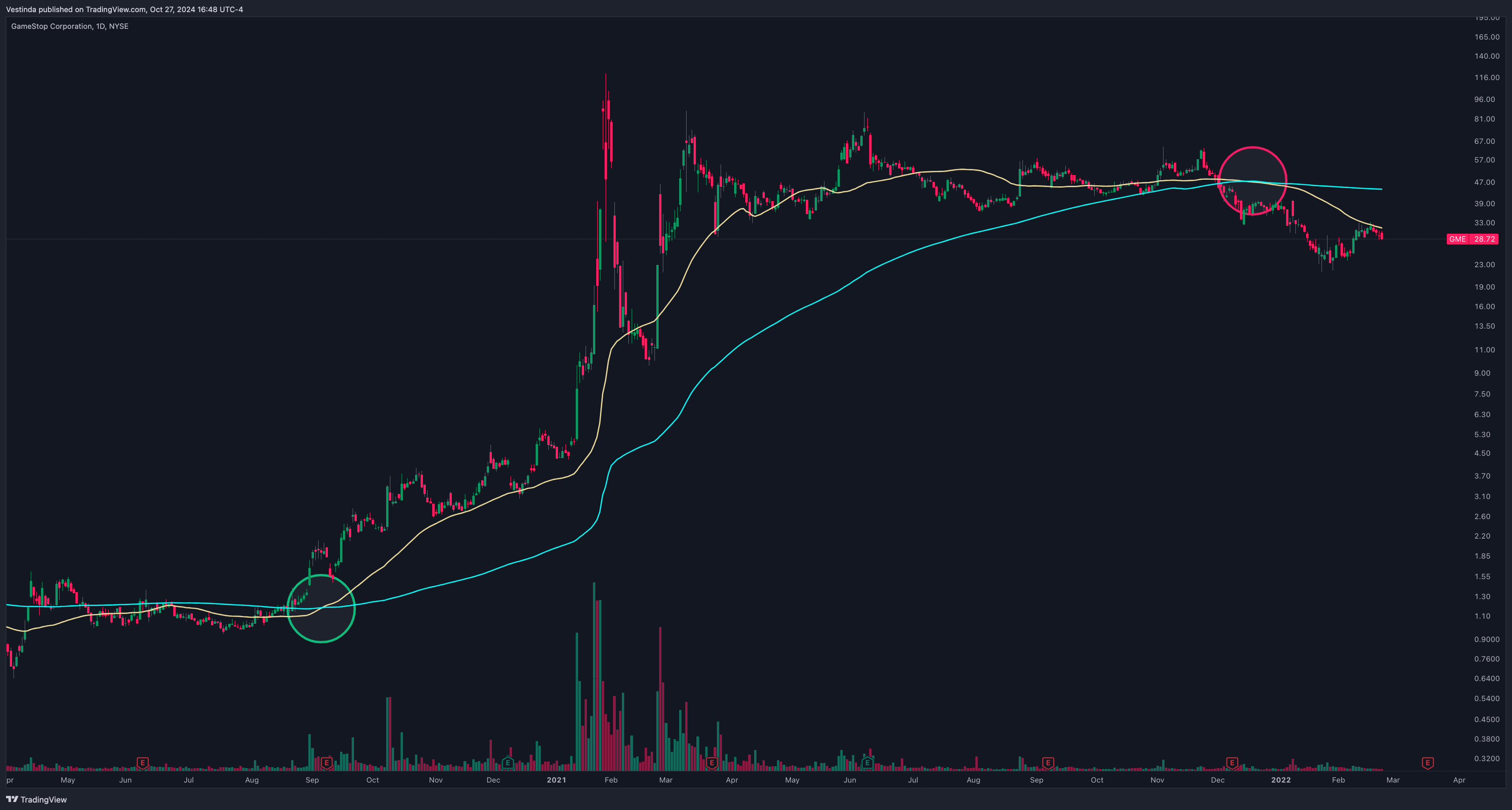
Why It Works: Using moving averages can help traders spot potential bullish or bearish shifts and avoid getting caught in short-term price swings.
How to Implement:
- Indicators: Use the 50-day moving average (short-term) and the 200-day moving average (long-term) for trend detection.
- Entry and Exit: Automate your strategy to buy GME when the 50-day MA crosses above the 200-day MA (Golden Cross) and sell when the 50-day MA crosses below the 200-day MA (Death Cross).
- Automation Tip: Program your algorithm to detect these moving average crossovers and trigger automatic buy/sell orders.
RSI (Relative Strength Index) Strategy
Concept: RSI is a momentum oscillator that identifies overbought or oversold conditions, making it useful for trading GME’s sharp price movements.
Why It Works: RSI can help you time entries and exits based on when GME is overbought or oversold, capturing profitable reversals.
How to Implement:
- Indicators: Use RSI with a 14-period setting.
- Entry and Exit: Automate trades to buy when RSI falls below 30 (indicating an oversold condition) and sell when RSI exceeds 70 (indicating an overbought condition).
- Automation Tip: Set your trading bot to execute trades based on RSI signals, ensuring quick responses to momentum shifts.
MACD (Moving Average Convergence Divergence) Strategy
Concept: MACD is a popular momentum indicator that shows the relationship between two moving averages, helping traders identify trend changes and momentum shifts.
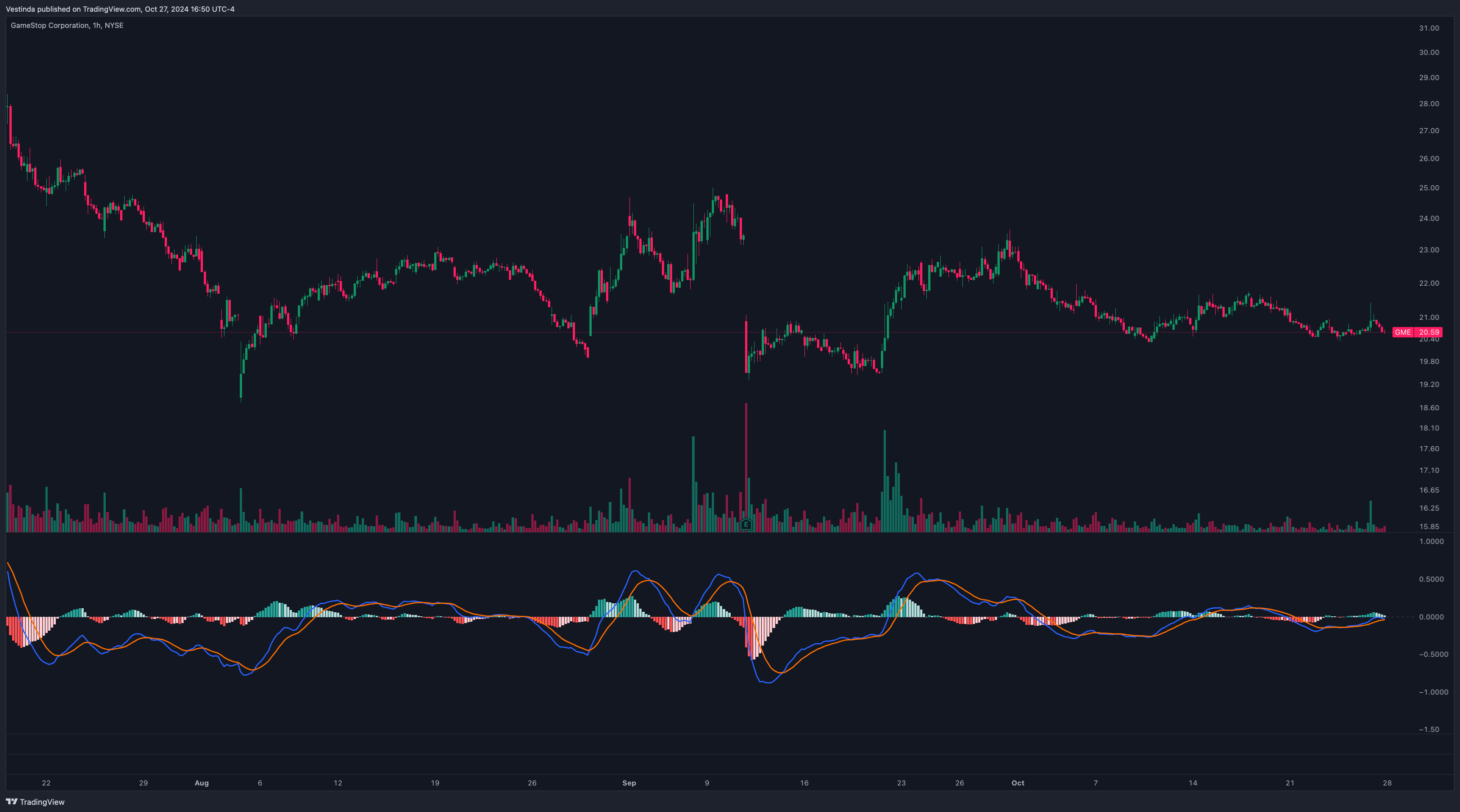
Why It Works: MACD crossovers provide clear signals for bullish or bearish momentum, helping you time your trades with more precision.
How to Implement:
- Indicators: Use the standard MACD settings (12, 26, 9).
- Entry and Exit: Automate your system to buy when the MACD line crosses above the signal line (bullish crossover) and sell when the MACD line crosses below the signal line (bearish crossover).
- Automation Tip: Program your system to detect MACD crossovers and execute trades as soon as momentum shifts.
VWAP (Volume Weighted Average Price) Strategy
Concept: VWAP reflects the average price of GME based on its volume and price, helping traders identify whether the stock is trading above or below its fair value.
Why It Works: VWAP can help traders determine when GME is overvalued or undervalued, providing ideal entry or exit points during volatile price movements.
How to Implement:
- Indicators: Use VWAP to track the volume-weighted average price on GME’s intraday charts.
- Entry and Exit: Automate trades to buy when the price is below VWAP (undervalued) and sell when the price is above VWAP (overvalued).
- Automation Tip: Use VWAP as a benchmark and automate your system to trigger trades when the price deviates significantly from the VWAP level.
Combining Indicators for Stronger GME Strategies:
RSI + MACD:
How It Works: Combine RSI with MACD to strengthen your trading signals. For example, enter trades when RSI indicates oversold conditions and MACD confirms a bullish crossover.
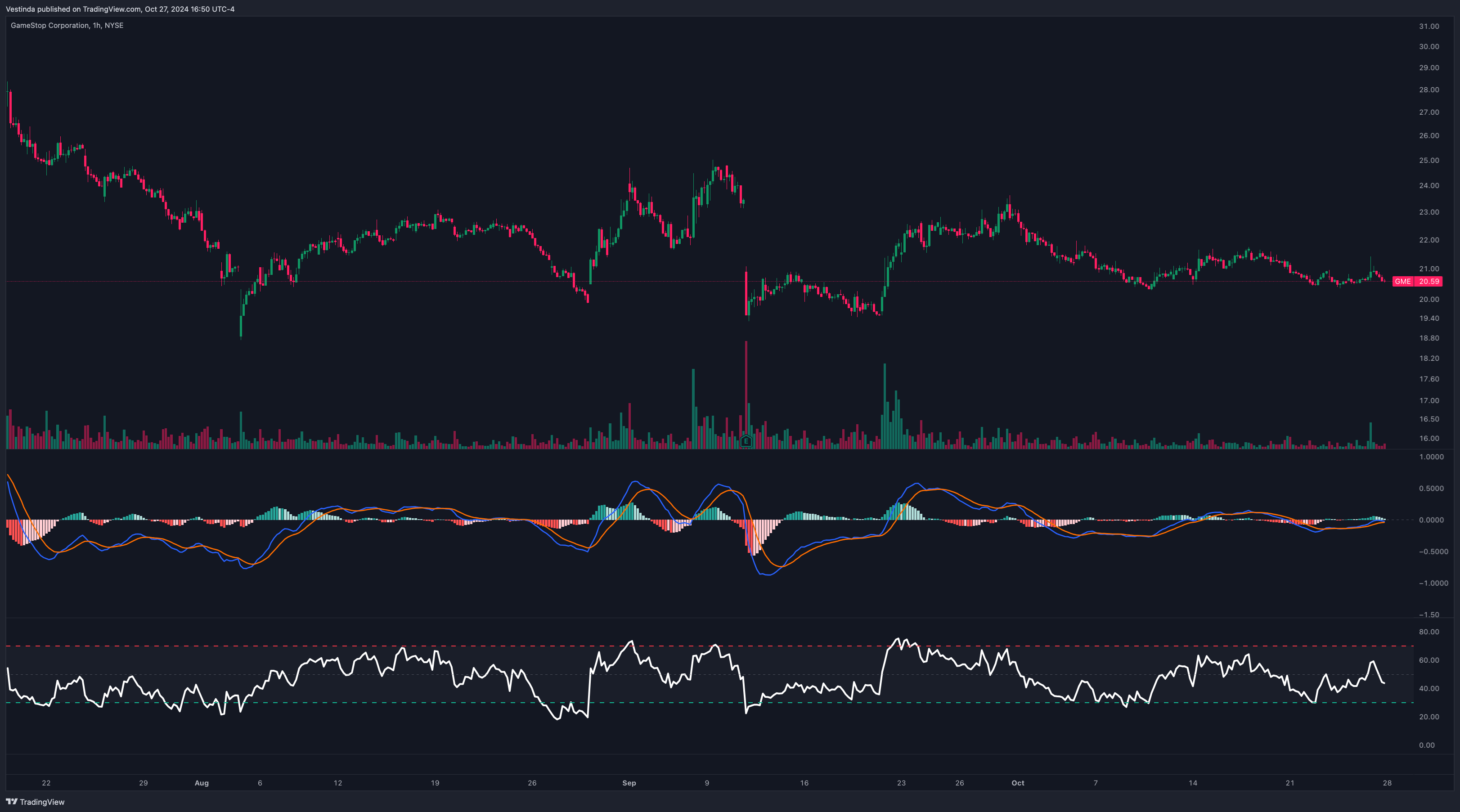
Automation Tip: Program your bot to enter a trade only when both RSI and MACD signals align, reducing false entries.
VWAP + Moving Averages:
How It Works: Use VWAP as a guide to value-based entries, and confirm trades with moving average crossovers. When the price is below VWAP and a Golden Cross forms, this creates a strong buying opportunity.
Automation Tip: Set your system to enter trades only when VWAP and moving averages provide confirming signals.
Risk Management for GME Algorithmic Trading:
Position Sizing:
Concept: Proper position sizing ensures that you control risk on each trade, especially in a highly volatile stock like GME.
How to Implement: Use risk management rules that limit exposure to a small percentage (e.g., 1-2%) of your total portfolio per trade.
Stop-Loss and Take-Profit Orders:
Concept: Stop-loss and take-profit orders protect your capital by automatically closing trades at predefined levels.
How to Implement: Set stop-losses below key support levels to limit downside risk and take-profits at resistance or other technical levels to lock in gains.
Trailing Stop-Loss Orders:
Concept: Trailing stop-loss orders allow you to protect gains by moving the stop-loss level higher as the price rises.
How to Implement: Automate your system to use trailing stop-losses, ensuring you capture profits while allowing for further upside movement.
Backtesting GME Strategies:
Why: Backtesting your GME trading strategy allows you to see how it would have performed under past market conditions, helping you refine your approach.
How to Implement: Use historical price and volume data to test your algorithmic strategy, adjusting parameters based on the results to optimize its performance in live trading.
Algorithmic trading strategies provide a structured, data-driven approach to trading volatile stocks like GME. By incorporating technical indicators such as moving averages, RSI, MACD, and VWAP, traders can optimize their entries and exits with precision and consistency. Combining these strategies with sound risk management and backtesting will help you navigate GME’s price swings and maximize profitability.
GME Algorithmic Trading: A Comprehensive How-To Guide
- Choose a reliable algorithmic trading platform that supports trading of GME stocks.
- Set up an account on the platform and complete any required verification processes.
- Research and analyze historical data and trends of GME stock to develop a strategy.
- Build or select a suitable algorithmic trading model that aligns with your strategy.
- Configure the algorithmic trading model by setting parameters such as buy/sell triggers and risk management rules.
- Test the algorithmic trading model using simulated or backtested data to ensure its effectiveness.
- Once confident in the model's performance, activate the algorithmic trading system to start trading GME stocks automatically.
Competitive Algorithmic Trading Events in GME Sphere
Algorithmic trading competitions in the GME space have gained considerable popularity in recent years. These competitions allow participants to design and implement trading algorithms specifically tailored to Gamestop Corp. stock. Participants compete against each other to achieve the highest returns within a given time frame.
In these competitions, participants utilize a combination of historical data, technical indicators, and machine learning techniques to develop their algorithms. The goal is to identify trading opportunities and make strategic decisions that can outperform traditional buy-and-hold strategies.
These competitions provide a platform for traders, data scientists, and programmers to showcase their skills and innovation in algorithmic trading. The GME space, in particular, offers unique challenges due to the stock's volatility and the rapid-changing dynamics of the retail investor sentiment surrounding Gamestop.
Overall, these algorithmic trading competitions in the GME space serve as a testing ground for new trading algorithms and strategies, fostering advancements in quantitative trading and providing valuable insights into the dynamics of this exciting market.
Analyzing GME Trades with Quantitative Techniques
Quantitative analysis techniques provide a systematic approach to GME trading. By employing mathematical models and statistical tools, traders can evaluate data and make informed decisions. These techniques involve analyzing historical price movements, volume patterns, and market indicators to identify trends and potential trading opportunities. Utilizing algorithms and statistical models, traders can generate quantitative trading strategies that exploit market inefficiencies. These strategies may include statistical arbitrage, mean reversion, trend following, and momentum trading. Through backtesting and optimization, traders can fine-tune their strategies and assess their effectiveness. However, it is important to note that quantitative analysis is not foolproof and does not guarantee success. It should be used in conjunction with other forms of analysis and risk management techniques to mitigate potential losses.
GME Algorithmic Trading Strategy Analysis
Evaluating the Performance of GME Algorithmic Trading Strategies
When assessing the effectiveness of GME algorithmic trading strategies, several key factors come into play. Firstly, it is essential to analyze the strategy's overall profitability, including both daily and cumulative returns. Next, evaluating the risk-adjusted performance metrics, such as the Sharpe ratio, provides insights into the strategy's volatility and the potential for generating excess returns. Additionally, conducting a robustness analysis helps determine if the strategy's performance remains stable across different market conditions or if it exhibits exceptional performance during specific periods. Evaluating the strategy's capacity to withstand transaction costs, such as slippage and commissions, is crucial in real-world trading scenarios. Lastly, comparing the strategy's performance against relevant benchmarks, such as market indices or other established strategies, assists in gauging its relative performance and identifying potential areas of improvement. Together, these evaluation techniques offer valuable insights into the effectiveness and sustainability of GME algorithmic trading strategies.
GME Algorithmic Trading: Transaction Cost Implications
The impact of transaction costs on GME algorithmic trading is significant. These costs, including commissions, fees, and market impact, can eat into the potential profits of algorithmic traders. Short sentences help to emphasize the point that transaction costs can have a negative effect on trading strategies. For instance, high commission fees reduce profits by increasing the overall trading costs. Moreover, market impact costs arise from the fact that large transactions can cause price changes, leading to worse execution prices. As a result, algorithmic traders need to carefully consider transaction costs and find ways to mitigate them, such as using low-cost brokerage firms or optimizing order execution algorithms. By considering transaction costs, traders can maximize their profits and ensure the efficiency of their algorithmic trading strategies when trading GME.
-
 Create
account -
 Discover profitable
strategies -
 Connect exchange
& start earning
Frequently Asked Questions
When choosing a machine learning algorithm for algorithmic trading, it is essential to consider several factors. Start by defining the problem you want to solve, whether it's predicting stock prices or detecting patterns in trading data. Next, assess the quantity and quality of available data. Then, consider the complexity of the algorithm and the computational resources required. Take into account the algorithm's historical performance and ability to adapt to changing market conditions. Finally, evaluate the algorithm's interpretability and transparency. It may be beneficial to experiment with different algorithms and compare their results to make an informed decision.
Yes, backtesting is crucial in GME algorithmic trading. It allows traders to evaluate the performance of their strategies by applying them to historical market data. Backtesting helps identify potential flaws in trading algorithms and refine them for better results. In the case of GME, where volatility is high, backtesting becomes even more critical to ensure algorithms can adapt to various market scenarios. By analyzing past data, traders can gain valuable insights and make informed decisions, increasing the likelihood of successful trading strategies in the dynamic GME market.
There are several notable GME (GameStop) algorithmic trading podcasts available that provide valuable insights for listeners. Firstly, "The Quant Investor" covers a wide range of algorithmic trading topics, including GME and its impact on the market. "Chat with Traders" also offers informative discussions on algorithmic trading and occasionally features experts discussing GME trading strategies. Lastly, "Better System Trader" shares practical advice on systematic trading approaches, which can be useful when navigating GME's market dynamics. These podcasts serve as excellent resources for those interested in algorithmic trading strategies and their application to the GME phenomenon.
When choosing a time frame for algorithmic trading GME (GameStop), several factors should be considered. Firstly, determine the trading strategy's objectives and desired frequency of trades. Shorter time frames (such as minutes or hours) are suited for high-frequency trading, while longer time frames (such as days or weeks) are more suitable for swing or trend trading. Secondly, analyze historical data and perform backtesting to identify the time frames that offer the best results and align with the chosen strategy. Finally, stay updated with relevant news and events that may impact GameStop's stock price, as this can influence the choice of a suitable time frame.
Machine learning can be applied in GME algorithmic trading for risk management purposes by incorporating it into the trading strategy. First, historical trading data and market indicators can be used to train a machine learning model to predict the probability of potential risks, such as sudden price drops or market volatility. This model can then be integrated with the algorithmic trading system to make real-time risk assessments and adjust trading decisions accordingly. By utilizing machine learning in risk management, traders can enhance their ability to identify and respond to market risks, ultimately improving the performance and stability of GME algorithmic trading strategies.
Conclusion
In conclusion, GME Algorithmic Trading has gained popularity in recent years, offering traders the opportunity to automate their trading strategies and potentially maximize their profits. The rise of online platforms and advanced trading tools has made it more accessible to individuals interested in exploring this field. Algorithmic trading competitions in the GME space provide a platform for participants to showcase their skills and innovation while navigating the unique challenges of Gamestop Corp.'s volatile stock. Employing quantitative analysis techniques can help traders develop informed strategies by evaluating historical data, market indicators, and trends. However, it's important to remember that quantitative analysis is not foolproof and should be used alongside other forms of analysis and risk management techniques. Evaluating the performance of GME algorithmic trading strategies is crucial, considering factors such as profitability, risk-adjusted metrics, robustness, transaction costs, and benchmark comparisons. Transaction costs can have a significant impact on algorithmic trading, and traders should consider ways to mitigate them to maximize profits and ensure efficient trading.

Successful traders rely on backtesting to be profitable.
Be like them with our
Free Backtesting Guide