
-
 Create
account -
 Build trading strategies
with no code -
 Validate
& Backtest -
 Automate
& start earning
Quantitative Strategies & Backtesting results for ETH
Here are some ETH trading strategies along with their past performance. You can validate these strategies (and many more) for free on Vestinda across thousands of assets and many years of historical data.
Quantitative Trading Strategy: MVWAP and VWAP Crossover on ETH
Based on the backtesting results statistics of a trading strategy from December 16, 2018 to December 16, 2023, the profit factor stands at 1.85, indicating that for every unit of risk taken, 1.85 units of profit were generated. This reflects a successful performance of the strategy. Moreover, the annualized return on investment (ROI) is an impressive 314.9%, suggesting significant monetary gains over the evaluated period. The average holding time for trades was approximately 2 weeks and 6 days, indicating that the strategy entails medium-term investments. On average, there were 0.19 trades per week, indicating a relatively low trading frequency. Out of a total of 50 closed trades, 50% of them were profitable, resulting in a noteworthy return on investment of 1574.51%.

 ETHUSDT

Choose another period and try again.
Quantitative Trading Strategy: Mass Index Crossover with RSI Entry on ETH
Based on the backtesting results statistics for the trading strategy conducted between December 10, 2018 and December 10, 2023, it can be observed that the strategy shows promising potential. The profit factor stands at 1.48, indicating that for every dollar risked, a profit of $1.48 was generated. The annualized return on investment (ROI) of 18.03% suggests that, on average, the strategy yielded consistent profits over the analyzed time period. With an average holding time of 7 weeks and 4 days, this strategy can be considered a longer-term approach. On average, the strategy executed 0.04 trades per week, indicating a relatively low-frequency trading style. The total number of closed trades was 11, with a winning trades percentage of 45.45%, contributing to an impressive return on investment of 90.17%. Overall, these backtesting results signify the potential success of the trading strategy.
ETHUSDT
Choose another period and try again.
ETH (Ethereum) Algorithmic Trading: Unlocking Profit Potential
Introduction
Algorithmic trading has transformed how traders approach Ethereum (ETH), offering precision, speed, and consistency in executing trades. By leveraging automated strategies based on technical indicators, market trends, and data analysis, traders can unlock Ethereum’s profit potential. This guide dives into algorithmic trading for ETH and how to optimize it for maximum returns.
What is Algorithmic Trading?
- Definition: A method of executing trades using pre-programmed instructions based on market data, indicators, and price movements.
- Core Features:
- Automated execution without manual intervention.
- Consistent application of strategies.
- Integration of advanced tools like AI and machine learning.
Why Use Algorithmic Trading for Ethereum?
- High Volatility: Ethereum’s frequent price swings create opportunities for algorithms to exploit.
- 24/7 Market: Automation ensures strategies are executed around the clock.
- Emotion-Free Trading: Algorithms eliminate psychological biases, ensuring disciplined execution.
Popular Algorithmic Trading Strategies for Ethereum:
1. Trend-Following with EMA and Supertrend:
- Concept: Identify and trade with Ethereum’s prevailing trend.
- Setup:
- Use a 20-period EMA for short-term trends and a 100-period EMA for medium-term trends.
- Add a Supertrend indicator (10, 3) to detect trend direction.
- Execution Rules:
- Buy Signal: Enter long when ETH price is above both EMAs, and the Supertrend turns bullish.
- Sell Signal: Exit when the Supertrend flips bearish or the price crosses below the 100 EMA.
- Best For: Trending markets with clear directional movements.

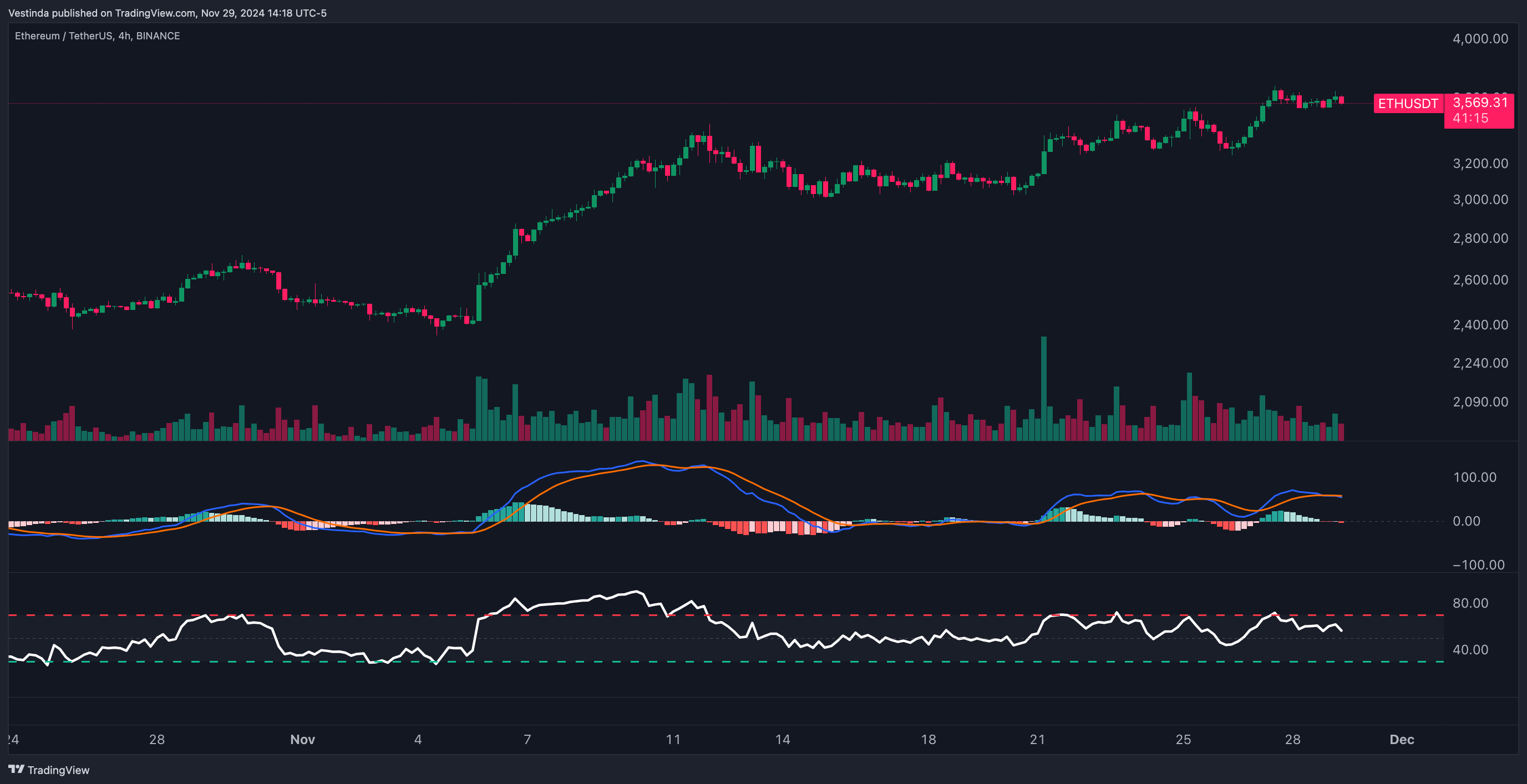
2. Momentum Trading with MACD and RSI:
- Concept: Capture price momentum using MACD and RSI indicators.
- Setup:
- Apply MACD (12, 26, 9) to gauge momentum shifts.
- Use RSI (14) to detect overbought or oversold conditions.
- Execution Rules:
- Buy Signal: Enter long when MACD shows a bullish crossover and RSI exits the oversold zone.
- Sell Signal: Exit when RSI enters the overbought zone or MACD shows a bearish crossover.
- Best For: Intraday and swing trades in volatile markets.
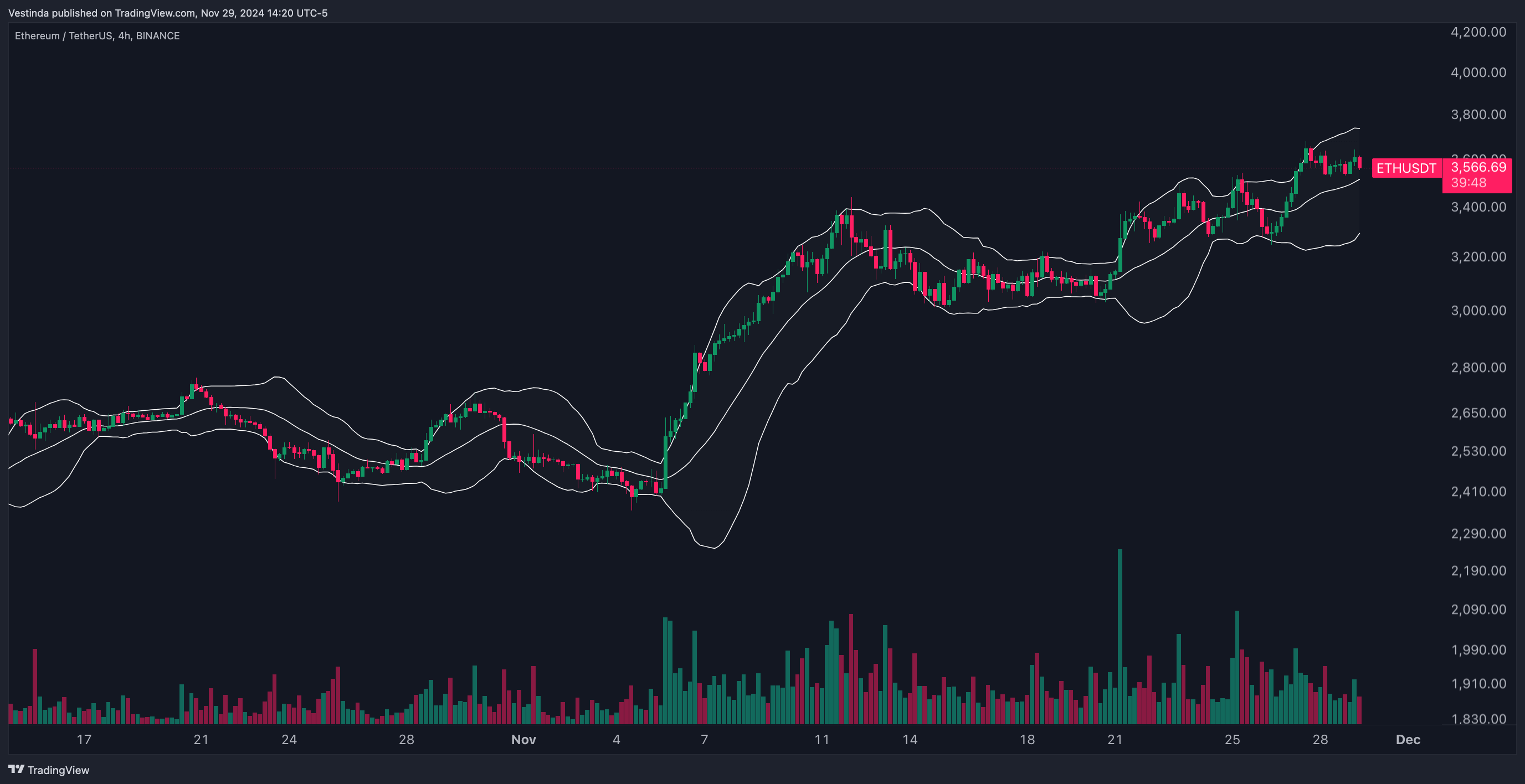
3. Breakout Trading with Bollinger Bands:
- Concept: Detect and capitalize on ETH price breakouts from consolidation.
- Setup:
- Use Bollinger Bands (20, 2) to identify compression zones.
- Execution Rules:
- Buy Signal: Enter long when ETH breaks above the upper band with increasing volume.
- Sell Signal: Exit near key resistance levels or when price consolidates below the band.
- Best For: High-volatility breakout scenarios.
How to Build and Implement Algorithmic Trading Strategies:
Step 1: Define Your Objectives
- Determine your trading style (scalping, swing trading, or trend-following).
- Identify key indicators and timeframes for your strategy.
Step 2: Code the Strategy
- Use platforms like TradingView or Python for developing algorithms.
- Example logic:
- IF ETH price crosses above the 50 EMA AND RSI exits oversold, THEN enter long.
Step 3: Backtest Thoroughly
- Test your strategy on historical Ethereum data to evaluate its performance.
- Focus on metrics like win rate, drawdown, and profit factor.
Step 4: Optimize Parameters
- Adjust indicator settings, timeframes, or risk management rules to enhance strategy efficiency.
Step 5: Monitor and Refine
- Regularly review live performance to ensure your algorithm adapts to market conditions.
Risk Management Tips:
- Position Sizing: Limit exposure to 1-2% of your portfolio per trade.
- Dynamic Stop-Loss: Use ATR-based stops to account for Ethereum’s volatility.
- Diversify Strategies: Employ multiple algorithms to hedge against unfavorable market conditions.
Advantages of Algorithmic Trading for Ethereum:
- Speed and Precision: Executes trades faster and more accurately than manual trading.
- Consistency: Adheres to pre-set rules, reducing emotional decision-making.
- Scalability: Manage multiple strategies and markets simultaneously.
Common Mistakes to Avoid:
- Neglecting Backtesting: Always validate your strategy on historical data before live deployment.
- Overfitting: Avoid making strategies too specific to past market conditions.
- Ignoring Market Context: Adjust strategies for varying market conditions, such as bull or bear trends.
Conclusion:
Algorithmic trading is a powerful tool for Ethereum traders, enabling them to capitalize on market opportunities efficiently and consistently. By implementing well-defined strategies, optimizing parameters, and managing risks, traders can unlock Ethereum’s profit potential. Continuous learning and refinement are essential to stay ahead in the dynamic world of crypto trading.
Ethereum Algorithmic Trading: A Practical Step-By-Step Guide
- Create an account on a cryptocurrency exchange platform that supports algorithmic trading.
- Deposit funds into your account and ensure that you have sufficient ETH available.
- Research and select an algorithmic trading strategy or find a pre-built one.
- Configure the parameters of your chosen strategy, including risk management measures.
- Activate the algorithmic trading software and monitor its performance over time.
- Regularly evaluate and adjust your strategy based on market conditions and desired outcomes.
- Stay updated with the latest news and developments in the cryptocurrency market to make informed decisions.
Ethereum Trading Competitions: Algorithmic Alchemy
Algorithmic Trading Competitions in the ETH Space offer participants the opportunity to showcase their trading strategies and compete for prizes in a decentralized and transparent manner. These competitions leverage the smart contract capabilities of Ethereum to provide a level playing field for participants. Traders develop and implement algorithms that autonomously execute trades based on predefined rules, optimizing performance and minimizing risk. Through the use of smart contracts, trades are executed in a trustless and secure manner, removing the need for intermediaries. Participants can monitor their performance in real time and adjust their strategies accordingly. The competitions attract both experienced traders and newcomers, fostering innovation and collaboration within the ETH community. These events not only promote algorithmic trading, but also contribute to the growth and development of the Ethereum ecosystem as a whole.
Evolving ML for ETH Algorithmic Trading
With the increasing popularity of algorithmic trading in the world of cryptocurrency, it is important to adapt machine learning strategies specifically for ETH trading. This involves using historical data to train the machine learning models in order to make accurate predictions on price movements. By analyzing various market indicators and patterns, the models can identify profitable trading opportunities and execute trades accordingly. Implementing machine learning in ETH algorithmic trading allows for a more efficient and automated approach, saving time and minimizing human error. However, it is crucial to constantly update and fine-tune the models to adapt to the ever-changing market conditions. Overall, incorporating machine learning strategies into ETH algorithmic trading can provide traders with a competitive edge and potentially increase profitability.
ETH Algorithmic Trading: Unlocking Technical Indicator Potential
Technical indicators play a crucial role in ETH algorithmic trading. These indicators analyze historical price data to provide insight into market trends, patterns, and potential future price movements. Traders use indicators such as moving averages, MACD, RSI, and Bollinger Bands to identify entry and exit points for their trades. By utilizing these indicators, traders aim to make informed decisions based on objective data rather than relying solely on emotions or gut feelings. Technical indicators help traders to identify potential price reversals, trends, and market volatility in real-time. They can also be customized and combined with other indicators to create personalized trading strategies. Overall, technical indicators serve as valuable tools that assist traders in enhancing their trading performance and increasing their chances of success in ETH algorithmic trading.
Sophisticated backtesting is not only possession of high-esteemed hedge funds anymore.
Impressive Team and support, Backtesting engine with detailed reports, The Strategy builder.

Great purchase!
I have always manually invested in stocks and cryptocurrencies, but after studying Vestinda, I must say it has enormous potential.

Mature platform for trading
Pro: Easy to use, Nice UX, A lot of customization for strategies, Back testing is an awesome tool, can check any strategy in history.

Frequently Asked Questions
Algorithmic trading can greatly impact market efficiency by increasing liquidity, reducing trading costs, and enhancing price discovery. The use of complex algorithms and automated trading systems allows for quick and efficient execution of trades, leading to improved market liquidity. This, in turn, reduces bid-ask spreads and enhances market efficiency. Additionally, algorithmic trading can facilitate price discovery by quickly incorporating new information into the market, ensuring that prices more accurately reflect fundamental values. Overall, algorithmic trading can contribute to a more efficient and effective functioning of financial markets.
To implement a mean-reversion strategy in ETH algorithmic trading, one can follow a simple approach. The strategy involves monitoring ETH's price movements and identifying periods of significant deviation from its mean value. When the price deviates significantly above the mean, one can sell their ETH holdings, predicting a potential reversal. Conversely, when the price dips below the mean, one can buy ETH, anticipating a possible upward correction. By continuously adjusting trades based on these mean deviations, an algorithmic trading system can execute the mean-reversion strategy in ETH trading.
The key components of an algorithmic trading system include data acquisition, strategy development, order generation, risk management, and execution. Data acquisition involves gathering real-time market data and historical market data for analysis. Strategy development entails designing and optimizing trading algorithms based on various indicators and parameters. Order generation involves creating trade orders based on the trading algorithms. Risk management involves monitoring and controlling the exposure to potential risks and managing portfolio positions. Execution involves transmitting orders to the market, monitoring trades, and handling any trade-related events. These components work together to automate and optimize the trading process.
To avoid overfitting in algorithmic trading models, several strategies can be adopted. First, using a larger and diverse data set can prevent the model from focusing on specific market conditions. Additionally, using regularization techniques like L1 or L2 regularization can help reduce the model's complexity. Feature engineering and selection can also remove irrelevant or highly correlated variables. Lastly, implementing cross-validation techniques such as k-fold validation can assess the model's performance on unseen data, ensuring its generalizability. Overall, a combination of these strategies can effectively mitigate the risk of overfitting in algorithmic trading models.
Yes, C++ is commonly used in algorithmic trading due to its performance, low-level control, and vast ecosystem of libraries and tools. C++ allows for highly efficient and fast execution of algorithms, which is crucial in the fast-paced trading environment. It offers extensive support for mathematical and statistical calculations, making it ideal for implementing complex trading strategies. Additionally, many trading platforms and financial institutions have C++ APIs, further driving its popularity in algorithmic trading.
ETH algorithmic trading refers to the use of computer programs and mathematical algorithms to execute trades on the Ethereum cryptocurrency network automatically. These algorithms analyze market data, such as price movements and trading volumes, to identify profitable opportunities and execute trades at optimal prices and timings. ETH algorithmic trading aims to remove human emotions and biases from the trading process, enabling faster and more efficient execution. It is commonly used by sophisticated traders and institutional investors to capitalize on market inefficiencies and generate consistent profits in the highly volatile Ethereum market.
Conclusion
In conclusion, ETH Algorithmic Trading offers traders the opportunity to capitalize on the price fluctuations of Ethereum in a disciplined and automated manner. By utilizing predefined rules and indicators, traders can take advantage of market opportunities that may be difficult to capture manually. Algorithmic Trading tools and software provide traders with the necessary tools to implement and monitor their strategies effectively. Additionally, Algorithmic Trading competitions in the ETH space foster innovation and collaboration within the community, contributing to the growth and development of the Ethereum ecosystem. Incorporating machine learning strategies and utilizing technical indicators further enhance the efficiency and profitability of ETH Algorithmic Trading.

Successful traders rely on backtesting to be profitable.
Be like them with our
Free Backtesting Guide