
-
 Create
account -
 Build trading strategies
with no code -
 Validate
& Backtest -
 Automate
& start earning
Quant Strategies & Backtesting results for BTC
Here are some BTC trading strategies along with their past performance. You can validate these strategies (and many more) for free on Vestinda across thousands of assets and many years of historical data.
Quant Trading Strategy: Long term invest on BTC
According to the backtesting results for the trading strategy conducted from March 15, 2020, to March 15, 2021, the annualized return on investment (ROI) stands at an impressive 27.13%. The average holding time for each trade was approximately 7 weeks and 5 days. The strategy generated an average of 0.03 trades per week, indicating a relatively low trading frequency. Over the duration of the backtesting period, a total of 2 trades were closed. However, it is worth noting that all of these trades were successful, resulting in a winning trades percentage of 100%. This data suggests that the strategy has demonstrated robust performance and potentially offers promising prospects for future trading endeavors.

 BTCUSDT

Choose another period and try again.
Quant Trading Strategy: RSI Trend-Following with Ichimoku Cloud and Dojis on BTC
The backtesting results of the trading strategy from November 24, 2017, to September 30, 2023, showcase promising statistics. With a profit factor of 1.16 and an annualized ROI of 31.53%, this strategy has demonstrated its potential for generating impressive returns. On average, each trade was held for approximately 2 days and 1 hour. With an average of 0.96 trades per week, the strategy maintained a consistent pace. Over the specified period, a total of 294 trades were closed, leading to a remarkable return on investment of 185.48%. Despite a modest percentage of winning trades at 22.11%, the strategy's overall effectiveness and potential for profitability cannot be dismissed.
BTCUSDT
Choose another period and try again.
BTC (Bitcoin) Day Trading Strategies and Tips
Introduction
Day trading Bitcoin requires a strategic approach to capitalize on its short-term price movements. With its high volatility and liquidity, Bitcoin offers ample opportunities for traders to generate profits. This guide highlights effective day trading strategies, actionable tips, and insights into mastering Bitcoin’s dynamic market.
Why Day Trade Bitcoin?
- High Volatility: Bitcoin’s frequent price swings provide numerous intraday opportunities.
- 24/7 Market Access: Unlike traditional assets, Bitcoin’s market operates continuously.
- Scalability: Bitcoin’s deep liquidity supports both small-scale and high-frequency trading.
Core Day Trading Strategies for Bitcoin
1. Scalping with Keltner Channels
Concept: Use Keltner Channels to identify intraday volatility and trade small price movements.
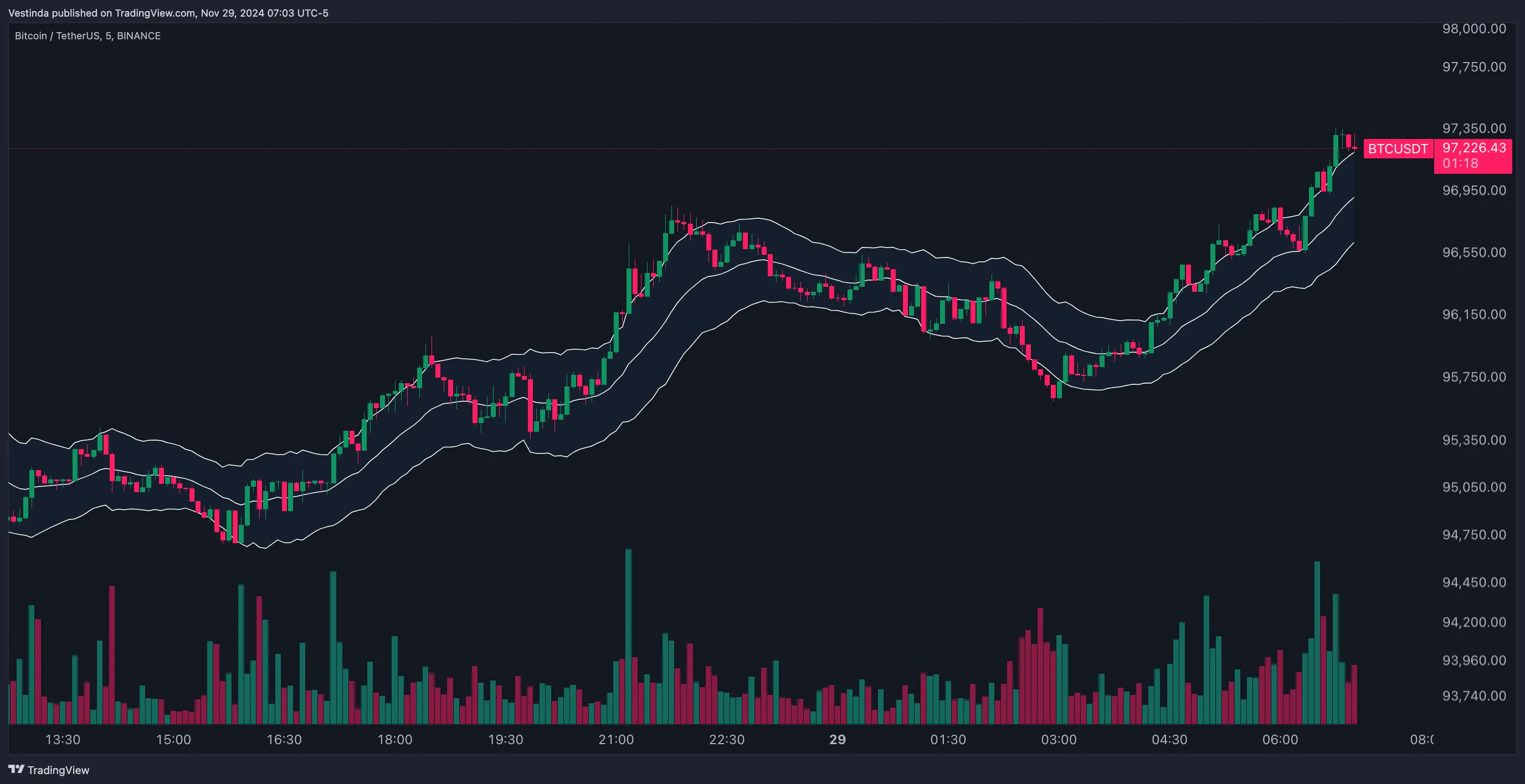
Execution Rules:
- Buy Signal: Enter long when Bitcoin touches the lower channel and rebounds upward.
- Sell Signal: Enter short when Bitcoin touches the upper channel and reverses downward.
- Enhancement: Combine with volume analysis to confirm breakout or reversal strength.
2. Momentum Trading with Stochastic RSI
Concept: Use the Stochastic RSI to detect overbought and oversold conditions in short timeframes.

Execution Rules:
- Buy Signal: Enter long when the Stochastic RSI crosses above 20 from the oversold zone.
- Sell Signal: Enter short when the Stochastic RSI crosses below 80 from the overbought zone.
- Enhancement: Align entries with broader trends observed on higher timeframes.
3. Breakout Strategy with Volume Indicators
Concept: Identify breakouts from consolidation phases using volume spikes as confirmation.
Setup: Use a volume oscillator or VWMA (Volume Weighted Moving Average) to detect unusual activity.
Execution Rules:
- Buy Signal: Enter long when Bitcoin breaks above a resistance level with increasing volume.
- Sell Signal: Enter short when Bitcoin breaks below a support level with high selling pressure.
- Enhancement: Set stop-losses just inside the consolidation range to minimize risk.
4. Reversal Trading with Candlestick Patterns
Concept: Use reversal candlestick patterns, such as hammers or shooting stars, to identify potential turning points.
Setup: Identify key support or resistance levels where reversals are likely to occur.
Execution Rules:
- Buy Signal: Enter long after a hammer forms at support, confirmed by bullish volume.
- Sell Signal: Enter short after a shooting star forms at resistance, confirmed by bearish momentum.
- Enhancement: Use Fibonacci retracement levels for additional validation of reversal zones.
Practical Tips for Bitcoin Day Trading
- Timeframe Selection: Use the 1-minute to 15-minute charts for intraday analysis. Cross-reference with 1-hour charts to align trades with the broader trend.
- Define Entry and Exit Rules: Set predefined criteria for entering and exiting trades, based on your chosen strategy.
- Limit Risk per Trade: Risk no more than 1-2% of your portfolio on any single trade.
- Use Alerts and Automation: Configure alerts for specific conditions, such as breakout levels or indicator crossovers.
- Monitor Market News: Stay updated on major Bitcoin-related events, as these can trigger intraday volatility.
Risk Management Best Practices
- Dynamic Stop-Loss Placement: Use ATR-based stop-losses to adapt to changing market conditions.
- Diversify Strategies: Employ a mix of scalping, breakout, and reversal strategies to hedge against varying trends.
- Keep Emotions in Check: Stick to your plan and avoid impulsive trades driven by fear or greed.
Conclusion
Day trading Bitcoin requires a blend of technical expertise, disciplined execution, and robust risk management. Strategies such as scalping with Keltner Channels, momentum trading with Stochastic RSI, and breakout analysis with volume indicators offer actionable frameworks for intraday success. By staying informed, refining your strategies, and managing risks effectively, you can master the art of Bitcoin day trading.
Becoming Profitable: Mastering Day Trading BTC
- Educate yourself on the basics of day trading and understand the risks involved.
Gain knowledge about technical analysis, chart patterns, and indicators used in BTC trading. - Create a trading plan and set realistic profit targets and risk management strategies.
Identify your trading style and set rules for entry and exit strategies. - Open an account on a reliable cryptocurrency exchange platform that supports BTC day trading.
- Start with a small capital investment and gradually increase as you gain experience and confidence.
Use a demo account to practice and test your strategies before trading with real money. - Monitor BTC price movements and identify potential trading opportunities based on your analysis.
Utilize stop-loss orders to minimize losses and protect your capital. - Stick to your trading plan, avoid impulsive decisions, and maintain discipline.
Take emotions out of trading and learn from both successful and unsuccessful trades. - Continuously learn and adapt to changing market conditions by staying updated with news and market trends.
Consider joining trading communities and forums to exchange ideas and insights.
Bitcoin Trade Bells: Analytical Indicator Insights
BTC day trading indicators play a crucial role in analyzing Bitcoin price movements. These indicators help traders make informed decisions about when to buy or sell BTC. Some popular indicators include moving averages, MACD, RSI, and Bollinger Bands. Moving averages track the average price over a specific period, providing insight into short and long-term trends. MACD measures the momentum of Bitcoin's price, indicating potential changes in direction. RSI assesses the market's overbought or oversold conditions. Bollinger Bands indicate volatility levels and potential price breakouts. Traders can combine these indicators to form a more comprehensive analysis, aiding in identifying optimal entry and exit points. However, it's essential to understand that no indicator guarantees accurate predictions, and traders should also consider other factors like market news and sentiment. Overall, BTC day trading indicators are valuable tools for traders in the volatile cryptocurrency market.
Trading tactics for maximizing BTC profits.
Day trading strategies are popular among traders looking to profit from short-term price movements. One common approach is scalping, where traders aim to make small but frequent trades to capitalize on quick market fluctuations. Another strategy is momentum trading, in which traders focus on stocks or cryptocurrencies with high trading volumes and strong price trends. Technical analysis plays a crucial role in day trading, with traders using charts and indicators to identify potential entry and exit points. Breakout trading involves taking positions when an asset's price breaks through a key level of support or resistance. Range trading, on the other hand, seeks to profit from price fluctuations within a defined range. It is important for day traders to manage risk carefully and make disciplined decisions based on their chosen strategy. BTC has become a popular asset for day traders due to its high volatility and liquidity.
Tax Implications of Day Trading BTC
Day trading can have tax implications, and it's crucial for traders to understand and comply with tax regulations. In the United States, day traders are required to report their trading activities to the Internal Revenue Service (IRS) and may be subject to capital gains taxes. Short-term capital gains tax rates apply to profits from day trading, which are typically higher than long-term capital gains rates. Traders can offset their gains by deducting trading-related expenses, such as platform fees or education costs. If a trader incurs losses, they can use those losses to offset their taxable gains, reducing their overall tax liability. It's important for day traders to keep accurate records of their trades and consult with a tax professional to ensure compliance with tax laws specific to their jurisdiction.
-
100,000 available assets New
-
years of historical data
-
practice without risking money

Frequently Asked Questions
The best hour to day trade depends on the market and individual trading strategies, but generally, the most active and volatile period is during the first two hours after the market opens. This period often offers ample opportunities for quick profits due to increased volume and price movements. Traders also need to consider their own availability and preferences, as day trading requires constant monitoring and decision-making. It is crucial to research and observe specific markets to determine the best hour for day trading, considering factors such as liquidity, news releases, and historical price patterns.
Day trading can be extremely challenging. It requires a deep understanding of the market, technical analysis, risk management, and the ability to make split-second decisions. The fast-paced nature of day trading can be mentally and emotionally taxing, as traders constantly need to monitor multiple stocks, identify patterns, and execute trades swiftly. Moreover, day trading involves significant risks due to price volatility, slippage, and commission costs. It demands discipline, dedication, and continuous learning to navigate the complexities of the stock market effectively. Success in day trading is not guaranteed and many traders experience losses, hence it should be approached with caution and thorough preparation.
Day trading BTC can be both profitable and risky. It requires constant monitoring of market trends, technical analysis skills, and a disciplined approach. The fast-paced nature of BTC markets can lead to substantial gains, but also significant losses. Volatility and unpredictable price movements make day trading BTC a high-risk endeavor. It is essential to understand market dynamics, set strict risk management strategies, and avoid emotional decision-making. Only experienced traders with a deep understanding of the cryptocurrency market should consider day trading BTC.
To learn trading, start by educating yourself about the fundamentals of the stock market, such as understanding different types of investments and the concepts of supply and demand. Take advantage of online resources, books, and courses to gain knowledge about technical and fundamental analysis. It's crucial to practice with virtual trading platforms to develop and refine your skills without risking real money. Furthermore, consider joining trading communities or finding a mentor to learn from experienced traders. Continuous learning, practice, and staying up-to-date with market trends are key to becoming a successful trader.
For beginners, it is recommended to start with traditional stock trading as it provides a solid foundation for understanding market dynamics. It allows newcomers to learn about fundamental and technical analysis, risk management, and portfolio diversification. Additionally, investing in stocks is relatively straightforward and offers numerous educational resources. While other forms of trading like forex or options may seem appealing, they often involve higher complexity and risk. Starting with stock trading allows beginners to familiarize themselves with the market before exploring more advanced strategies.
Day trading is a challenging endeavor because it requires a great deal of skill, knowledge, and discipline. The fast-paced nature of the market demands quick decision-making and frequent trading, amplifying the potential risks and losses. Traders must accurately analyze market trends, understand complex financial indicators, and interpret news events, all while managing emotions to avoid impulsive decisions. Moreover, day trading requires constant vigilance and dedication, as traders need to closely monitor positions and adapt to rapidly changing market conditions. These factors, combined with the inherent unpredictability of the markets, contribute to the difficulty of day trading and make it a highly demanding and risky pursuit.
Conclusion
In conclusion, BTC (Bitcoin) day trading is a popular strategy for individuals looking to take advantage of the volatility in the BTC market. By educating themselves on the basics of day trading, creating a trading plan, using day trading indicators, and employing various day trading strategies, traders can increase their chances of success. It is important to understand the risks involved and to manage risk carefully. Day traders should also be aware of the tax implications of day trading and comply with tax regulations. Overall, BTC day trading can be a lucrative opportunity for those with a solid understanding of the market and the ability to navigate its fast-paced nature.

Successful traders rely on backtesting to be profitable.
Be like them with our
Free Backtesting Guide