
-
 Create
account -
 Build trading strategies
with no code -
 Validate
& Backtest -
 Automate
& start earning
Quant Strategies & Backtesting results for BTC
Here are some BTC trading strategies along with their past performance. You can validate these strategies (and many more) for free on Vestinda across thousands of assets and many years of historical data.
Quant Trading Strategy: RSI Trend-Following with Ichimoku Cloud and Dojis on BTC
Based on the backtesting results statistics for the trading strategy from November 24, 2017, to September 30, 2023, several key findings can be highlighted. The strategy demonstrated a profit factor of 1.16, indicating moderate profitability. The annualized return on investment (ROI) stood impressively at 31.53%, exceeding the average market return. On average, trades were held for approximately 2 days and 1 hour, suggesting a short-term trading approach. With an average of 0.96 trades per week, the strategy maintained a relatively conservative frequency. The total number of closed trades amounted to 294, reflecting an active trading approach. Moreover, the winning trades percentage was 22.11%, indicating room for improvement in achieving profitable outcomes. Overall, the strategy showcased a return on investment of 185.48%, implying potential for growth and successful trading performance.

 BTCUSDT

Choose another period and try again.
Quant Trading Strategy: Accumulation Distribution Crossover on BTC
Based on the backtesting results from November 20, 2018 to November 20, 2023, the trading strategy showcased promising statistics. The profit factor stood at 1.6, indicating a favorable ratio between profits earned and losses incurred. The annualized return on investment (ROI) boasted an impressive 131.77%, highlighting the strategy's potential for generating substantial gains. On average, the holding time for trades spanned approximately 2 weeks and 2 days, while the strategy exhibited a low frequency of trades with only 0.21 per week. Over the testing period, a total of 57 trades were closed, with a winning trades percentage of 19.3%. Overall, the return on investment reached an exceptional 658.85%.
BTCUSDT
Choose another period and try again.
BTC (Bitcoin) Algo Trading Strategies: Strengthen Your Trading Strategy
Introduction
Bitcoin’s volatile nature and around-the-clock trading environment make it ideal for algorithmic strategies that can adapt quickly to price movements. By leveraging the Supertrend indicator alongside other tools, traders can create responsive strategies that capture Bitcoin’s trends with precision. This guide covers effective algo strategies tailored for Bitcoin, featuring the Supertrend indicator, popular entry/exit methods, and key backtesting insights.
Understanding Bitcoin’s Market Dynamics:
- Volatility: Bitcoin frequently experiences rapid price swings, presenting opportunities for momentum-based algo strategies.
- 24/7 Trading: Bitcoin’s continuous market requires algorithms that can operate without manual intervention.
- Key Benefit: Algo strategies allow traders to capitalize on Bitcoin’s trends and breakouts in real-time, removing emotional decision-making.
Core BTC Algo Trading Strategies:
1. Mean Reversion Strategy with Supertrend for Confirmation:
Concept: This strategy assumes Bitcoin’s price will revert to its mean after large deviations, and the Supertrend helps confirm reentry points.
Why It Works: Supertrend adapts to changing volatility, enhancing mean reversion signals with its trend-following approach.

How to Implement:
- Indicator Setup: Apply a 20-period moving average for mean reversion and add the Supertrend indicator (set to default values of 10 and 3).
- Entry and Exit: Enter long when Bitcoin’s price falls below the moving average, and Supertrend confirms a bullish trend. Exit when Supertrend turns bearish or price returns to the moving average.
- Backtesting Tip: Test this strategy across different market conditions to optimize Supertrend parameters for Bitcoin’s volatility.
2. Breakout Strategy with Bollinger Bands and Supertrend:
Concept: Use Bollinger Bands to identify breakouts and Supertrend to confirm trend direction, capturing significant price moves in Bitcoin.
Why It Works: Bollinger Bands highlight volatility changes, and Supertrend helps confirm trends during breakouts, reducing false signals.
How to Implement:
- Indicators: Apply Bollinger Bands (20-period, 2 standard deviations) and Supertrend for trend confirmation.
- Entry and Exit: Buy when Bitcoin’s price breaks above the upper Bollinger Band with a bullish Supertrend signal; go short on a lower band breakout with a bearish Supertrend.
- Backtesting Tip: Test various Bollinger Band and Supertrend settings to align with Bitcoin’s high volatility and trend strength.
3. RSI and Supertrend for Trend Reversal Detection:
Concept: Use RSI to detect overbought/oversold levels and confirm reversal entries with Supertrend, capturing timely trend reversals.
Why It Works: The combination of RSI and Supertrend reduces false signals, improving trade timing by capturing key reversals.
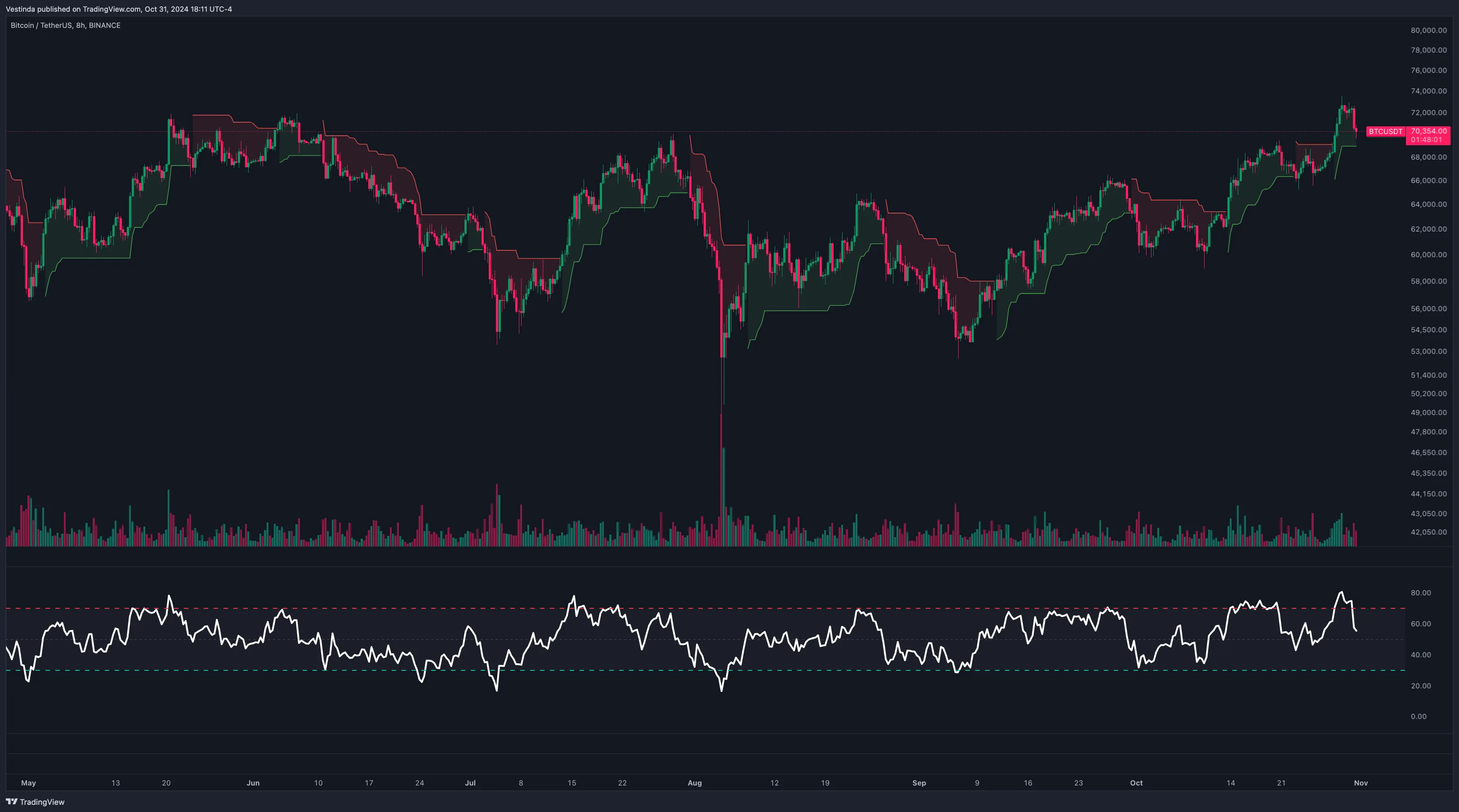
How to Implement:
- Indicators: Apply RSI (14-period) and Supertrend (default or modified to fit market volatility).
- Entry and Exit: Enter long when RSI falls below 30 (oversold) with a Supertrend bullish signal; go short when RSI rises above 70 (overbought) with a bearish Supertrend.
- Backtesting Tip: Test RSI thresholds and Supertrend sensitivity to align reversal detection with Bitcoin’s volatility patterns.
Combining Supertrend with Other Indicators for Enhanced BTC Strategies:
1. MACD + Supertrend for Trend Confirmation:
How It Works: Use MACD crossovers to detect trend changes and confirm entries with Supertrend for added reliability.

Example: Enter long when the MACD line crosses above the signal line, with Supertrend showing a bullish signal; exit or go short when the MACD line crosses below the signal line and Supertrend confirms a bearish trend.
Backtesting Tip: Test different MACD (e.g., 12, 26, 9) and Supertrend parameters across various timeframes to find the most reliable combination for Bitcoin’s price action.
2. Bollinger Bands + Volume for Breakout Confirmation with Supertrend:
How It Works: Use Bollinger Bands for breakout entries, confirm with Supertrend, and verify with volume spikes to ensure strong moves.
Example: Go long when Bitcoin breaks above the upper Bollinger Band with Supertrend bullish and volume confirming.
Backtesting Tip: Test different volume thresholds to filter out weak breakouts and adjust Supertrend parameters to Bitcoin’s volatility.
Risk Management for BTC Algo Strategies:
1. Position Sizing Using Fixed Ratios:
Concept: Maintain consistent risk exposure by setting position sizes based on a fixed percentage of account equity, adjusted as the account grows or shrinks.
How to Implement: Use a risk-per-trade model, allocating no more than 1-2% of the account on each trade.
Automation Tip: Set position sizing in the algo software to adjust automatically according to the account balance.
2. Stop-Loss and Take-Profit with Supertrend Signals:
Concept: Use Supertrend signals for dynamic stop-loss and take-profit levels, setting stops in line with Supertrend reversals.
How to Implement: Place stop-losses outside the Supertrend indicator boundary, with take-profits set at 1.5:1 or 2:1 risk/reward levels.
Backtesting Tip: Test Supertrend settings and stop-loss distances to balance risk and reward effectively.
3. Trailing Stops with Supertrend for Trend Following:
Concept: Use trailing stops with Supertrend to capture profits as Bitcoin trends favorably.
How to Implement: Set a trailing stop distance based on Supertrend settings, adjusting stops as Supertrend shifts with price.
Automation Tip: Integrate trailing stops in algo software for consistent risk management aligned with Supertrend’s trend signals.
Backtesting and Optimizing BTC Strategies with Supertrend:
1. Backtest Across Market Conditions:
Purpose: Ensure the strategy adapts to Bitcoin’s varying market conditions (bullish, bearish, ranging).
How to Implement: Run tests on historical Bitcoin data, adjusting Supertrend parameters for different market cycles.
2. Continuous Performance Monitoring:
Purpose: Fine-tune Supertrend and other indicator settings based on live performance.
How to Implement: Track live trade metrics, adjusting Supertrend and other indicator periods for optimal results.
Conclusion:
Incorporating the Supertrend indicator into BTC algo strategies provides a powerful tool for capturing trends and managing volatility in Bitcoin’s dynamic market. By combining Supertrend with indicators like Bollinger Bands and RSI, traders can strengthen their strategies and reduce false signals. Regular backtesting and real-time optimization ensure these strategies remain effective, allowing traders to capitalize on Bitcoin’s unique price action.
BTC Backtesting: A Step-by-Step Guide
- Gather historical BTC price data from a reliable source such as an exchange API.
- Choose a time frame for the backtest, e.g., 6 months or 1 year.
- Define the trading strategy and set the parameters to be tested.
- Implement the strategy using a backtesting platform or programming language (e.g., Python).
- Simulate the trades according to the strategy and record their outcomes.
- Analyze the results, including profit/loss, win rate, and risk metrics.
- Adjust the strategy if necessary and repeat the backtesting process for further optimization.
The Crucial Role of Backtesting for BTC Traders
Backtesting is a crucial practice for BTC traders that can enhance their chances of success. It involves evaluating trading strategies using historical data to determine their effectiveness. By analyzing past market conditions, traders can identify patterns and trends, enabling them to make more informed decisions in the future. Backtesting helps traders understand the potential risks and rewards of a strategy before implementing it with real money. It allows them to refine and optimize their strategies, improving their overall trading performance. Additionally, backtesting enables traders to gain confidence in their approach, reducing emotional biases that can lead to impulsive and irrational trading decisions. By backtesting, BTC traders can increase their probability of profitable trades and achieve long-term success in the cryptocurrency market.
Testing Trading Strategies for Bitcoin Market-Making
Backtesting BTC market-making strategies can ensure profitability in volatile crypto markets.
It involves using historical data to simulate trading strategies and evaluate their performance.
To start, gather extensive historical data, including trade prices, volumes, and order book snapshots.
Next, select a market-making strategy that suits your risk appetite and trading goals.
Develop clear rules for trade execution, position sizing, and risk management.
Implement the strategy on simulated trading platforms to assess its effectiveness in different market conditions.
Continuously analyze and refine the strategy based on the backtesting results to improve performance.
Identify key metrics like profitability, liquidity provisioning, and trade execution costs to measure success.
Ensure realistic assumptions, such as slippage and costs, are incorporated into the backtesting process.
Finally, monitor and adjust the strategy regularly to adapt to changing market dynamics and maximize profitability.
Fundamental Analysis in Bitcoin Backtesting Strategies
Fundamental analysis plays a crucial role in backtesting Bitcoin (BTC) trading strategies. It involves examining various factors that can impact BTC's price, such as economic indicators, news events, and even regulatory decisions. By analyzing these fundamental variables, traders can gain insights into market trends and make informed decisions. During backtesting, fundamental analysis can be used to understand the price movement correlations with specific events, helping traders identify patterns. However, implementing fundamental analysis in backtesting is not without its challenges. Historical data may not accurately reflect future market conditions, and it can be difficult to quantify the impact of specific events. Additionally, the cryptocurrency market is highly volatile, making it challenging to predict long-term trends accurately. Incorporating fundamental analysis in backtesting can enhance trading strategies but should be complemented with technical analysis and risk management to achieve optimal results.
-
100,000 available assets New
-
years of historical data
-
practice without risking money

Frequently Asked Questions
To backtest a BTC strategy with risk parity principles, follow these steps:
1. Define your risk parity strategy by allocating your portfolio across multiple assets, including BTC, based on their respective risk levels.
2. Gather historical price and trading data for BTC and the other assets in your portfolio.
3. Implement your risk parity strategy using this data, allocating the portfolio weights according to the calculated risk parity formula.
4. Simulate trades and track the returns of your strategy over a chosen time period.
5. Analyze the results, assessing the performance and risk characteristics of the BTC strategy based on the backtested data.
Predicting whether cryptocurrency prices will rise or fall is extremely challenging and speculative. Several factors influence crypto prices, such as market sentiments, demand and supply dynamics, regulatory changes, technological advancements, and investor behavior. Analyzing historical trends, technical indicators, and fundamental developments may provide some insights, but they don't guarantee accurate predictions. Additionally, crypto markets are highly volatile and subject to manipulation, making it even more difficult to anticipate their direction. It is crucial to approach cryptocurrency investments with caution and conduct thorough research, utilizing expert opinions and diverse sources of information.
To backtest a BTC strategy for different market regimes, begin by identifying key market indicators, such as moving averages or volatility measures, that reflect the desired regimes (e.g., bull or bear markets, high or low volatility). Collect historical BTC price data and calculate these indicators. Define specific entry and exit rules based on the identified indicators for each regime. Use a backtesting platform or coding language like Python to simulate trading based on these rules, considering transaction costs. Assess and compare the strategy's performance metrics, including returns, drawdowns, and risk-adjusted measures, across various market regimes. Iterate and refine the strategy as needed for robustness.
Backtesting can be a useful tool to identify seasonality effects in BTC. By analyzing historical data and running simulations, backtesting allows traders to assess how BTC price has performed during specific seasons or time periods in the past. This analysis can reveal patterns or trends that might indicate seasonality effects. However, it is important to note that backtesting alone cannot guarantee accurate predictions for future BTC price movements, as cryptocurrency markets are highly volatile and influenced by various factors. Nevertheless, backtesting can provide valuable insights for informed decision-making when considering seasonality effects in BTC trading strategies.
Conclusion
In conclusion, BTC backtesting is a vital practice for traders looking to succeed in the cryptocurrency market. By evaluating trading strategies using historical data, traders can refine their approaches, identify patterns, and make informed decisions. Backtesting helps traders understand the potential risks and rewards of their strategies before risking real money. It also helps reduce emotional biases and increases traders' confidence in their approach. Furthermore, incorporating fundamental analysis in backtesting can enhance trading strategies, although it comes with its challenges. To achieve optimal results, traders should also consider technical analysis and risk management. Overall, BTC backtesting is a powerful tool that can increase the probability of profitable trades and long-term success in the cryptocurrency market.

Successful traders rely on backtesting to be profitable.
Be like them with our
Free Backtesting Guide