-
 Create
account -
 Build trading strategies
with no code -
 Validate
& Backtest -
 Connect exchange
& start earning
Automated Strategies & Backtesting results for TSLA
Here are some TSLA trading strategies along with their past performance. You can validate these strategies (and many more) for free on Vestinda across thousands of assets and many years of historical data.
Automated Trading Strategy: MVWAP and VWAP Crossover on TSLA
Based on the backtesting results from December 16, 2016, to December 16, 2023, the trading strategy displayed promising performance. The strategy recorded a profit factor of 2.43, indicating a favorable ratio of profits to losses. The annualized return on investment (ROI) stood at an impressive 332.94%, exemplifying the strategy's ability to generate substantial gains over time. On average, positions were held for three weeks and six days, suggesting a moderately short-term approach. With an average of 0.14 trades per week, the strategy maintained a conservative frequency of trading. Despite a winning trades percentage of 38.46%, the overall return on investment reached 2378.13%. Most importantly, the strategy outperformed the buy and hold approach by producing excess returns of 32.17%.
 TSLA
TSLA

Choose another period and try again.
Automated Trading Strategy: MVWAP and VWAP Crossover on TSLA
The backtesting results for this trading strategy, analyzed from December 15, 2016, to December 15, 2023, reveal promising statistics. The profit factor stands at an impressive 2.43, indicating a favorable risk-reward ratio. The annualized return on investment (ROI) is an exceptional 332.94%, showcasing the strategy's profitability over the specified timeframe. On average, positions are held for approximately 3 weeks and 6 days, while the number of trades executed per week amounts to 0.14. With 52 closed trades in total, the strategy demonstrates consistency. Although the winning trades percentage is 38.46%, the strategy outperforms the buy and hold approach, generating excess returns of 33.26%. Overall, these results suggest a potentially successful trading strategy.
TSLA
Choose another period and try again.
Mastering Tesla Scalping Techniques: A Step-by-Step Guide
Introduction:
Tesla (TSLA) is one of the most volatile and heavily traded stocks in the market, making it an ideal candidate for scalping—a trading strategy focused on capturing small, quick profits from intraday price movements. Given its rapid price swings driven by news, market sentiment, and investor interest, TSLA offers numerous opportunities for traders looking to capitalize on short-term moves. In this guide, we’ll explore effective scalping strategies for TSLA, offering insights and tips to help you maximize your trading performance.
Why Scalp TSLA?
- High Volatility: Tesla’s stock price is known for its frequent and significant intraday swings, providing ample opportunities for scalpers to profit from short-term moves.
- Strong Liquidity: TSLA is one of the most actively traded stocks, ensuring tight bid-ask spreads and quick order execution—both crucial for successful scalping.
- Market Sentiment: Tesla’s price is highly sensitive to news, earnings reports, and broader market trends, making it a dynamic stock for traders who can respond quickly to changing conditions.
Key Scalping Strategies for TSLA:
Moving Average Scalping:
Concept: Use short-term moving averages to identify quick entry and exit points based on price trends.
How to Implement:
- Indicators: Apply 9-period and 21-period Exponential Moving Averages (EMAs) to a 1-minute or 5-minute chart.
- Entry and Exit: Enter a long position when the 9-period EMA crosses above the 21-period EMA and exit when it crosses back below. For short positions, reverse the conditions.
- Quick Trades: Scalping involves executing multiple trades within a short period, aiming for small gains on each trade.
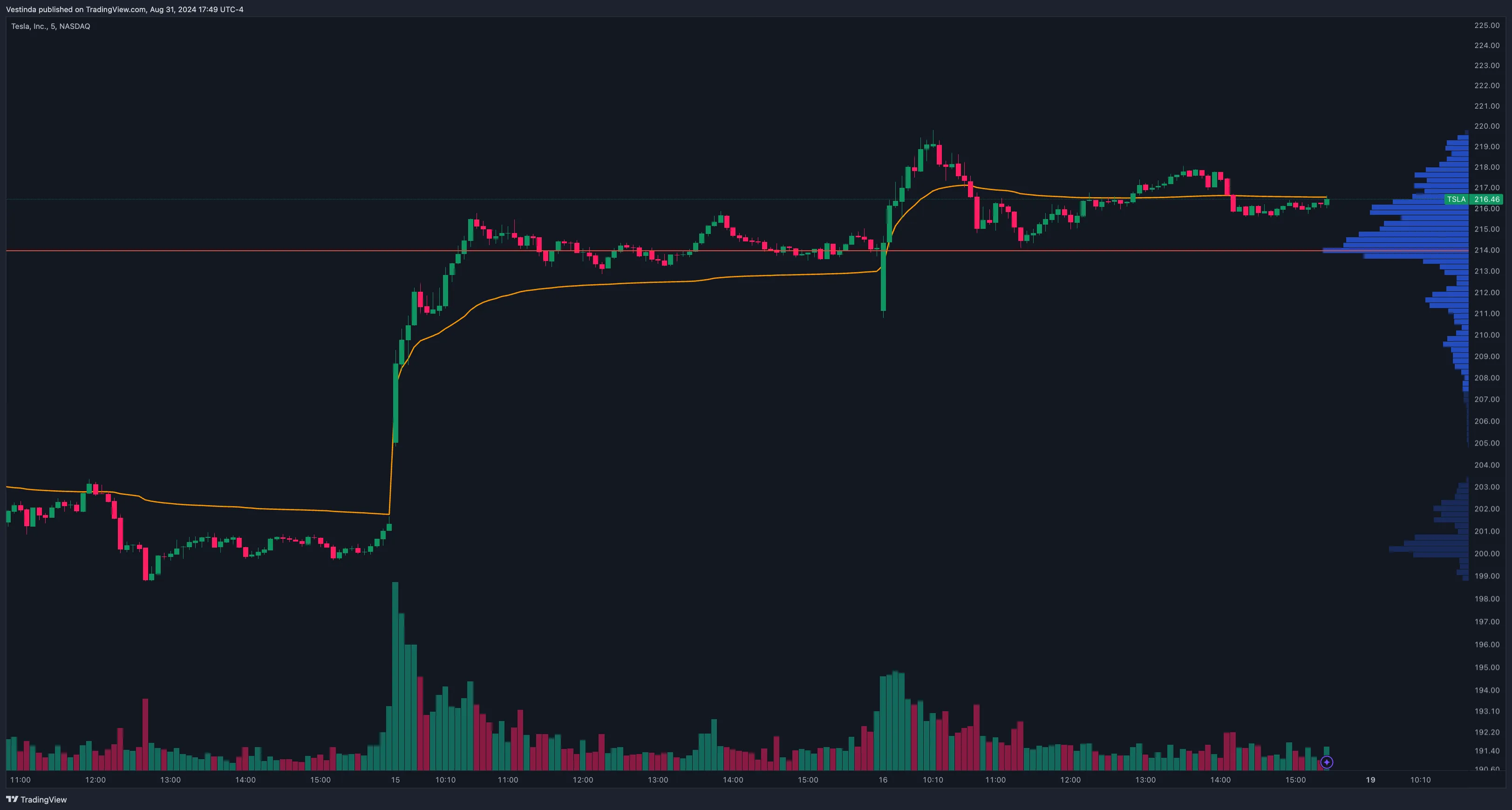
VWAP Scalping:
Concept: The Volume Weighted Average Price (VWAP) is a key indicator for intraday traders, showing the average price of TSLA weighted by volume throughout the day.
How to Implement:
- Indicator: Apply VWAP to your intraday chart (e.g., 1-minute or 5-minute).
- Entry and Exit: Buy TSLA when the price crosses above the VWAP and sell when it crosses below. This strategy is particularly effective when TSLA is trending strongly, allowing you to capture profits from short-term price movements.
Bollinger Bands Scalping:
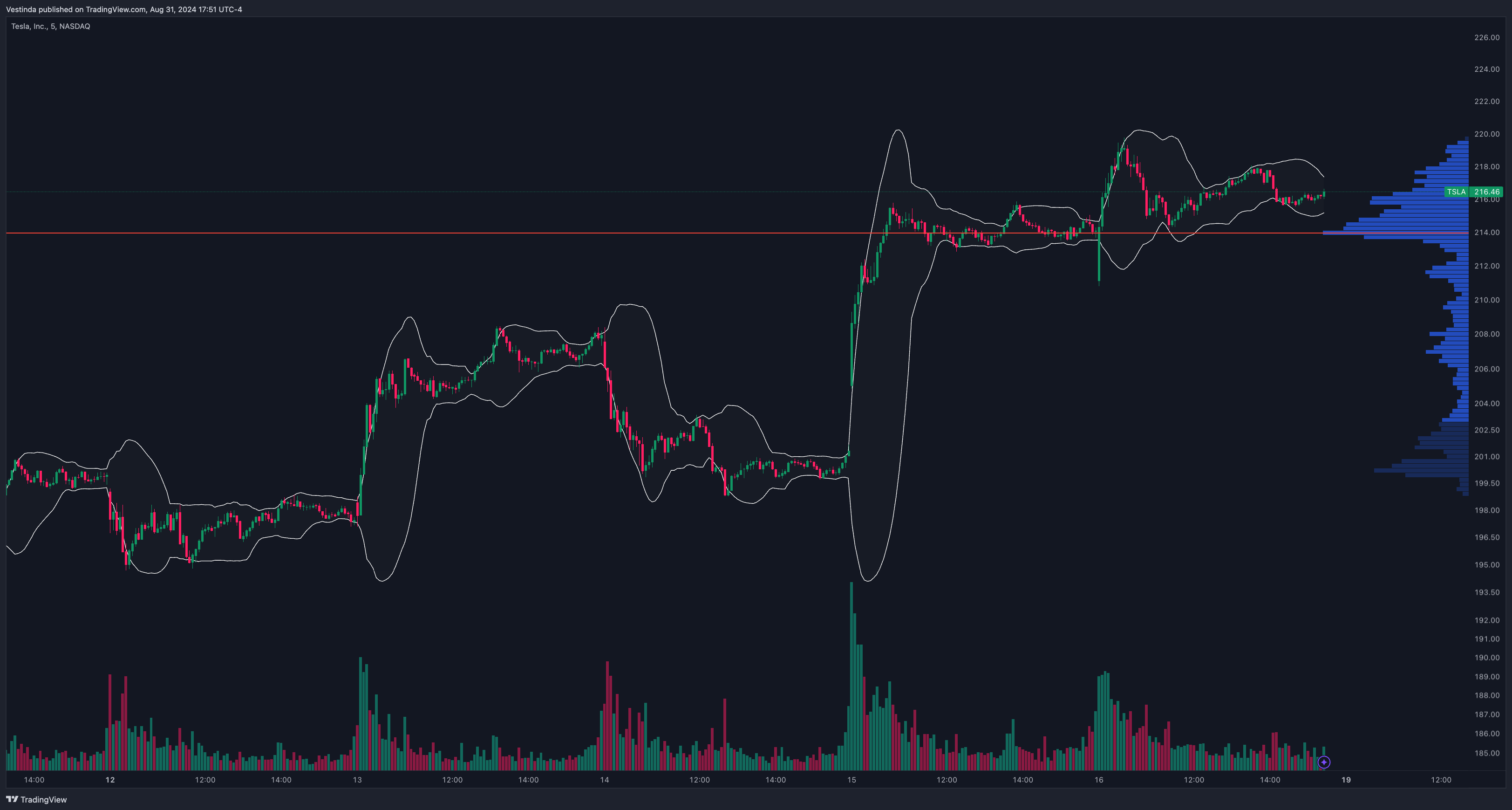
Concept: Use Bollinger Bands to identify overbought and oversold conditions in TSLA, providing entry points for scalping trades.
How to Implement:
- Indicators: Set Bollinger Bands on a 1-minute or 5-minute chart.
- Entry and Exit: Buy TSLA when the price touches or moves below the lower Bollinger Band and sell when it reaches the middle or upper band. Reverse for short positions.
- Tight Stop-Losses: Set tight stop-losses just outside the bands to protect against sudden reversals, ensuring that losses are minimized on losing trades.
Momentum Scalping:
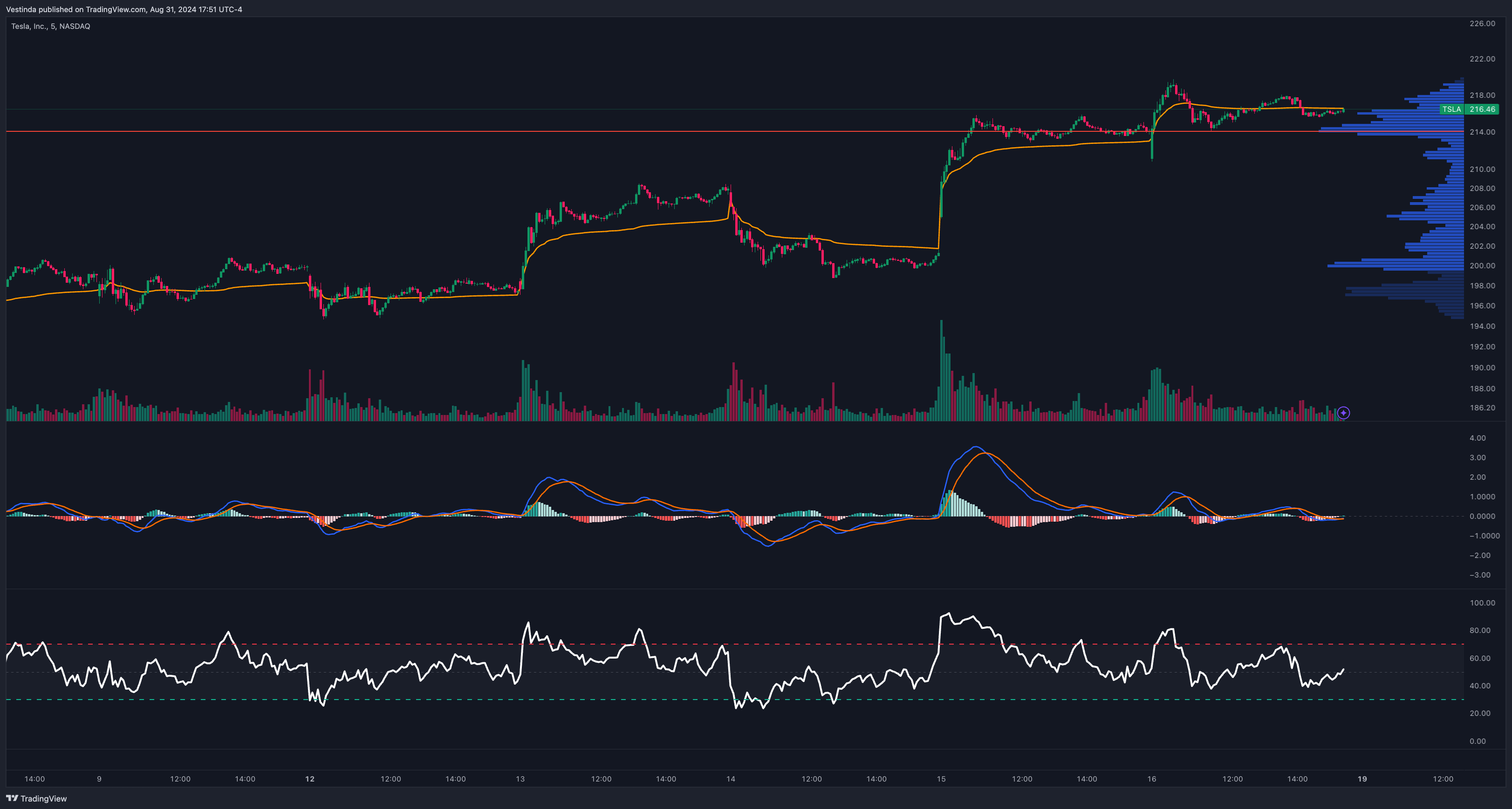
Concept: Take advantage of TSLA’s rapid price movements during high volatility periods by trading on momentum.
How to Implement:
- Indicators: Use the Relative Strength Index (RSI) and Moving Average Convergence Divergence (MACD) to gauge momentum.
- Entry and Exit: Enter trades when RSI and MACD confirm strong momentum in one direction. Exit when momentum begins to fade or when RSI indicates overbought or oversold conditions in TSLA.
Tools and Indicators for Successful TSLA Scalping:
Timeframes:
Why: Scalping requires analyzing very short timeframes, typically 1-minute or 5-minute charts, to identify quick opportunities.
How to Use: Monitor these charts closely for fast-moving setups that align with your chosen strategy.
Volume Analysis:
Why: Volume confirms the strength of price movements, which is crucial for validating scalping signals in a high-volatility stock like TSLA.
How to Use: Combine volume analysis with your primary indicators (e.g., VWAP, RSI) to ensure that price movements are supported by sufficient market activity.
Stop-Loss and Take-Profit Orders:
Why: Given the fast-paced nature of scalping, it’s essential to use stop-loss and take-profit orders to manage risk and lock in profits automatically.
How to Use: Set tight stop-losses just outside of your key levels (e.g., Bollinger Bands, VWAP) and use take-profit orders at predetermined levels to capture gains.
Risk Management for TSLA Scalping:
Position Sizing:
Concept: Due to TSLA’s high volatility, it’s crucial to carefully manage your position size to avoid excessive risk.
How to Implement: Use a small percentage of your trading capital for each trade (e.g., 1-2%) to minimize the impact of potential losses, especially given TSLA’s price swings.
Avoid Overtrading:
Concept: Scalping can be exhausting and may lead to overtrading, which can erode profits through increased transaction costs and emotional decision-making.
How to Implement: Set a daily trade limit and adhere to it, focusing on high-quality setups rather than frequent trading.
Monitoring Market Conditions:
Concept: TSLA’s performance is closely tied to broader market trends, news related to Tesla, and sentiment in the technology sector. Understanding these factors is crucial for effective scalping.
How to Implement: Regularly check economic indicators, tech sector news, and overall market sentiment to gauge potential impacts on TSLA’s price action.
Tech-driven TSLA Scalping Strategies
Leveraging technology, TSLA scalping bots have revolutionized trading strategies. These automated software programs capitalize on short-term price fluctuations. Using algorithms and high-speed execution, they exploit opportunities, making quick profits. TSLA scalping bots leverage real-time market data to identify patterns and execute trades instantly. They work relentlessly, scanning the market for discrepancies and arbitrage opportunities. With their lightning-fast processing power, TSLA scalping bots can execute a high volume of trades within milliseconds. Efficient execution and round-the-clock operation make these bots ideal for the fast-paced nature of the stock market. By leveraging technology, TSLA scalping bots streamline trading processes and maximize profitability in the ever-changing world of Tesla shares.
Navigating Evolving TSLA Scalping Strategies
Adapting to changing market conditions is crucial for success in TSLA scalping. Tesla, a dynamic and highly volatile stock, requires a nimble approach. Monitoring real-time data and staying informed about market news are key strategies. The ability to quickly react to shifts in the market is essential, as TSLA can experience rapid price movements. Implementing effective risk management techniques can help navigate these fluctuations. Traders must be flexible and ready to adjust their trading strategies accordingly. It is important to note that Tesla's performance is influenced by various factors, such as government policies, competition, and technological advancements. This necessitates staying up-to-date with industry trends and adapting to emerging opportunities. Ultimately, successful TSLA scalping requires a combination of agility, knowledge, and adaptability to navigate the ever-changing market conditions.
Indicators' Impact: TSLA Scalping Insights
Indicators play a crucial role in TSLA scalping, providing key insights for traders. Firstly, moving averages help identify the trend's direction, aiding in decision-making. Furthermore, oscillators, like the Relative Strength Index, detect overbought or oversold conditions, guiding optimal entry and exit points. Traders also rely on volume indicators to confirm price movements, ensuring accuracy. Additionally, Bollinger Bands help measure market volatility, allowing for efficient scalp trading strategies. Moreover, the use of Fibonacci retracement levels by scalpers helps identify potential reversal zones. Overall, indicators enable TSLA scalpers to analyze market conditions and execute successful trades with precision and confidence.
Sophisticated backtesting is not only possession of high-esteemed hedge funds anymore.
Impressive Team and support, Backtesting engine with detailed reports, The Strategy builder.

Great purchase!
I have always manually invested in stocks and cryptocurrencies, but after studying Vestinda, I must say it has enormous potential.

Mature platform for trading
Pro: Easy to use, Nice UX, A lot of customization for strategies, Back testing is an awesome tool, can check any strategy in history.

Frequently Asked Questions
To identify support and resistance levels in TSLA scalping, there are a few key techniques to consider. Firstly, traders can analyze historical price levels where TSLA has previously reversed direction. These areas can serve as both support and resistance. Secondly, using technical indicators like moving averages, trendlines, and Fibonacci retracement levels can help identify potential support and resistance areas. Additionally, monitoring significant news events or earnings releases that may impact TSLA's price can offer valuable insights into determining support and resistance levels. Finally, closely observing trading volumes can also indicate potential areas of support and resistance. Combining these techniques can enhance the accuracy of identifying support and resistance levels in TSLA scalping.
Yes, 5-minute scalping can be profitable. It is a short-term trading strategy that focuses on capturing small price movements within a tight time frame. Traders who have a good understanding of technical analysis, quick decision-making skills, and strict risk management can potentially generate profits from this strategy. However, it requires discipline, experience, and a deep understanding of the market dynamics. Traders should also be aware of the high trading costs, including spreads and commissions, that can impact profitability. Overall, with the right skills and approach, 5-minute scalping can be a profitable trading strategy.
Yes, it is possible to become wealthy through scalping in the financial markets. Scalping is a short-term trading strategy that aims to make quick profits from small price movements. By executing a large number of trades within a short time frame, successful scalpers can capitalize on these small price fluctuations. However, scalping requires a high level of skill, discipline, and access to advanced trading tools. It can be highly stressful and demanding. While it is possible to accumulate wealth through scalping, it is crucial to note that it also involves significant risks and requires continuous learning and adaptation.
To analyze candlestick patterns in TSLA scalping, one should first familiarize themselves with common patterns like doji, hammer, engulfing, and shooting star. These patterns can indicate potential reversals or continuations in price movement. Additionally, one should consider the context in which these patterns appear, such as support and resistance levels or trendlines. By combining these candlestick patterns with other technical indicators like moving averages or volume, traders can gain insights into potential entry and exit points for short-term scalping. It is crucial to conduct thorough research and practice before implementing candlestick analysis in TSLA scalping strategies.
The 5 8 13 21 EMA strategy is a trading strategy that uses four different exponential moving averages (EMAs) to identify potential buy or sell signals. The numbers represent the periods used for each EMA. When the shorter EMAs (5 and 8) cross above the longer EMAs (13 and 21), it generates a bullish signal indicating a potential buy opportunity. Conversely, when the shorter EMAs cross below the longer EMAs, it generates a bearish signal indicating a potential sell opportunity. Traders often use this strategy to gauge short-term momentum and identify possible trend reversals.
Conclusion
In conclusion, TSLA Scalping is a trading strategy that aims to capitalize on small price fluctuations in Tesla's stock, allowing traders to make quick profits. Leveraging technology and automated systems, such as TSLA scalping bots, has revolutionized the way traders execute this strategy. Adapting to the dynamic and volatile nature of Tesla's stock is crucial for success, and staying informed about market news and utilizing effective risk management techniques is essential. Indicators play a crucial role in TSLA scalping, providing traders with key insights and helping them make informed decisions. Ultimately, successful TSLA scalping requires agility, knowledge, and adaptability to navigate the ever-changing market conditions.

Successful traders rely on backtesting to be profitable.
Be like them with our
Free Backtesting Guide