
-
100,000 available assets New
-
years of historical data
-
practice without risking money

Quantitative Strategies & Backtesting results for SHIB
Here are some SHIB trading strategies along with their past performance. You can validate these strategies (and many more) for free on Vestinda across thousands of assets and many years of historical data.
Quantitative Trading Strategy: Long Term Investment on SHIB
Based on the backtesting results for a trading strategy from October 20, 2022, to October 20, 2023, the statistics reveal promising outcomes. The strategy exhibited a profit factor of 1.66, indicating a positive overall return. The annualized return on investment (ROI) stood at an impressive 10.01%, suggesting consistent growth throughout the period. On average, trades were held for approximately 1 week and 1 day, indicating a short-term trading approach. With an average of 0.07 trades per week, the strategy displayed a disciplined and selective trading method. The number of closed trades amounted to 4, highlighting a cautious approach with a focus on quality over quantity. The strategy demonstrated a winning trades percentage of 75%, further affirming its effectiveness. Additionally, when compared to a buy and hold approach, this strategy outperformed significantly, generating excess returns of 58.99%.

 SHIBUSDT

Choose another period and try again.
Quantitative Trading Strategy: Detrended Price Oscillations with Keltner Channel and Shadows on SHIB
The backtesting results for the trading strategy from October 20, 2022, to October 20, 2023, reveal a profit factor of 0.67, indicating that for every unit of risk taken, the strategy generated 0.67 units of profit. The annualized return on investment (ROI) stands at -33.77%, suggesting a negative performance over the specified period. On average, the strategy held positions for approximately 14 hours and 36 minutes before closing them. With an average of 2.37 trades per week, the strategy remained relatively active. It executed a total of 124 closed trades during the period, with a winning trades percentage of 20.97%. These statistics shed light on the performance and characteristics of the implemented trading strategy.
SHIBUSDT
Choose another period and try again.
SHIB (Shiba Inu) Arbitrage: Unleashing Lucrative Trading Opportunities
Introduction
Arbitrage trading offers a risk-minimized approach to profiting from price discrepancies across different markets or exchanges. For Shiba Inu (SHIB), these opportunities arise frequently due to its high trading volume and the fragmented nature of cryptocurrency exchanges. This guide explores effective arbitrage strategies for SHIB and how to capitalize on them efficiently.
What is Arbitrage Trading?
- Definition: Arbitrage involves buying SHIB at a lower price on one exchange and selling it at a higher price on another.
- Types of Arbitrage:
- Exchange Arbitrage: Exploiting price differences between exchanges.
- Spatial Arbitrage: Trading across exchanges in different regions.
- Triangular Arbitrage: Leveraging price differences between three trading pairs within the same exchange.
Why SHIB is Ideal for Arbitrage?
- High Volatility: Frequent price swings create consistent arbitrage opportunities.
- Wide Availability: Listed on multiple global exchanges with varying liquidity levels.
- High Trading Volume: Ensures faster execution and minimal slippage.
Effective SHIB Arbitrage Strategies:
1. Exchange Arbitrage:
Concept: Buy SHIB on a low-priced exchange and sell on a higher-priced exchange.
- Setup: Identify two exchanges with significant price differences for SHIB (e.g., Binance and Coinbase).
- Execution Rules:
- Monitor real-time SHIB prices using arbitrage tracking tools or APIs.
- Execute simultaneous buy and sell orders to lock in profits.
- Challenges:
- Account for withdrawal fees and network congestion affecting transfer times.
- Ensure both exchanges support fast settlements.
2. Triangular Arbitrage:
Concept: Exploit price discrepancies between three SHIB trading pairs within the same exchange.
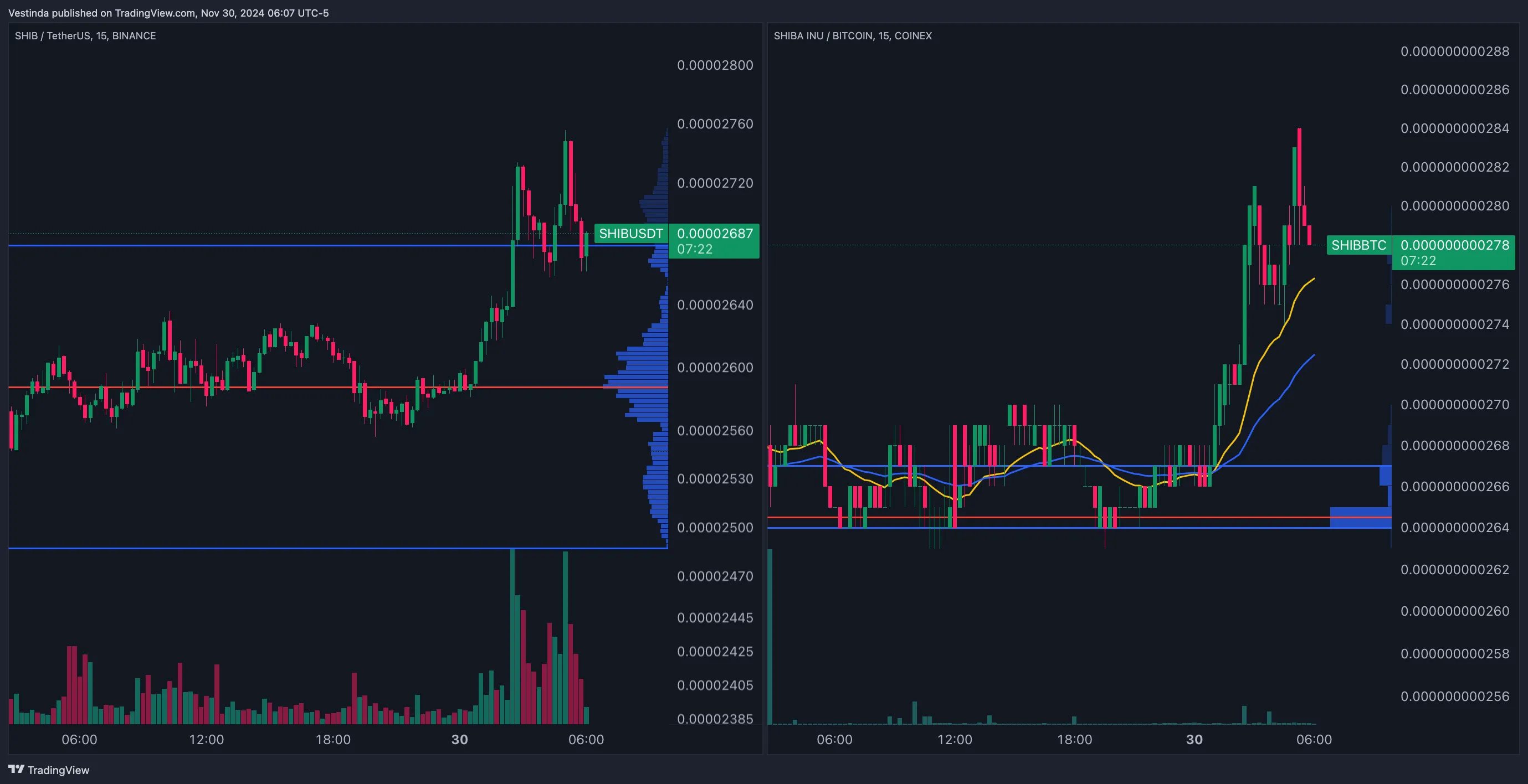
- Example: Trade SHIB/USDT, USDT/BTC, and BTC/SHIB on Binance / Bitfinex and CoinEx.
- Execution Rules:
- Identify inefficiencies in conversion rates between the pairs.
- Automate the process using bots to ensure precision and speed.
- Best For: Traders with experience in managing multiple order executions.
3. Statistical Arbitrage with AI Tools:
Concept: Use advanced algorithms to identify historical pricing inefficiencies for SHIB.
- Setup: Employ AI-driven platforms to analyze data trends across exchanges.
- Execution Rules:
- Set predefined conditions for entry and exit based on statistical models.
- Use bots for executing trades quickly when conditions are met.
- Enhancement: Combine with volume-weighted indicators for higher accuracy.
4. Spot and Futures Arbitrage:
Concept: Profit from price differences between SHIB’s spot and futures markets.
- Setup: Identify significant price gaps between SHIB spot price and futures contracts on exchanges like Binance Futures.
- Execution Rules:
- Go long on SHIB in the spot market and short in the futures market when futures price exceeds the spot price.
- Close positions when the price gap narrows.
- Best For: Traders comfortable with leveraged instruments.
Tools for SHIB Arbitrage:
- Price Tracking Tools: Use platforms like CoinMarketCap or CoinGecko for real-time price comparisons.
- Arbitrage Bots: Automate trades with bots that monitor price differences and execute trades.
- Advanced Charting: Analyze historical price spreads using TradingView.
Risk Management in Arbitrage Trading:
- Monitor Fees: Include transaction fees, withdrawal costs, and network charges in your calculations.
- Limit Transfer Delays: Use exchanges with fast processing times to reduce risks of price movements during transfers.
- Diversify Exchanges: Spread your capital across multiple exchanges to access opportunities quickly.
Challenges of SHIB Arbitrage:
- Slippage: Price changes during execution may reduce profitability.
- Liquidity Issues: Some exchanges may not have sufficient SHIB liquidity for large trades.
- Regulatory Hurdles: Be aware of regional restrictions that may affect your ability to transfer funds or trade.
Conclusion:
Arbitrage trading provides a low-risk way to profit from SHIB’s dynamic market. By leveraging strategies like exchange arbitrage, triangular setups, and spot-futures arbitrage, traders can maximize returns while managing risks effectively. Employing automation tools and monitoring real-time market data ensures efficiency and precision in execution.
Mastering SHIB Trading with Arbitrage: Step-by-Step
- Identify exchanges with different prices for SHIB.
- Calculate the potential profit by buying low on one exchange and selling high on another.
- Register and verify accounts on both exchanges.
- Deposit funds into both exchange accounts.
- Buy SHIB at the lower-priced exchange and transfer it to the higher-priced exchange.
- Sell SHIB at the higher-priced exchange and withdraw the funds.
SHIB Arbitrage: Real-life Profitable Scenarios
Arbitrage trading involves capitalizing on price discrepancies between different markets. With SHIB crypto, a trader can execute arbitrage by buying SHIB from one venue and selling it at a higher price on another. For instance, the trader might buy SHIB from a centralized exchange like Binance and then sell it on a decentralized exchange like Uniswap. The key is to act swiftly as prices can change rapidly, necessitating the use of automated bots or algorithms.
To execute this arbitrage strategy, the trader should first identify the price difference between the two venues. Once a suitable arbitrage opportunity is found, the trader can use their automated bot to simultaneously buy SHIB from Binance and sell it on Uniswap. The efficiency and speed of the bot are crucial in taking advantage of the price discrepancy before it levels out. By capitalizing on these opportunities, traders can generate profits by exploiting price inefficiencies within the SHIB market.
Liquidity Impact on SHIB Arbitrage Opportunities
Liquidity plays a crucial role in determining the success of SHIB arbitrage opportunities. In a highly liquid market, trading volume is high, and there is a tight spread between buy and sell prices. This allows arbitrageurs to execute quick trades, taking advantage of price differences across multiple exchanges. However, in a low-liquidity market, trading volume is limited, and the spread between buy and sell prices widens. This makes it difficult for arbitrageurs to quickly buy and sell SHIB at favorable prices. As a result, the potential profits from arbitrage diminish. Additionally, low liquidity increases the risk of slippage, where the execution price of a trade differs from the expected price due to market fluctuations. Therefore, having a good understanding of liquidity conditions is essential for those seeking profitable SHIB arbitrage opportunities.
Synergizing SHIB Analysis: Technical-Fundamental Arbitrage
Combining Technical and Fundamental Analysis in SHIB Arbitrage:
To effectively exploit arbitrage opportunities in the SHIB market, a combination of technical and fundamental analysis is crucial. Technical analysis involves studying price charts and indicators to identify patterns and trends. By examining support and resistance levels, moving averages, and other technical tools, traders can gauge the market sentiment and make informed decisions.
On the other hand, fundamental analysis focuses on evaluating the intrinsic value of an asset by examining its underlying factors. In the case of SHIB, factors such as project development, partnerships, and overall market sentiment towards meme tokens play a role.
By combining these two approaches, traders can gain a more comprehensive understanding of the SHIB market and increase their chances of profiting from arbitrage opportunities. Technical analysis provides short-term insights, while fundamental analysis offers a broader perspective on the token's potential.
Sophisticated backtesting is not only possession of high-esteemed hedge funds anymore.
Impressive Team and support, Backtesting engine with detailed reports, The Strategy builder.

Great purchase!
I have always manually invested in stocks and cryptocurrencies, but after studying Vestinda, I must say it has enormous potential.

Mature platform for trading
Pro: Easy to use, Nice UX, A lot of customization for strategies, Back testing is an awesome tool, can check any strategy in history.

Frequently Asked Questions
Liquidity providers play a crucial role in SHIB arbitrage by ensuring the availability of assets required for trading. They provide the necessary liquidity on various platforms, allowing traders to swiftly execute transactions and take advantage of price differences. Without liquidity providers, SHIB arbitrage would be challenging due to limited supply and increased slippage. By maintaining a healthy supply-demand balance, liquidity providers minimize market inefficiencies and promote price stability. Their impact on SHIB arbitrage is vital as they facilitate smooth and efficient trading while enhancing overall market liquidity and functionality.
Sentiment analysis tools analyze public sentiment and emotions surrounding a particular topic. While sentiment analysis can provide valuable insights into market trends and consumer behavior, it may not be directly applicable to identifying SHIB arbitrage opportunities. Arbitrage involves exploiting price discrepancies between different markets, which typically requires real-time market data and precise execution. Sentiment analysis may indirectly inform market sentiment towards SHIB, but it is not a standalone tool for identifying arbitrage opportunities. Other financial analysis tools and strategies are more suitable for arbitrage trading.
Arbitrage trading is relatively common among sophisticated investors and professional traders in financial markets. It involves exploiting price disparities between different markets or assets to make risk-free profits. While difficult to measure precisely, arbitrage opportunities are typically short-lived due to high market efficiency and the presence of algorithmic trading. Moreover, intense competition and advances in technology have made it challenging for individual traders to consistently capitalize on these discrepancies. Nevertheless, large institutional investors and hedge funds continue to engage in arbitrage trading as part of their investment strategies.
Yes, you can use market-making strategies in SHIB arbitrage. Market-making involves providing liquidity to the market by simultaneously placing buy and sell orders at different price levels. In SHIB arbitrage, you can employ market-making strategies by taking advantage of price discrepancies across different exchanges or trading pairs to buy low and sell high. By continuously monitoring and adjusting your orders, you can profit from the price spreads and contribute to the efficiency of the SHIB market. However, it is important to consider the risks involved and ensure proper risk management strategies are in place.
Arbitrage trading is challenging due to various factors. Firstly, it requires identifying price discrepancies across different markets in real-time, which demands monitoring numerous sources simultaneously. Additionally, executing trades swiftly is crucial as prices can quickly adjust, minimizing profit opportunities. Furthermore, arbitrage opportunities are fleeting and highly competitive, attracting experienced traders and sophisticated algorithms. Market regulations, transaction costs, and liquidity constraints also hinder arbitrage trading. Lastly, efficient markets tend to have minimal price discrepancies, reducing arbitrage opportunities. Overall, successfully engaging in arbitrage trading requires expertise, technological capabilities, and continuous monitoring to overcome these difficulties.
Conclusion
In conclusion, SHIB Arbitrage is an exciting opportunity for cryptocurrency traders to take advantage of price discrepancies across different exchanges. By buying SHIB at a lower price on one exchange and selling it at a higher price on another, traders can generate profits. To execute this strategy effectively, traders can rely on automated bots or algorithms to act swiftly and capitalize on the price differences. However, liquidity plays a crucial role in determining the success of SHIB arbitrage opportunities, and combining technical and fundamental analysis is essential to identify profitable opportunities. By understanding market conditions and analyzing the intrinsic value of SHIB, traders can increase their chances of success in SHIB arbitrage.

Successful traders rely on backtesting to be profitable.
Be like them with our
Free Backtesting Guide