
Imagine having a financial toolkit that grows your wealth and secures your future—this is what an investment portfolio offers. An investment portfolio is a collection of various assets, such as stocks, bonds, real estate, and cash, tailored to meet specific financial goals and risk tolerance.
In this article, we’ll explore the fundamentals of an investment portfolio and how it works. We’ll delve into the types of assets commonly included, the principles of diversification, and the strategies for balancing risk and return.
We’ll provide tips on how to build and manage your portfolio effectively. Whether you’re a beginner or looking to refine your investment approach, understanding the mechanics of an investment portfolio is crucial for financial success in 2024 and beyond.
Article summary
What is an investment portfolio?
An investment portfolio is your collection of investments, like a toolbox for your financial goals. It can hold stocks, bonds, cash, and even real estate. The mix depends on how much risk you’re comfortable with and how long you’ll invest. Imagine a balanced portfolio like a sturdy building with a mix of materials (stocks, bonds, etc.) for strength and stability. You build it to grow your wealth over time.
How do investment portfolios work?
Investment portfolios work by combining various asset classes to achieve specific financial goals while managing risk. The primary objective is to diversify investments to balance risk and reward according to an investor’s risk tolerance, time horizon, and financial objectives.
When constructing a portfolio, an investor or financial advisor selects assets based on the desired asset allocation, which is the percentage of the portfolio invested in each asset class. For example, a conservative portfolio might have a higher allocation to bonds and cash equivalents, while an aggressive portfolio might focus more on stocks.
Start earning 60% a year with automated trading Free Sign UpDiversification is a key principle in portfolio management. By spreading investments across different asset classes, sectors, and geographic regions, the portfolio can reduce the impact of poor performance in any single investment. This approach helps in smoothing returns over time and mitigating risks.
Portfolios are managed actively or passively. Active management involves regular buying and selling of assets to outperform the market, relying on research and market timing. Passive management, on the other hand, involves investing in index funds or ETFs that track a market index, aiming to match market performance.
Regular monitoring and rebalancing of the portfolio are crucial. As the values of different assets change, rebalancing ensures that the portfolio maintains its intended asset allocation, thereby aligning with the investor’s risk tolerance and financial goals.
Types of investment portfolio
Let’s have a look at the types of investment portfolios:
Growth portfolio
A growth portfolio focuses on capital appreciation by investing in high-growth stocks, such as technology companies and startups with significant potential for rapid expansion. These stocks typically reinvest their profits into the business rather than paying dividends, aiming to increase their market value over time.
This type of portfolio is suitable for investors with a high risk tolerance and a long-term investment horizon, as it can be more volatile compared to other types of portfolios. The goal is to achieve substantial returns through significant price increases, but it also comes with the risk of considerable losses if the companies do not perform as expected. Diversifying across various sectors and companies can help mitigate some risks while maximizing growth potential.
How to Build a Growth Portfolio Aligned with Your Risk Profile
Assess Your Risk Profile for Growth Investing
Understand your risk tolerance and capacity. High-growth investments are volatile, so ensure you’re comfortable with potential short-term losses and have a long-term outlook (5+ years).
Define Your Growth Investment Goals
Clarify your objectives, such as capital appreciation and long-term wealth building. Ensure these goals align with your tolerance for risk and your investment horizon.
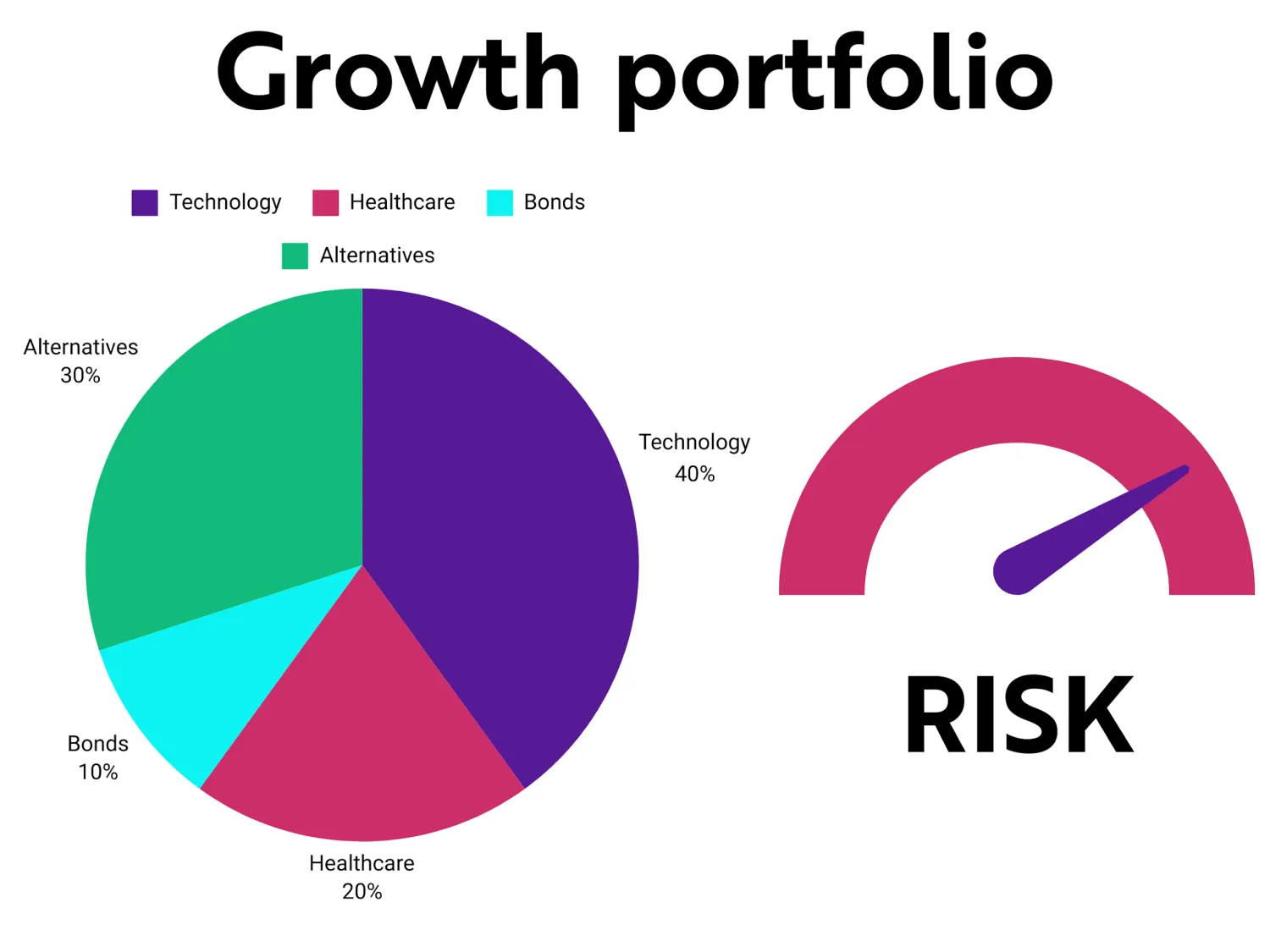 Determine Appropriate Asset Allocation:
1. Tech (40%): Focus on high-growth technology stocks:
- Apple Inc. (AAPL): A leading technology company with a robust ecosystem.
- Microsoft Corporation (MSFT): Dominant in software and cloud computing.
- NVIDIA Corporation (NVDA): A key player in graphics processing units (GPUs) and AI technology.
- Amazon.com Inc. (AMZN): E-commerce giant with significant cloud computing operations (AWS).
- Alphabet Inc. (GOOGL): Parent company of Google, strong in digital advertising and AI.
2. Alternatives (30%): Diversify with alternatives like venture capital, private equity, or real estate:
- Blackstone Group Inc. (BX): Leading alternative asset manager with investments in private equity, real estate, and more.
- Brookfield Asset Management Inc. (BAM): Global alternative asset manager with a focus on real estate, renewable energy, and infrastructure.
- Realty Income Corporation (O): REIT specializing in commercial real estate with monthly dividend payments.
- Carlyle Group Inc. (CG): Global investment firm focusing on private equity, real estate, and credit.
- Kkr & Co. Inc. (KKR): Another prominent investment firm in private equity and alternative assets.
3. Health (20%): Focus on high-growth healthcare stocks:
- Johnson & Johnson (JNJ): Diversified healthcare products and pharmaceuticals.
- Pfizer Inc. (PFE): Major pharmaceutical company with a strong pipeline.
- UnitedHealth Group Incorporated (UNH): Leading provider of healthcare services.
- Thermo Fisher Scientific Inc. (TMO): Key player in life sciences and laboratory equipment.
- Moderna Inc. (MRNA): Biotechnology company focused on mRNA vaccines and therapeutics.
4. Bonds (10%): Consider high-yield bonds for added stability:
- iShares iBoxx $ High Yield Corporate Bond ETF (HYG): Provides exposure to high-yield corporate bonds.
- SPDR Bloomberg Barclays High Yield Bond ETF (JNK): Another option for diversified high-yield bond exposure.
- Vanguard High-Yield Corporate Fund (VWEHX): A mutual fund option with a focus on high-yield corporate bonds.
Diversify Within the Growth Portfolio
Manage risk by spreading investments across various sectors, geographies, and company sizes (large-cap, mid-cap, and small-cap).
Regular Monitoring and Rebalancing
Periodically review and adjust your portfolio to maintain your desired asset mix and ensure it aligns with your risk profile and goals.
Income portfolio
An income portfolio prioritizes generating regular income through investments that provide consistent dividends or interest payments. Common components of an income portfolio include dividend-paying stocks, bonds, real estate investment trusts (REITs), and other income-generating assets.
This type of portfolio is ideal for investors seeking steady cash flow, such as retirees or those requiring supplemental income. Dividend-paying stocks are typically from well-established companies with a history of stable earnings. Bonds, including government and corporate bonds, offer periodic interest payments. REITs provide exposure to real estate markets with regular dividend payouts. While income portfolios focus on income generation, they also offer potential for capital appreciation, though generally with lower risk and return expectations compared to growth portfolios.
How to Build an Income Portfolio Aligned with Your Risk Profile
Assess Your Risk Profile: Determine your risk tolerance and capacity, considering your need for regular income and ability to withstand potential market fluctuations. Typically, income portfolios are suited for moderate to low-risk tolerance investors.
Define Your Investment Goals: Clarify your objectives, such as generating a stable income stream, preserving capital, and achieving modest capital appreciation. Align these goals with your overall financial plan and time horizon.
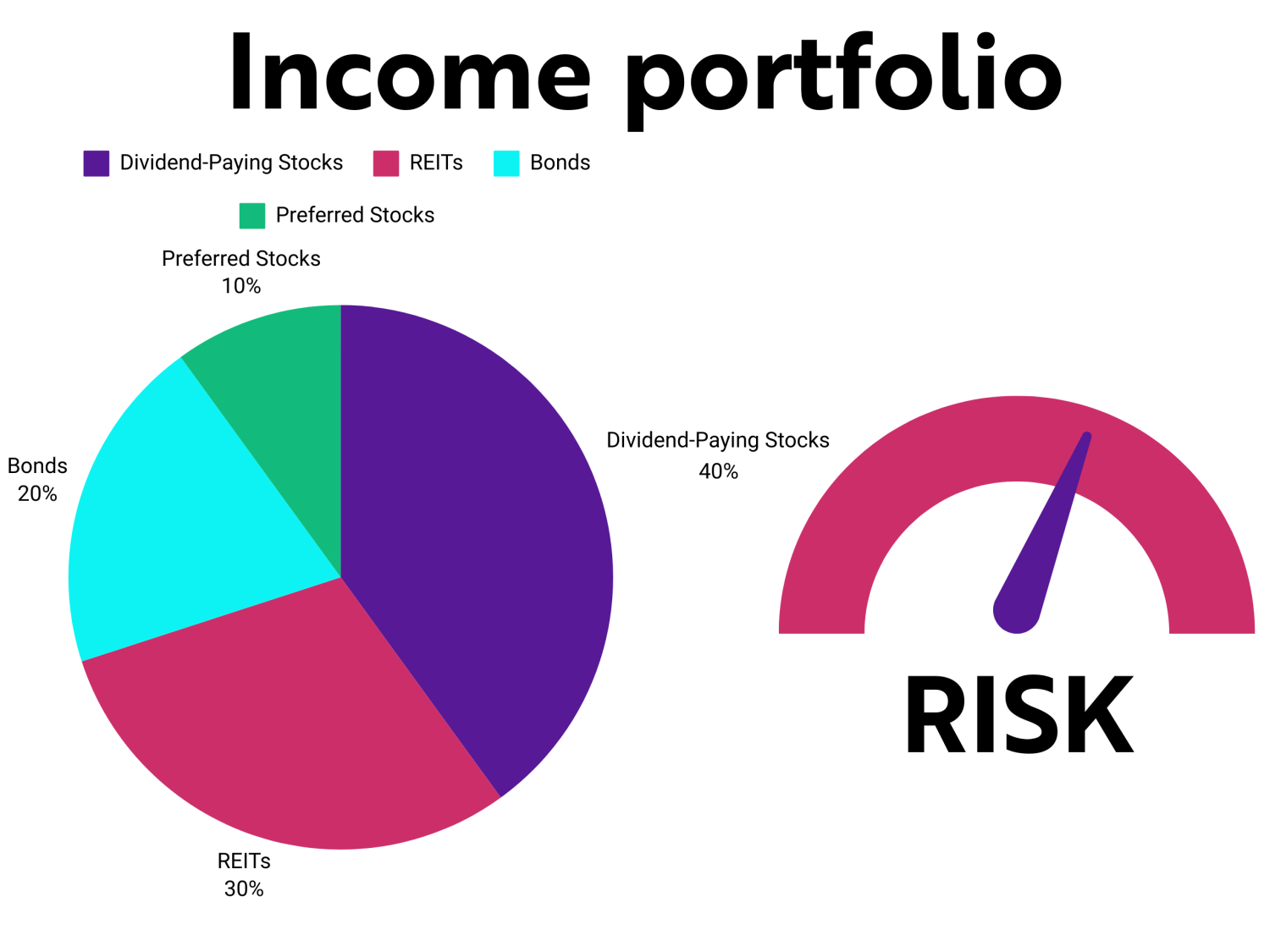 Determine Appropriate Asset Allocation:
For an income portfolio, the focus is on generating consistent cash flow while preserving capital. Here’s a suggested asset allocation:
1. Dividend-Paying Stocks (40%): Prioritize stocks with a history of paying reliable dividends.
- Procter & Gamble Co. (PG): A consumer goods giant known for steady dividend growth.
- Johnson & Johnson (JNJ): Offers consistent dividends in the healthcare sector.
- Coca-Cola Co. (KO): A staple in consumer beverages with a strong dividend history.
- AT&T Inc. (T): Provides dividends through its telecommunications and media operations.
- PepsiCo Inc. (PEP): Another solid choice in consumer staples with reliable dividend payments.
2. Real Estate Investment Trusts (REITs) (30%): Focus on income-generating properties.
- Realty Income Corporation (O): Known as the “Monthly Dividend Company,” specializing in commercial real estate.
- Vanguard Real Estate ETF (VNQ): Provides exposure to a diversified portfolio of REITs.
- Simon Property Group Inc. (SPG): A leading retail REIT with strong dividend payouts.
- Digital Realty Trust, Inc. (DLR): Focuses on data center properties with steady income streams.
- Public Storage (PSA): Specializes in self-storage facilities with consistent dividends.
3. Bonds (20%): Include a mix of government and corporate bonds for income and stability.
- iShares iBoxx Investment Grade Corporate Bond ETF (LQD): Invests in high-quality corporate bonds.
- Vanguard Total Bond Market ETF (BND): Offers broad exposure to U.S. investment-grade bonds.
- SPDR Bloomberg Barclays High Yield Bond ETF (JNK): Provides a higher yield from corporate bonds.
- Treasury Inflation-Protected Securities (TIPS): Protects against inflation while providing regular income.
- Vanguard Intermediate-Term Corporate Bond ETF (VCIT): Focuses on intermediate-term investment-grade bonds.
4. Preferred Stocks (10%): Offer higher yields and priority over common stocks in dividends.
- iShares Preferred and Income Securities ETF (PFF): A broad exposure to preferred stocks.
- SPDR Wells Fargo Preferred Stock ETF (PSK): Another diversified preferred stock option.
- Vanguard Preferred Stock Fund (VPRSX): A mutual fund focusing on preferred stocks with regular income.
- Preferred Bank (PFBC): A specific bank stock known for issuing preferred shares.
- Bank of America Corp. (BAC): Offers preferred shares with attractive yields.
Diversify Within the Income Portfolio: Spread investments across various sectors and asset classes to mitigate risk and enhance income stability. For instance, diversify among different types of bonds (e.g., government, corporate) and stocks from various industries.
Regular Monitoring and Rebalancing: Periodically review and adjust your portfolio to ensure it remains aligned with your risk profile and income goals. This involves monitoring the performance of your investments and making necessary adjustments to maintain the desired asset allocation.
Balanced Portfolio
A balanced portfolio aims to strike a middle ground between growth and income, providing both capital appreciation and regular income. It typically includes a mix of stocks, bonds, and other assets. The stocks provide growth potential, while bonds and income-generating assets, such as dividend-paying stocks or real estate investment trusts (REITs), offer stability and regular income.
This diversification helps reduce risk by spreading investments across various asset classes, which can perform differently under the same market conditions. Balanced portfolios are ideal for investors seeking moderate growth with less volatility compared to an all-stock portfolio. They are well-suited for those with a medium risk tolerance, often appealing to individuals in the middle stages of their investment journey or those approaching retirement.
How to Build a Balanced Portfolio Aligned with Your Risk Profile
Assess Your Risk Profile: Understand your risk tolerance and capacity. Balanced portfolios are suitable for medium risk tolerance, as they offer moderate growth with less volatility compared to an all-stock portfolio.
Define Your Investment Goals: Clearly outline your objectives, such as achieving moderate growth, generating income, and preserving capital. Ensure these goals align with your overall financial plan and investment horizon, often suited for those in the middle stages of their investment journey or approaching retirement.
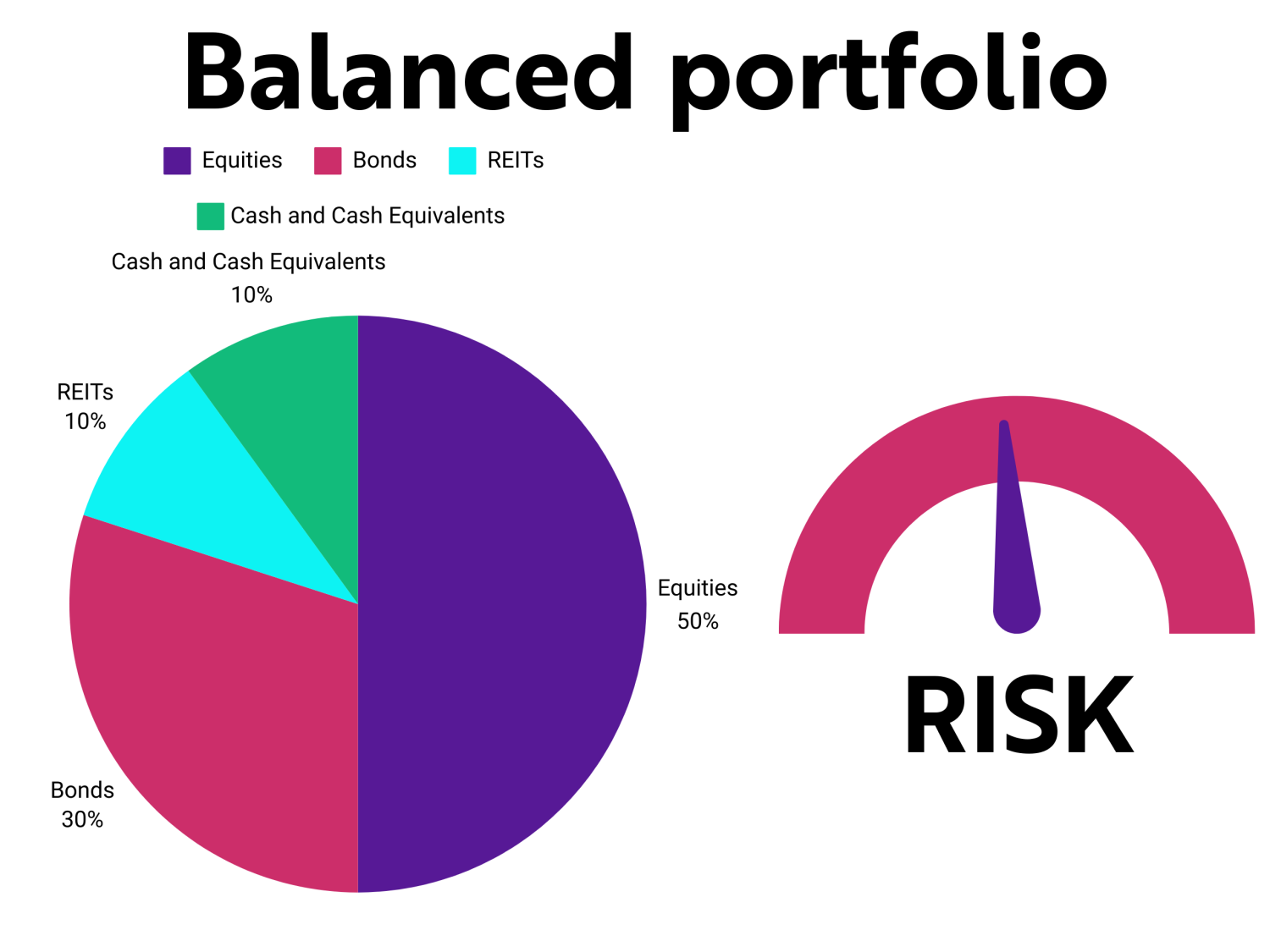 Determine Appropriate Asset Allocation:
A balanced portfolio aims to provide a mix of growth and income with moderate risk. Here’s a suggested asset allocation:
1. Equities (50%): Split between growth and dividend-paying stocks for potential appreciation and income.
- Apple Inc. (AAPL): A strong growth stock with consistent performance in technology.
- Procter & Gamble Co. (PG): A stable consumer goods company with reliable dividends.
- Microsoft Corporation (MSFT): Offers growth potential in software and cloud computing.
- Johnson & Johnson (JNJ): Provides both stability and income in the healthcare sector.
- Vanguard Total Stock Market ETF (VTI): Broad exposure to the entire U.S. stock market.
2. Bonds (30%): Include a mix of government and corporate bonds for income and reduced volatility.
- iShares iBoxx $ Investment Grade Corporate Bond ETF (LQD): Invests in high-quality corporate bonds.
- Vanguard Total Bond Market ETF (BND): Offers a broad range of U.S. investment-grade bonds.
- iShares U.S. Treasury Bond ETF (GOVT): Focuses on U.S. Treasury securities for stability.
- PIMCO Income Fund (PONAX): A diversified bond fund providing regular income.
- Vanguard Intermediate-Term Corporate Bond ETF (VCIT): Covers intermediate-term corporate bonds.
3. Real Estate Investment Trusts (REITs) (10%): Provide income and potential for appreciation through real estate.
- Vanguard Real Estate ETF (VNQ): Diversified exposure to REITs, offering income and growth.
- Realty Income Corporation (O): Known for monthly dividend payments from commercial properties.
- Simon Property Group Inc. (SPG): A major retail REIT with strong income potential.
- American Tower Corporation (AMT): Focuses on telecommunications infrastructure, offering growth and dividends.
- Digital Realty Trust, Inc. (DLR): Specializes in data center properties with a steady income stream.
4. Cash and Cash Equivalents (10%): Maintain liquidity and stability.
- Vanguard Prime Money Market Fund (VMMXX): A money market fund offering liquidity and safety.
- iShares Short Treasury Bond ETF (SHV): Focuses on short-term U.S. Treasury securities.
- Fidelity Government Cash Reserves (FDRXX): A money market fund providing a safe place to park cash.
- SPDR Bloomberg Barclays 1-3 Month T-Bill ETF (BIL): Invests in very short-term U.S. Treasury bills.
- Vanguard Ultra-Short-Term Bond ETF (VUSB): Offers a balance of income and stability with very short-duration bonds.
Diversify Within the Balanced Portfolio: Spread investments across various sectors and asset classes to mitigate risk. Diversification helps reduce the impact of poor performance in any single investment or asset class.
Regular Monitoring and Rebalancing: Periodically review and adjust your portfolio to ensure it remains aligned with your risk profile and investment goals. This involves assessing the performance of your investments and making necessary adjustments to maintain your desired asset allocation.
Aggressive portfolio
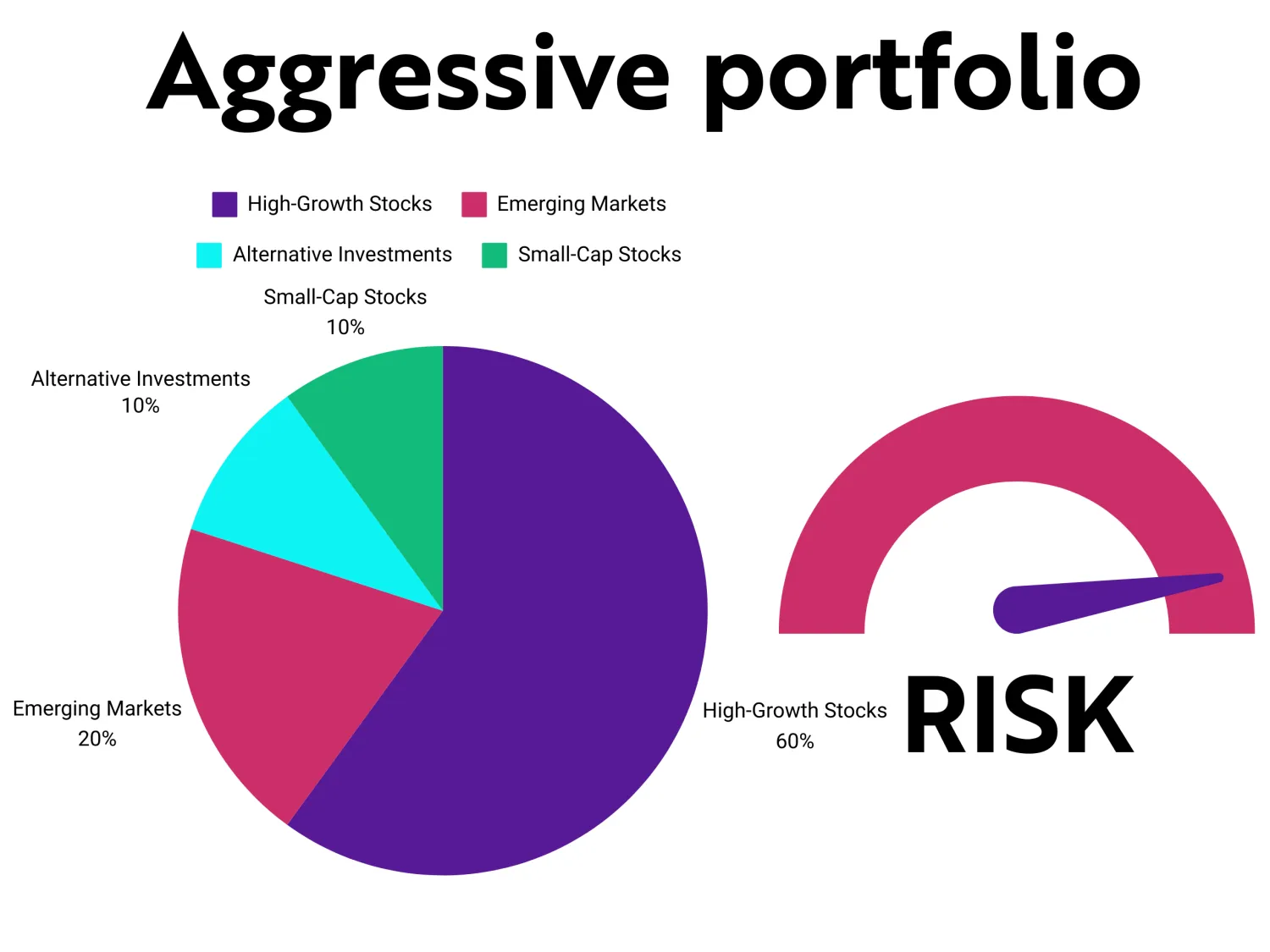
An aggressive portfolio is designed for investors seeking high returns by taking on higher levels of risk. This type of portfolio is heavily weighted towards equities, including growth stocks, small-cap stocks, and emerging markets, which have the potential for significant capital appreciation. Aggressive portfolios may also include high-yield bonds and alternative investments like venture capital or cryptocurrency.
The primary goal is rapid growth, but this comes with increased volatility and the potential for substantial losses. Aggressive portfolios are best suited for investors with a high risk tolerance, long investment horizon, and the financial capacity to withstand short-term market fluctuations. These investors are typically younger, allowing them time to recover from any downturns and benefit from the compounding growth over the long term.
How to Build an Aggressive Portfolio Aligned with Your Risk Profile
Assess Your Risk Profile: Determine your risk tolerance and capacity. Aggressive portfolios are suitable for investors with a high risk tolerance who can handle significant volatility and potential losses. Consider your financial situation, investment knowledge, and ability to stay calm during market downturns.
Define Your Investment Goals: Clearly outline your objectives, such as rapid capital growth and maximizing returns. Align these goals with your long-term financial plan, ensuring you have a long investment horizon, typically 10+ years, to benefit from market recoveries and compounding growth.
 Determine Appropriate Asset Allocation:
An aggressive portfolio is designed for investors willing to take on higher risk in pursuit of greater returns, often focusing on equities and alternative investments. Here’s a suggested asset allocation:
1. High-Growth Stocks (60%): Focus on companies with strong growth potential, often in technology and innovative sectors.
- Tesla Inc. (TSLA): A leader in electric vehicles and renewable energy.
- NVIDIA Corporation (NVDA): Key player in GPUs and AI technology.
- Amazon.com Inc. (AMZN): Dominates e-commerce and cloud computing services.
- Alphabet Inc. (GOOGL): Parent company of Google, excelling in digital advertising and AI.
- Zoom Video Communications Inc. (ZM): A major player in video communication technology.
2. Emerging Markets (20%): Invest in fast-growing economies for higher potential returns.
- iShares MSCI Emerging Markets ETF (EEM): Provides exposure to large and mid-cap companies in emerging markets.
- Vanguard FTSE Emerging Markets ETF (VWO): Covers a broad range of companies in developing economies.
- Alibaba Group Holding Ltd. (BABA): A leading e-commerce and tech company in China.
- Tencent Holdings Ltd. (TCEHY): A major Chinese internet and technology conglomerate.
- Samsung Electronics Co., Ltd. (SSNLF): A leading player in electronics and technology in South Korea.
3. Alternative Investments (10%): Include non-traditional assets like private equity, commodities, and cryptocurrencies.
- Grayscale Bitcoin Trust (GBTC): Provides exposure to Bitcoin, a major cryptocurrency.
- SPDR Gold Shares (GLD): Offers a way to invest in gold, a traditional hedge against market volatility.
- Brookfield Asset Management Inc. (BAM): Focuses on real estate, infrastructure, and renewable energy investments.
- ARK Innovation ETF (ARKK): Invests in disruptive technologies and innovative companies.
- Carlyle Group Inc. (CG): A global investment firm specializing in private equity and alternative assets.
4. Small-Cap Stocks (10%): Invest in smaller companies with high growth potential, albeit higher risk.
- iShares Russell 2000 ETF (IWM): Provides exposure to a broad range of small-cap U.S. stocks.
- Vanguard Small-Cap Growth ETF (VBK): Focuses on small-cap stocks with strong growth characteristics.
- SPDR S&P 600 Small Cap Growth ETF (SLYG): Targets small-cap companies expected to grow faster than the overall market.
- PennyMac Financial Services Inc. (PFSI): A smaller financial services company in the U.S. mortgage market.
- Planet Fitness, Inc. (PLNT): A rapidly growing chain of fitness centers.
Diversify Within the Aggressive Portfolio: Spread investments across various sectors, industries, and geographies to mitigate risk. Diversification helps reduce the impact of poor performance in any single investment.
Regular Monitoring and Rebalancing: Periodically review and adjust your portfolio to ensure it remains aligned with your risk profile and investment goals. Market conditions can change rapidly, so staying informed and making necessary adjustments is crucial for maintaining your desired asset allocation.
Conservative portfolio
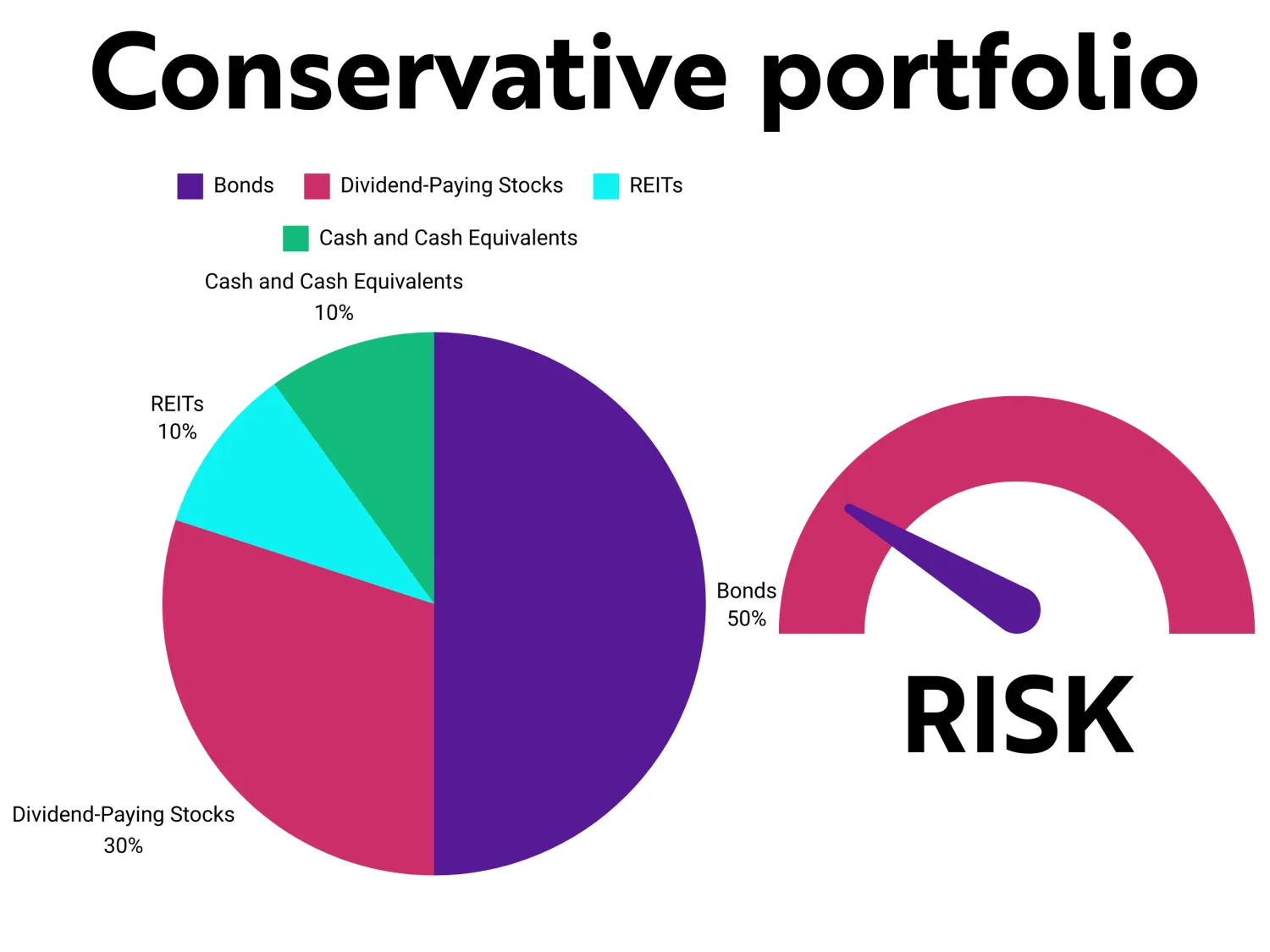
A conservative portfolio prioritizes capital preservation and stable returns, making it ideal for investors with a low risk tolerance or those nearing retirement. This type of portfolio typically includes a higher allocation of high-quality bonds, such as government and investment-grade corporate bonds, which provide regular interest payments and are less volatile.
Also, it includes blue-chip stocks—large, established companies with strong financials and a history of stable dividends. The conservative approach aims to minimize risk and protect principal while generating modest, consistent returns. This strategy suits those who prioritize safety over growth and seek to maintain their investment’s value while earning a steady income.
How to Build a Conservative Portfolio Aligned with Your Risk Profile
Assess Your Risk Profile: Understand your low risk tolerance and capacity for handling market fluctuations. Conservative portfolios are suitable for investors who prioritize capital preservation and stable income over high returns, often including retirees or those nearing retirement.
Define Your Investment Goals: Clearly outline your objectives, such as preserving capital, generating steady income, and maintaining investment value. Align these goals with your overall financial plan, focusing on safety and stability rather than aggressive growth.
 Determine Appropriate Asset Allocation:
A conservative portfolio prioritizes capital preservation and income over growth, making it suitable for risk-averse investors. Here’s a suggested asset allocation:
1. Bonds (50%): Focus on high-quality bonds to provide steady income and lower volatility.
- Vanguard Total Bond Market ETF (BND): Offers broad exposure to U.S. investment-grade bonds.
- iShares U.S. Treasury Bond ETF (GOVT): Invests in U.S. Treasury securities, providing safety and stability.
- Vanguard Intermediate-Term Corporate Bond ETF (VCIT): Focuses on intermediate-term corporate bonds with reliable returns.
- PIMCO Total Return Fund (PTTRX): A well-known bond fund with a diverse portfolio.
- iShares iBoxx $ Investment Grade Corporate Bond ETF (LQD): Invests in high-quality corporate bonds.
2. Dividend-Paying Stocks (30%): Prioritize stocks with a strong history of paying dividends for steady income.
- Procter & Gamble Co. (PG): A stable consumer goods company known for consistent dividends.
- Johnson & Johnson (JNJ): Offers reliable dividends in the healthcare sector.
- Coca-Cola Co. (KO): A staple in the consumer sector with a strong dividend track record.
- Verizon Communications Inc. (VZ): Provides dividends through its telecommunications services.
- AT&T Inc. (T): A major telecommunications company with a focus on dividend payouts.
3. Real Estate Investment Trusts (REITs) (10%): Provide income through property investments.
- Vanguard Real Estate ETF (VNQ): Offers broad exposure to U.S. REITs.
- Realty Income Corporation (O): Known for its monthly dividend payments from commercial real estate.
- Public Storage (PSA): Specializes in self-storage facilities with consistent income.
- Simon Property Group Inc. (SPG): A leading retail REIT offering strong dividends.
- W.P. Carey Inc. (WPC): Focuses on diverse property types with steady income.
4. Cash and Cash Equivalents (10%): Maintain liquidity and preserve capital.
- Vanguard Prime Money Market Fund (VMMXX): A money market fund offering liquidity and safety.
- iShares Short Treasury Bond ETF (SHV): Focuses on short-term U.S. Treasury securities.
- Fidelity Government Cash Reserves (FDRXX): Provides a safe place to park cash with minimal risk.
- SPDR Bloomberg Barclays 1-3 Month T-Bill ETF (BIL): Invests in very short-term U.S. Treasury bills.
- Vanguard Ultra-Short-Term Bond ETF (VUSB): Offers income with low duration risk.
Diversify Within the Conservative Portfolio: Spread investments across various sectors and asset classes to mitigate risk. Diversification helps protect your portfolio from poor performance in any single investment, ensuring more stable returns.
Regular Monitoring and Rebalancing: This involves monitoring the performance of your investments and making necessary adjustments to maintain your desired asset allocation.
An example of an investment portfolio can be illustrated through a scenario involving a 35-year-old professional named Sarah. Sarah is keen on building her wealth for retirement, which she plans for in 30 years, and has a moderate risk tolerance.
Sarah’s diversified investment portfolio includes:
- 60% in Stocks: To capture growth, Sarah invests in a mix of individual stocks and exchange-traded funds (ETFs) that span various sectors such as technology, healthcare, and consumer goods. This portion aims for higher returns, understanding that it comes with higher volatility.
- 20% in Bonds: To balance the volatility of stocks, Sarah allocates 20% to bonds. This includes government bonds and corporate bonds, providing a steady stream of income and reducing overall portfolio risk.
- 10% in Real Estate: Sarah invests in a real estate investment trust (REIT), giving her exposure to real estate without the need to manage properties directly. This investment provides potential income from rental properties and long-term appreciation.
- 5% in Commodities: To hedge against inflation and diversify further, Sarah includes a small portion in commodities like gold and silver ETFs.
- 5% in Cash or Cash Equivalents: Sarah maintains 5% of her portfolio in a high-yield savings account or money market funds to ensure liquidity for emergencies or new investment opportunities.
This diversified portfolio balances growth and income while managing risk, aligning with Sarah’s long-term financial goals and moderate risk tolerance. By regularly reviewing and rebalancing her portfolio, Sarah can adjust her investments to remain aligned with her financial objectives and market conditions.
What does a good portfolio look like?
A good investment portfolio is well-diversified, balancing risk and return to achieve long-term financial goals. It typically includes a mix of asset classes such as stocks, bonds, real estate, and cash equivalents.
For example, a balanced portfolio might allocate 60% to stocks for growth potential, 30% to bonds for stability and income, and 10% to real estate and other assets for diversification. Each component serves a specific purpose: stocks for capital appreciation, bonds for income and risk mitigation, and real estate for inflation protection.
A good portfolio is regularly reviewed and rebalanced to maintain its desired risk level and to adapt to changing market conditions and personal financial goals. This strategic diversification helps in managing risk and optimizing returns over time.
What is the best portfolio for beginners?
For beginners, a balanced portfolio is ideal, combining growth potential with stability.
 This typically includes a mix of:
- Stocks (50-60%): Large-cap and mid-cap stocks or equity mutual funds/ETFs for growth.
- Bonds (30-40%): Government and high-quality corporate bonds for stability and income.
- Cash and Cash Equivalents (10-20%): Savings accounts or money market funds for liquidity and safety.
This mix helps beginners benefit from stock market growth while reducing risk with bonds and cash. Diversification across asset classes and sectors mitigates risk, and regular contributions and rebalancing ensure the portfolio remains aligned with financial goals. Beginners should also focus on low-cost index funds or ETFs to keep fees low and simplify the investment process.

Ebiere Watchman is a prolific writer specialized in web 3.0 and finance. Ebiere’s experience includes research projects, sales copywriting, and storytelling. She prides herself in crafting impeccable content to drive mass adoption in cryptocurrency.