
-
100,000 available assets New
-
years of historical data
-
practice without risking money

Automated Strategies & Backtesting results for SOL
Here are some SOL trading strategies along with their past performance. You can validate these strategies (and many more) for free on Vestinda across thousands of assets and many years of historical data.
Automated Trading Strategy: Lock and keep profits on SOL
Based on the backtesting results statistics for the trading strategy conducted from February 26, 2021, to December 17, 2023, the strategy has shown promising performance. With a profit factor of 1.9 and an annualized return on investment (ROI) of 272.43%, it has outperformed the market significantly. On average, the strategy held positions for approximately 6 weeks and 5 days and executed trades at a frequency of 0.05 trades per week. Out of 8 closed trades, 50% were winners. The return on investment reached an impressive 756.75%. Moreover, compared to a buy and hold strategy, it generated excess returns of 59.47%, making it a favorable option for maximizing profits in the given time period.

 SOLUSDT

Choose another period and try again.
Automated Trading Strategy: Follow the trend on SOL
The backtesting results for the trading strategy, spanning from November 18, 2020, to December 8, 2023, indicate promising statistics. The profit factor stands at 2.04, highlighting a favorable return on investment. The annualized return on investment impressively reaches 949.03%, indicating substantial growth over the testing period. On average, positions were held for a week, and there were 0.37 trades per week, showcasing a patient and calculated approach. The number of closed trades totaled 60, showcasing a reasonably active strategy. Notably, the winning trades percentage stood at 31.67%, suggesting a selective, cautious approach to capturing profitable opportunities. Overall, these backtesting results offer an optimistic outlook for this trading strategy.
SOLUSDT
Choose another period and try again.
SOL (Solana) Arbitrage: Looking for Profits with High-Speed Transactions
Introduction
Solana (SOL) has revolutionized blockchain technology with its unparalleled speed and low transaction costs, making it a prime candidate for arbitrage trading. Arbitrage, the practice of profiting from price differences across markets, becomes even more efficient with Solana's lightning-fast transactions. This guide explores how to leverage Solana’s blockchain for arbitrage opportunities, strategies to maximize profits, and tools to streamline the process.
Why Solana is Perfect for Arbitrage
- High-Speed Transactions: Solana processes up to 65,000 transactions per second, ensuring timely execution of arbitrage trades.
- Low Fees: Transaction costs on Solana are fractions of a cent, allowing for more profitable trades.
- Broad Market Presence: SOL is listed on numerous centralized and decentralized exchanges, increasing arbitrage opportunities.
Core Arbitrage Strategies for Solana
1. Exchange-to-Exchange Arbitrage
Concept: Capitalize on price differences for SOL between two exchanges.
Example:
- Buy SOL on Exchange A at $20 and sell it on Exchange B at $20.50.
- Profit: $0.50 per SOL, minus transaction fees.
Tip: Use exchanges with fast deposit/withdrawal options and low fees for optimal results.
2. Triangular Arbitrage
Concept: Exploit price discrepancies among three currency pairs within the same exchange.
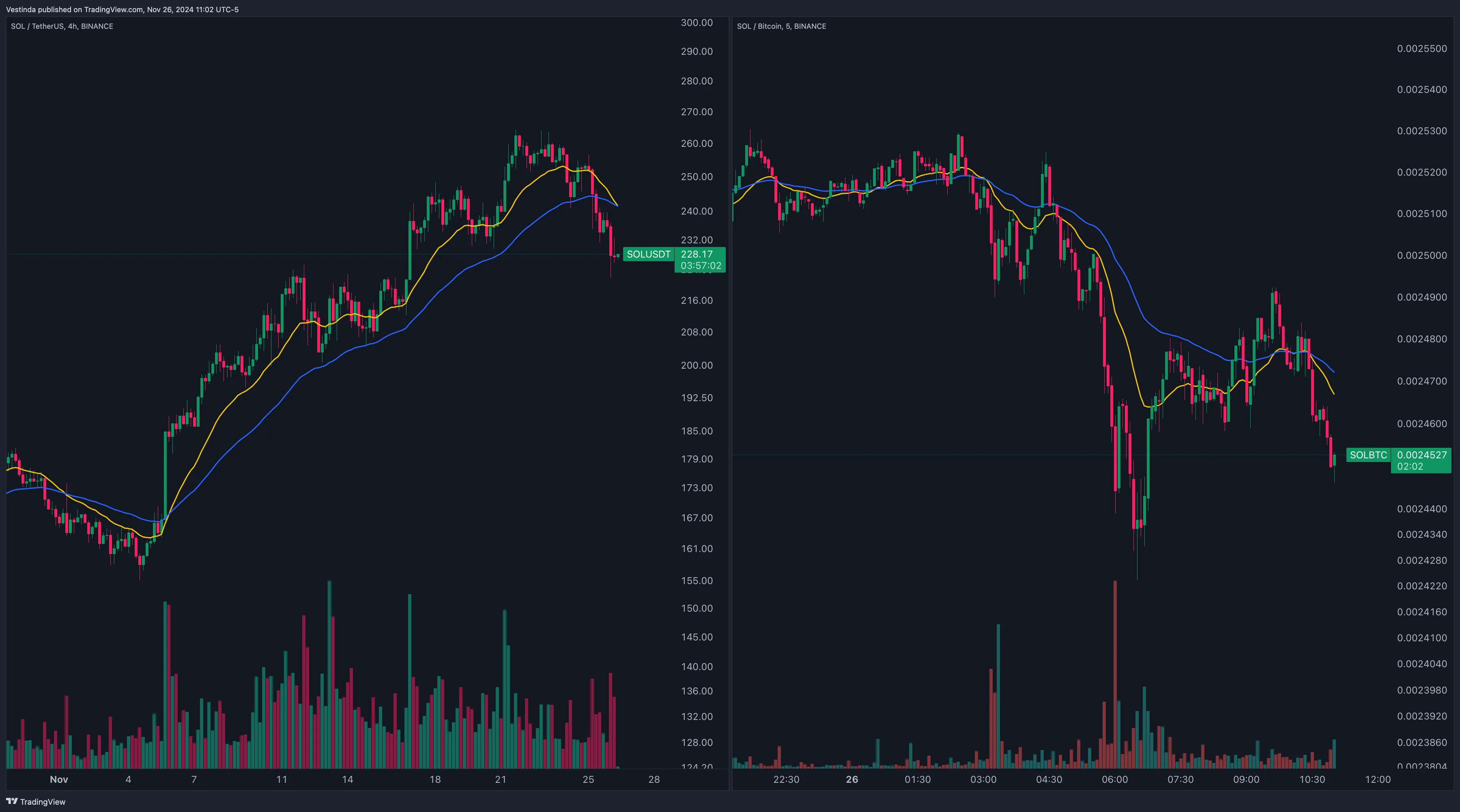
Example:
- Trade SOL/USDT → USDT/BTC → SOL/BTC.
- Profit from misaligned exchange rates among the pairs.
Optimization Tip: Monitor pairs with high liquidity for quicker execution.
3. DeFi Arbitrage
Concept: Use decentralized exchanges (DEXs) on Solana’s blockchain to identify price gaps between liquidity pools.
Example:
- Swap SOL for USDC on one DEX and USDC back to SOL on another for a net profit.
Tip: Factor in slippage and liquidity pool fees when calculating potential profits.
Tools for Arbitrage on Solana
1. Arbitrage Bots
Automate price tracking and trade execution to capitalize on fleeting opportunities.
Examples: Hummingbot, custom Python scripts with Solana APIs.
2. Price Tracking Platforms
Use tools like CoinMarketCap or TradingView to monitor SOL prices across multiple platforms.
3. DeFi Dashboards
Platforms like Raydium or Orca provide real-time data on Solana-based liquidity pools for DeFi arbitrage opportunities.
Challenges and Solutions in Solana Arbitrage
1. Network Congestion
Challenge: During peak demand, transaction speeds may slow slightly.
Solution: Use wallets and exchanges that prioritize Solana transactions.
2. Tight Price Gaps
Challenge: Price differences across exchanges are often small due to market efficiency.
Solution: Use high-speed bots to capitalize on micro-arbitrage opportunities.
3. Fees and Slippage
Challenge: Unexpected costs can eat into profits.
Solution: Include all fees and potential slippage in your calculations before executing trades.
Maximizing Arbitrage Profits with Solana
1. Leverage Stablecoins
Pair SOL with stablecoins like USDC or USDT to reduce volatility during arbitrage trades.
2. Optimize Transfer Times
Use Solana-compatible wallets with instant transfer capabilities to minimize delays.
3. Diversify Across Platforms
Monitor both centralized and decentralized exchanges for a broader range of arbitrage opportunities.
4. Backtest Strategies
Test arbitrage setups on historical data to refine execution and improve profitability.
Conclusion
Solana’s high-speed, low-cost blockchain has redefined the possibilities for arbitrage trading. By employing strategies like exchange-to-exchange arbitrage, triangular setups, and DeFi opportunities, and leveraging Solana’s unique capabilities, traders can unlock consistent profits. With the right tools and risk management practices, Solana arbitrage becomes a powerful strategy for navigating the cryptocurrency market.
SOL Trading: Mastering Arbitrage Techniques Step-by-Step
- Research the current market prices of SOL across different exchanges.
- Identify price discrepancies, where there is a significant difference in SOL's price on different exchanges.
- Transfer funds to the exchange with the lower price for SOL.
- Purchase SOL at the lower price on the chosen exchange.
- Transfer the purchased SOL to the exchange with the higher price.
- Sell the transferred SOL at the higher price, making a profit from the price difference.
SOL Arbitrage Showcase
Arbitrage trading involves capitalizing on price discrepancies between different markets or exchanges. For instance, let's consider SOL CRYPTO, which refers to the cryptocurrency Solana. To execute an arbitrage trade with SOL, a trader would need to identify two venues where they can buy and sell SOL tokens at different prices simultaneously. By moving swiftly, the trader can exploit this price difference for profit.
To illustrate, let's assume the trader identifies Venue A selling SOL at $40 and Venue B buying SOL at $42. In this scenario, the trader would swiftly buy SOL from Venue A at a lower price and sell it on Venue B to make a profit. Given the time-sensitive nature of arbitrage trading, it is crucial to utilize automated bots or algorithms. These tools can monitor multiple exchanges in real-time, identify price discrepancies, and execute trades faster than human traders, maximizing profit potential. Consequently, swift decision-making and leveraging automation are indispensable in arbitrage trading, particularly in the highly volatile world of cryptocurrencies like Solana.
SOL Fundamental Analysis: Unlocking Arbitrage Opportunities
Fundamental Analysis in SOL Arbitrage Trading:
Fundamental analysis plays a crucial role in SOL arbitrage trading. It involves assessing the intrinsic value of SOL by examining its underlying factors. Traders evaluate the project's team, technology, market trends, and potential competitors to make informed trading decisions. By analyzing the project's whitepaper, roadmap, and partnerships, traders gain insights into its long-term potential. They also consider macroeconomic factors, regulatory environments, and industry news that may impact SOL's price. Understanding these fundamental aspects allows traders to identify pricing discrepancies between different exchanges. By leveraging these discrepancies, traders can exploit profitable arbitrage opportunities. However, it is important to note that fundamental analysis should be complemented with technical analysis for a comprehensive trading strategy in SOL arbitrage.
SOL Arbitrage: Leveraging Options and Derivatives
Utilizing options and derivatives in SOL arbitrage can provide traders with additional opportunities for profit.
Options allow traders to purchase the right to buy or sell SOL at a predetermined price, offering flexibility and risk management.
Derivatives, such as futures contracts, enable traders to speculate on SOL's future price movements without owning the underlying asset.
These tools can be used to hedge risks, increase leverage, and amplify returns, enhancing arbitrage strategies.
By carefully analyzing SOL's price movements and market trends, traders can identify arbitrage opportunities and execute trades swiftly.
Options and derivatives enable traders to take advantage of price discrepancies between different exchanges, exploiting inefficiencies in the market.
-
Track your
Crypto Portfolio -
Copy Crypto trading
strategies -
Build trading strategies
with no code
-
Backtest trading strategies
on Crypto, Forex, Stocks, etc. -
Demo Trading
Risk-free Paper Trading -
Automate trading strategies
with Live Trading
Frequently Asked Questions
Sentiment analysis can be a useful tool for identifying potential SOL arbitrage opportunities. By analyzing social media posts, news articles, and other sources of market sentiment, it becomes possible to gauge investor sentiment towards SOL and detect potential discrepancies between sentiment and market prices. However, sentiment analysis alone may not be sufficient for executing profitable arbitrage trades, as other factors such as liquidity, transaction costs, and market conditions also play crucial roles. Therefore, while sentiment analysis can provide valuable insights, it should be combined with a comprehensive analysis of market dynamics for successful SOL arbitrage.
Yes, stop-loss orders can be utilized for risk management in SOL arbitrage. By placing stop-loss orders, traders can automatically sell their positions if the price of SOL reaches a predetermined level, thus limiting potential losses. These orders help mitigate risks associated with sudden market fluctuations or unpredictable events. However, it is important to carefully determine appropriate stop-loss thresholds in order to avoid triggering unnecessary trades due to normal volatility.
Spot arbitrage in SOL refers to the practice of simultaneously buying and selling SOL in different markets to take advantage of price discrepancies. It involves immediate settlement and requires traders to hold SOL before executing trades. On the other hand, futures arbitrage involves exploiting price differences between the spot market and SOL futures contracts. Traders can buy SOL in the spot market and simultaneously sell SOL futures contracts, or vice versa, to profit from the price gaps. Unlike spot arbitrage, futures arbitrage allows traders to avoid physically holding SOL and settle contracts at a later date, enabling them to exploit price differences over time.
Day trading refers to a trading strategy where individuals buy and sell financial instruments, such as stocks, commodities, or currencies, within the same trading day. Day traders take advantage of short-term price fluctuations and aim to profit from the intraday volatility in the markets. These traders rely on various technical analysis tools and indicators to identify opportunities for short-term trades. Day trading requires close monitoring of the markets and quick decision-making to execute trades. It is considered a high-risk, high-reward approach to trading, as profits can be made, but losses can also mount rapidly.
Conclusion
In conclusion, SOL (Solana) Arbitrage presents a lucrative opportunity for traders to capitalize on price discrepancies within the Solana cryptocurrency. By executing arbitrage trading strategies, traders can buy SOL at a lower price on one exchange and sell it at a higher price on another, maximizing their returns. To successfully engage in SOL Arbitrage, traders must conduct thorough research, utilize automated tools such as arbitrage bots, and stay updated on market trends and news. Additionally, incorporating fundamental analysis, options, and derivatives can further enhance profit potential and risk management in SOL Arbitrage trading.

Successful traders rely on backtesting to be profitable.
Be like them with our
Free Backtesting Guide