






Quantitative Strategies & Backtesting results for SHIB
Here are some SHIB trading strategies along with their past performance. You can validate these strategies (and many more) for free on Vestinda across thousands of assets and many years of historical data.
Quantitative Trading Strategy: Ride the clouds on SHIB
Based on the backtesting results for the trading strategy from October 20, 2022, to October 20, 2023, several key statistics were observed. The profit factor of the strategy stood at 0.76, indicating a relatively low profitability. The annualized return on investment (ROI) was computed at -12.3%, implying a negative performance over the specified period. On average, the holding time for trades lasted approximately 1 day and 14 hours, with an average of 0.55 trades executed per week. The total number of closed trades counted 29, out of which only 24.14% were winning trades. Despite the negative ROI, the strategy outperformed the buy and hold strategy, generating excess returns of 26.37%.

 SHIBUSDT

Choose another period and try again.
Quantitative Trading Strategy: VWAP and KAMA Confirmation on SHIB
Based on the backtesting results statistics for the trading strategy from May 10, 2021, to October 20, 2023, several key metrics stand out. The profit factor is 1.62, indicating that for every unit of risk taken, the strategy generated 1.62 units of profit. The annualized return on investment (ROI) is an impressive 113.35%, suggesting the strategy has been highly profitable over this period. The average holding time for trades is approximately 6 days and 1 hour, with an average of 0.33 trades per week. With 43 closed trades, the winning trades percentage is 20.93%. Notably, the strategy outperformed the buy and hold approach, generating excess returns of 1557.46%. Overall, these backtesting results exhibit strong performance and validate the efficacy of the trading strategy.
SHIBUSDT
Choose another period and try again.
SHIB (Shiba Inu) Swing Trading Strategies for Profit
Introduction
Swing trading is a strategic approach that allows traders to capitalize on medium-term price movements in volatile markets like Shiba Inu (SHIB). By combining technical analysis and well-defined entry and exit rules, swing traders can maximize profits while managing risks. This guide outlines effective swing trading strategies tailored for SHIB.
Why Swing Trade Shiba Inu?
- High Volatility: SHIB’s price fluctuations create frequent opportunities for swing traders.
- Short to Medium-Term Gains: Ideal for capturing moves over days or weeks.
- 24/7 Market Access: SHIB’s always-on trading environment suits flexible strategies.
Core Swing Trading Strategies for SHIB:
1. Trend-Following with Moving Averages:
Concept: Identify and trade SHIB’s prevailing trend using exponential moving averages (EMAs).
- Setup: Apply a 20-period EMA (short-term) and a 100-period EMA (medium-term).
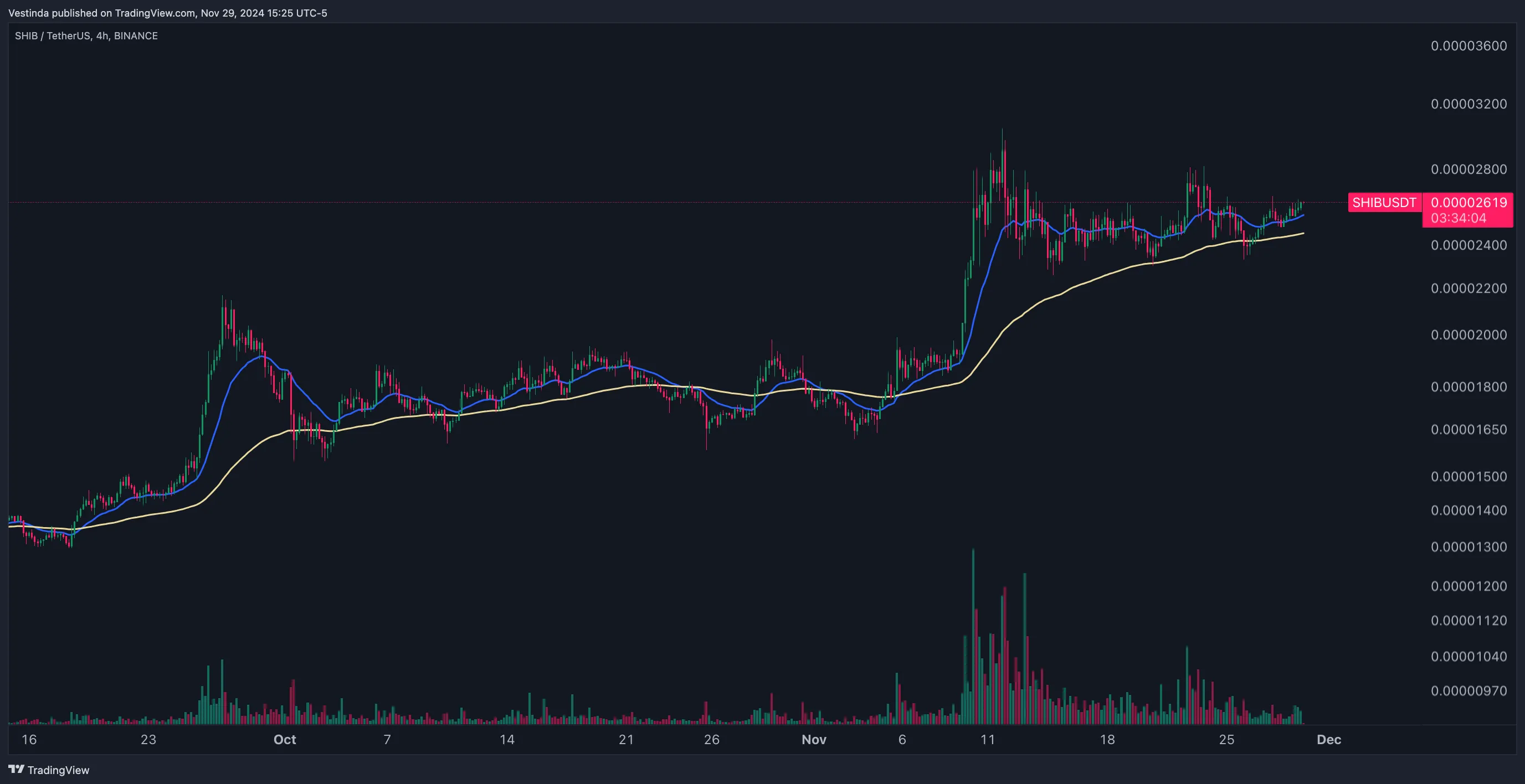
- Execution Rules:
- Buy Signal: Enter long when the 20 EMA crosses above the 100 EMA, and SHIB’s price stays above both.
- Sell Signal: Exit when the 20 EMA crosses below the 100 EMA or price dips below the 100 EMA.
- Enhancement: Combine with MACD for momentum confirmation.
2. Reversal Trading with RSI and Candlestick Patterns:
Concept: Trade SHIB reversals at overbought or oversold levels using RSI and candlestick patterns.
- Setup: Use RSI (14) to identify overbought (>70) and oversold (<30) zones.
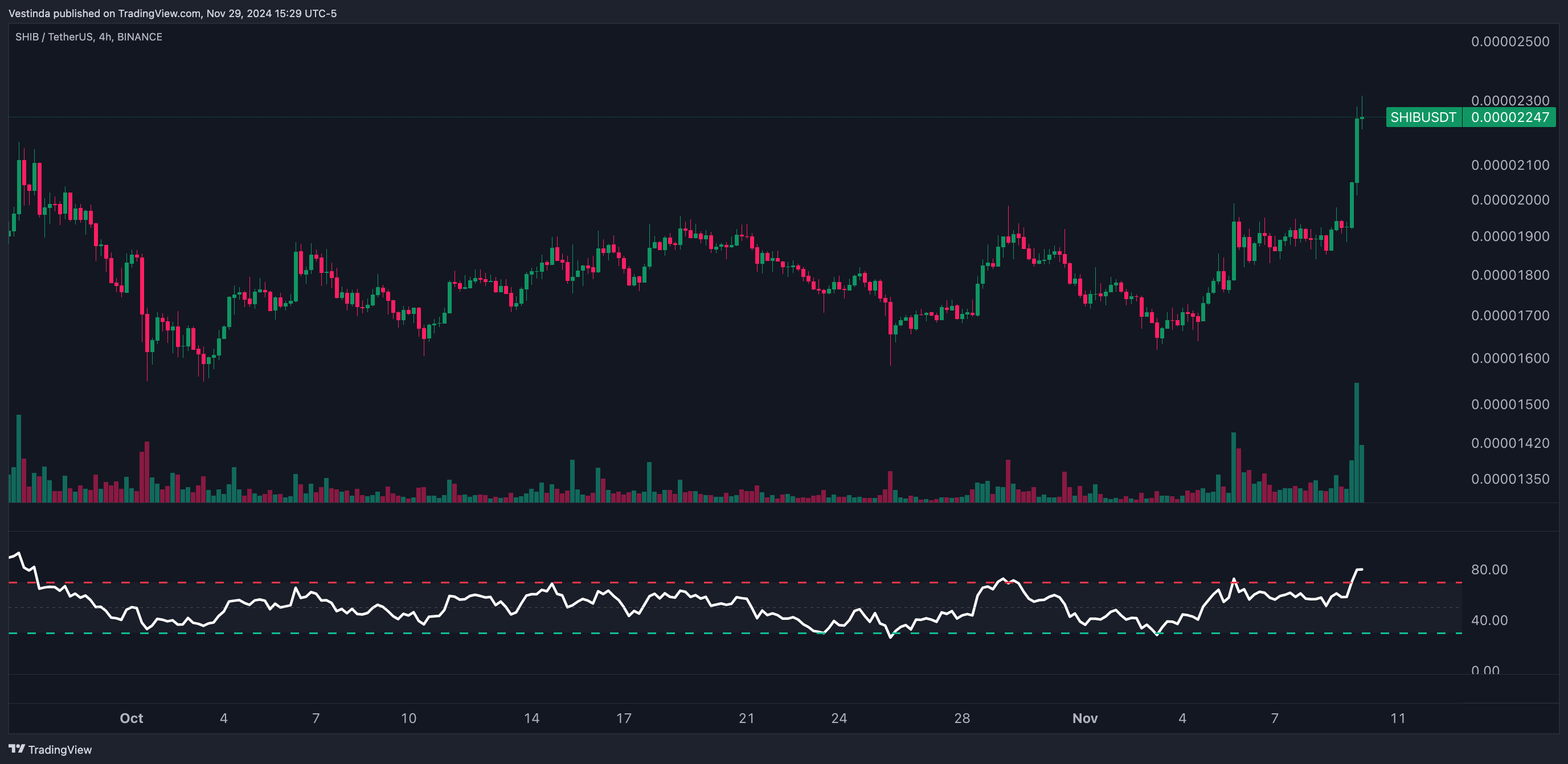
- Execution Rules:
- Buy Signal: Enter long when RSI exits oversold territory, confirmed by a bullish candlestick pattern (e.g., hammer or bullish engulfing).
- Sell Signal: Exit when RSI re-enters the overbought zone or a bearish pattern forms.
- Enhancement: Validate signals with support and resistance levels.
3. Breakout Trading with Bollinger Bands:
Concept: Capture SHIB’s breakouts from consolidation phases using Bollinger Bands.
- Setup: Apply Bollinger Bands with a 20-period SMA and standard deviation of 2.

- Execution Rules:
- Buy Signal: Enter long when SHIB’s price breaks above the upper band with rising volume.
- Sell Signal: Exit near key resistance levels or when price consolidates.
- Enhancement: Use volume indicators to confirm breakout strength.
4. Swing Zones with Fibonacci Retracements:
Concept: Trade SHIB’s pullbacks to Fibonacci levels within trending markets.
- Setup: Plot Fibonacci retracement levels from the recent high to low swing.
- Execution Rules:
- Buy Signal: Enter long when SHIB retraces to the 38.2% or 50% Fibonacci level and forms a bullish confirmation candle.
- Sell Signal: Exit near the 61.8% extension or the next resistance level.
- Enhancement: Combine with volume spikes for added validation.
Tips for Swing Trading SHIB:
- Focus on Key Levels: Identify and trade around strong support and resistance zones.
- Utilize Multiple Timeframes: Analyze SHIB’s broader trend on higher timeframes (e.g., daily) and refine entries on lower timeframes (e.g., 4-hour).
- Set Realistic Profit Targets: Use a risk/reward ratio of at least 1:2 to ensure profitable trades.
- Monitor Market Conditions: Stay updated on SHIB-related news and events that may influence price volatility.
Risk Management for Swing Trading SHIB:
- Position Sizing: Risk no more than 1-2% of your total capital per trade.
- Stop-Loss Orders: Place dynamic stop-losses below support levels or key moving averages.
- Diversify Strategies: Employ multiple setups to adapt to varying market conditions.
Common Mistakes to Avoid:
- Chasing Trades: Wait for confirmed signals instead of reacting to price spikes.
- Neglecting Risk Management: Always define your stop-loss and profit-taking levels before entering a trade.
- Ignoring Market Context: Avoid trading against the broader market trend.
Conclusion:
Swing trading Shiba Inu offers a balanced approach to trading, enabling traders to capitalize on significant price movements while minimizing time commitment. By mastering strategies like trend-following, breakout trading, and reversal patterns, traders can navigate SHIB’s volatile market effectively. Combine technical analysis with disciplined execution and risk management to achieve consistent results.
Mastering Profitable Swing Trading with SHIB
- Educate yourself on the basics of swing trading and the SHIB market.
- Set up a trading account with a reliable and reputable broker.
- Analyze SHIB price charts and identify potential entry and exit points.
- Implement risk management strategies, such as setting stop-loss and take-profit levels.
- Execute trades based on your analysis and follow your trading plan strictly.
- Regularly review and adjust your trading strategy based on market conditions.
- Maintain a disciplined approach and control your emotions to avoid impulsive decisions.
Swinging with MA: SHIB Trading Insights
Using moving averages in swing trading can provide valuable insights into market trends.
Moving averages act as support and resistance levels, aiding in identifying potential entry and exit points. By analyzing the crossover of different moving averages, traders can spot trend reversals and changes in momentum.
Short-term moving averages, such as the 20-day or 50-day, are useful for capturing smaller price movements and confirming short-term trends. Meanwhile, longer-term moving averages, like the 100-day or 200-day, help traders identify the overall market direction.
For swing traders interested in cryptocurrencies like SHIB, combining moving averages with other technical indicators can enhance their decision-making process. It is important to note, however, that moving averages are just one tool in a trader's arsenal and should be used in conjunction with other analysis methods for better accuracy.
SHIB Swing: Crafting Your Winning Trading Strategy
Developing a swing trading strategy can be a valuable tool for traders looking to capitalize on short-term market movements. This strategy involves identifying trends within a predetermined time frame, typically days to weeks, and capitalizing on price fluctuations. To develop a successful swing trading strategy, it is important to identify key support and resistance levels, use technical indicators to gauge entry and exit points, and manage risk effectively. Traders may choose to use a combination of technical analysis tools, such as moving averages and trendlines, to establish a trading plan. Additionally, staying updated on market news and events can help inform decision-making and increase the likelihood of success. When swing trading, it is imperative to be mindful of market volatility and liquidity, as this can impact the execution of trades. As with any strategy, it is vital to continuously monitor and adjust the strategy based on market conditions and individual risk tolerance. SHIB, a popular cryptocurrency, should be considered in swing trading strategies given its volatility and potential for quick gains.
Fibonacci Strategy: Engaging SHIB Trading with Precision
Fibonacci Retracement is a popular technical analysis tool used in trading. It helps identify potential levels of support and resistance. By using the Fibonacci sequence, which adds the previous two numbers to generate the next one, traders can determine key price levels. These levels are regarded as areas where the market may experience a pullback before continuing its trend. Fibonacci retracement levels commonly used are 23.6%, 38.2%, 50%, 61.8%, and 78.6%. When applied to the price chart of an asset, it can reveal possible entry or exit points for traders. Fibonacci Retracement has gained relevance in the cryptocurrency market as well, including coins like SHIB. It assists traders in identifying potential areas of price consolidation or reversal, enhancing their decision-making process.
-
 Create
account -
 Build trading strategies
with no code -
 Validate
& Backtest -
 Automate
& start earning
Frequently Asked Questions
Determining which crypto to trade daily depends on several factors including market trends, volatility, and personal risk tolerance. Popular choices for daily trading include Bitcoin (BTC), Ethereum (ETH), and Ripple (XRP), as they tend to have high liquidity and market capitalization. However, it is crucial to conduct extensive research, analyze technical indicators, and follow news updates before making any trading decisions. Moreover, diversify your portfolio by considering other altcoins such as Litecoin (LTC) or Cardano (ADA) to mitigate risks associated with a single asset. Always remember, daily trading can be highly unpredictable and requires a disciplined approach, so proceed with caution.
To adapt the SHIB swing trading strategy to different time frames, consider adjusting the length of the swing periods according to the desired timeframe. For shorter timeframes like intraday or hourly charts, focus on shorter swing periods with tighter stops and targets. On the other hand, for longer timeframes such as daily or weekly charts, extend the swing periods and adjust stops and targets accordingly. Remember to conduct thorough analysis, including technical indicators and support/resistance levels, specific to each timeframe to ensure effective implementation of the SHIB swing trading strategy.
The best timeframe for swing trading is commonly considered to be the daily chart. This timeframe allows traders to capture medium-term price movements, typically lasting a few days to a few weeks. It provides a balance between sufficient trading opportunities and avoiding excessive market noise. The daily chart offers clearer trends and patterns, enabling traders to enter and exit trades with greater accuracy. Moreover, it allows for adequate risk management as traders can set wider stop-loss levels and take advantage of longer-term price action. Ultimately, the best timeframe for swing trading depends on an individual's trading style, preferences, and specific market conditions.
When setting stop-loss orders for swing trading SHIB, it's crucial to consider the price volatility and risk tolerance. Start by analyzing the recent price movements and identifying potential support levels. Place the stop-loss order slightly below a significant support level to protect against sudden price drops. Additionally, trailing stop-loss orders can be helpful for capturing profit while mitigating risk. Regularly monitor the price action and adjust the stop-loss order accordingly to secure gains or limit potential losses. Remember, setting stop-loss orders should align with your individual risk management strategy.
Yes, Binance allows swing trading. Swing trading involves taking short to medium-term positions in the market, aiming to capture short-term price movements. With its wide range of trading pairs and extensive tools and features, Binance provides a suitable platform for swing traders to execute their strategies. Traders can take advantage of Binance's advanced trading interface, including limit orders, stop-loss orders, and more. Additionally, Binance offers various technical analysis tools and charting options, aiding swing traders in making informed trading decisions.
The amount of money needed for swing trading can vary depending on various factors such as the individual's risk tolerance and trading strategy. Generally, it is advisable to have a substantial amount of capital to effectively utilize swing trading strategies and manage potential losses. While there is no fixed amount, a recommended minimum starting capital could be around $25,000. This allows for diversification and flexibility in trading positions. It's crucial to remember that swing trading involves potential risks, and thorough research and risk management should be conducted irrespective of the amount of capital invested.
Conclusion
In conclusion, swing trading in the SHIB market can be an exciting and profitable venture for traders looking to capitalize on short-term price movements. By understanding the basics of swing trading, setting up a reliable trading account, and developing a disciplined approach, traders can enhance their chances of success. Incorporating technical analysis tools such as moving averages and Fibonacci retracement can further improve decision-making and identify potential entry and exit points. It is important for traders to stay updated on market conditions, manage risk effectively, and continuously adjust their strategy to adapt to changing market dynamics. With its volatility and potential for quick gains, SHIB is a cryptocurrency worth considering in swing trading strategies.

Successful traders rely on backtesting to be profitable.
Be like them with our
Free Backtesting Guide