
-
 Create
account -
 Build trading strategies
with no code -
 Validate
& Backtest -
 Automate
& start earning
Quant Strategies & Backtesting results for DOGE
Here are some DOGE trading strategies along with their past performance. You can validate these strategies (and many more) for free on Vestinda across thousands of assets and many years of historical data.
Quant Trading Strategy: Play the breakout on DOGE
The backtesting results for the trading strategy applied from March 15, 2020, to March 15, 2021, have displayed impressive statistics. The profit factor stands at a remarkable 83.11, indicating a strong performance. The annualized return on investment (ROI) is an astonishing 1191.42%, showcasing exceptional growth over the given period. On average, each trade was held for approximately 5 weeks and 2 days, suggesting a slightly longer-term approach. With an average of 0.09 trades per week, it appears that the strategy was relatively conservative in terms of trade frequency. Out of a total of 5 closed trades, the strategy achieved an impressive winning trades percentage of 80%. Overall, these statistics demonstrate the effectiveness and potential profitability of the trading strategy utilized.

 DOGEUSDT

Choose another period and try again.
Quant Trading Strategy: Template Parabolic SAR EMA on DOGE
Based on the backtesting results statistics for the trading strategy spanning March 15, 2020, to March 15, 2021, several key observations emerge. The strategy exhibits a profit factor of 1.86, indicating that for every dollar risked, the strategy generated $1.86 in profit. The annualized ROI stands impressively at 189.64%, showcasing the strategy's ability to achieve substantial returns over time. On average, positions were held for approximately 13 hours and 44 minutes, suggesting a relatively short-term approach. With an average trading frequency of 1.45 trades per week, the strategy maintained a disciplined and cautious approach. The number of closed trades reached 76, further highlighting a consistent trading activity. Although the winning trades percentage stands at 30.26%, the remarkable ROI exhibits the strategy's ability to achieve overall profitability despite a moderate success rate.
DOGEUSDT
Choose another period and try again.
Introduction to Profitable DOGE Swing Trading
Dogecoin (DOGE) has become a prominent cryptocurrency, known for its volatility and strong price swings. Swing trading, a strategy aimed at capturing intermediate price moves within a trend, is particularly effective for DOGE. This guide explores proven swing trading strategies, key indicators, and risk management practices to help traders profit from DOGE’s dynamic price action.
Why Swing Trade DOGE?
- Volatility Opportunities: DOGE’s frequent price swings provide ample opportunities for swing traders to capitalize on both upward and downward movements.
- Time Efficiency: Swing trading focuses on multi-day to multi-week price moves, reducing the need for constant monitoring compared to day trading.
- Market Accessibility: DOGE trades 24/7, offering flexibility in managing trades and adapting to global market dynamics.
Core DOGE Swing Trading Strategies:
1. Trend-Following with EMA Crossover:
Concept: Use exponential moving average (EMA) crossovers to identify and follow DOGE’s trends.
Why It Works: EMA crossovers highlight momentum shifts, helping traders enter and exit trades aligned with prevailing trends.
How to Implement:
- Indicator Setup: Apply a 20-period EMA (short-term) and a 50-period EMA (long-term).
- Entry and Exit: Enter long when the 20 EMA crosses above the 50 EMA, and exit or short when it crosses below.
- Optimization Tip: Test different EMA periods to suit DOGE’s volatility and optimize entry/exit timing.
2. Support and Resistance Swing Strategy:
Concept: Trade DOGE’s price reversals at key support and resistance levels, focusing on buying near support and selling near resistance.
Why It Works: DOGE often respects psychological price levels, providing reliable reversal points for swing trades.
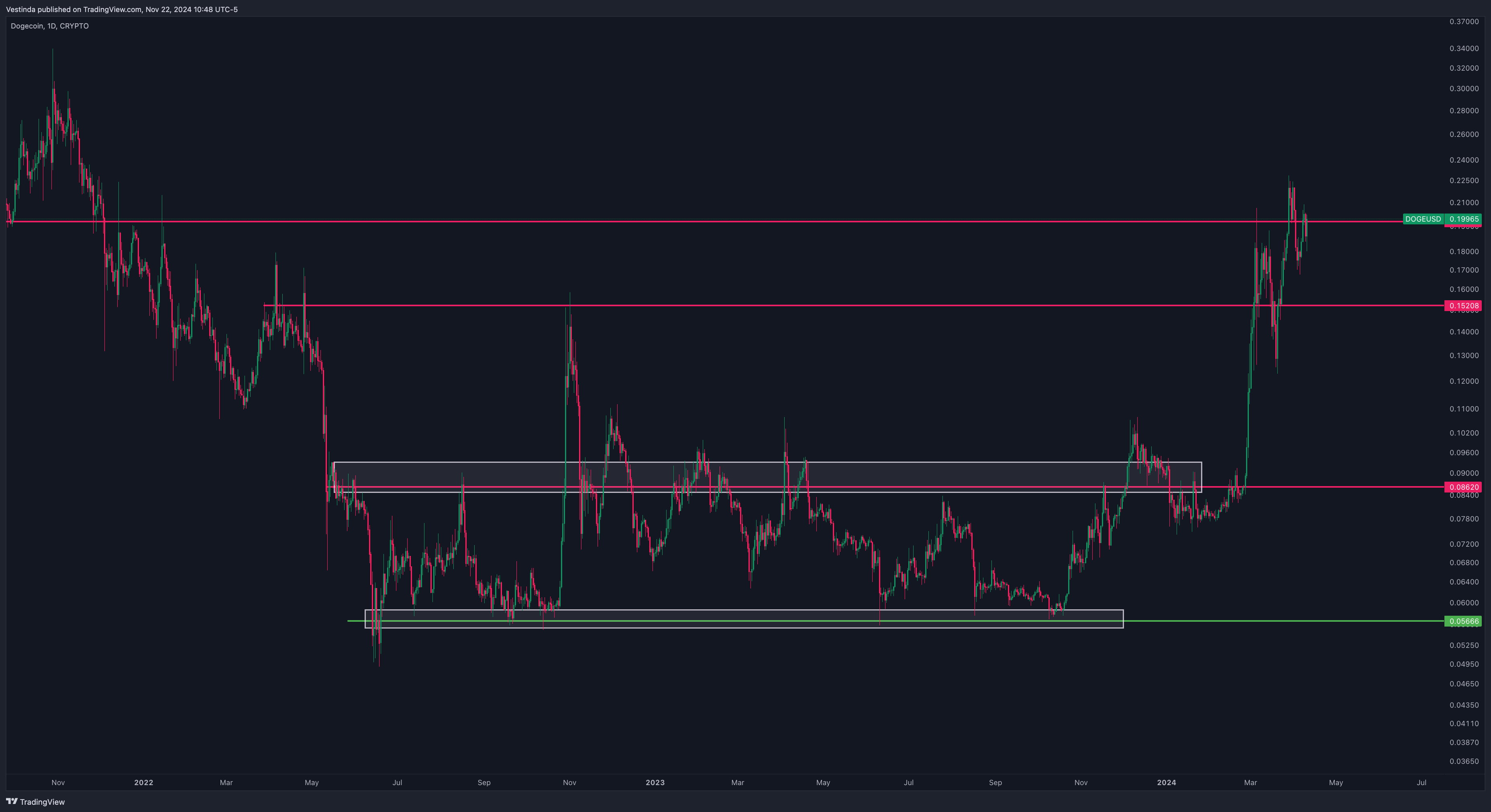
How to Implement:
- Indicator Setup: Identify horizontal support and resistance zones using historical price data.
- Entry and Exit: Buy when price approaches support and forms a bullish reversal pattern; sell when price nears resistance and forms a bearish signal.
- Optimization Tip: Use volume spikes or candlestick patterns to confirm reversals at these levels.
3. Swing Reversal Strategy with RSI Divergence:
Concept: Detect divergences between DOGE’s price and RSI to identify potential swing reversals.
Why It Works: RSI divergence signals weakening momentum, often preceding significant price reversals.
How to Implement:
- Indicator Setup: Apply RSI with a 14-period setting.
- Entry and Exit: Enter long on bullish divergence (RSI rising while price falls) and exit or short on bearish divergence (RSI falling while price rises).
- Optimization Tip: Combine RSI divergence with support/resistance or trendline breaks for enhanced accuracy.
Combining Indicators for Enhanced Swing Trading:
1. Bollinger Bands + MACD for Volatility and Momentum:
How It Works: Use Bollinger Bands to detect volatility-based price moves and confirm momentum with MACD crossovers.
Example: Enter long when DOGE price touches the lower Bollinger Band, and MACD shows a bullish crossover. Go short when price touches the upper band, and MACD shows a bearish crossover.
Optimization Tip: Test Bollinger Band widths and MACD settings to fine-tune breakout and momentum detection.
2. Supertrend + Fibonacci Retracements for Swing Entry:
How It Works: Combine Supertrend for trend direction with Fibonacci retracements to pinpoint swing entry levels during pullbacks.

Example: Enter long when DOGE retraces to a 50% Fibonacci level in an uptrend confirmed by a bullish Supertrend. Exit at the next resistance or swing high.
Optimization Tip: Adjust Supertrend sensitivity and use multiple Fibonacci levels to identify high-probability trades.
Risk Management in DOGE Swing Trading:
1. Position Sizing Based on Swing Length:
Concept: Adjust position sizes according to the expected duration and magnitude of the swing trade.
How to Implement: Allocate smaller positions for longer swings with greater potential drawdown and larger positions for shorter, tighter swings.
Automation Tip: Use position sizing calculators or tools to standardize risk across trades.
2. Stop-Loss and Take-Profit Levels:
Concept: Set stop-losses and take-profits based on technical levels, aligning with DOGE’s price structure.
How to Implement: Place stop-losses just below recent swing lows (for longs) or above swing highs (for shorts). Set take-profits at the next major support/resistance level.
Optimization Tip: Test different risk/reward ratios, aiming for at least 1:2 to ensure profitability over time.
3. Trailing Stops for Extended Swings:
Concept: Use trailing stops to lock in profits as DOGE trends favorably, allowing trades to capture extended price moves.
How to Implement: Set a trailing stop distance based on a percentage of the swing length or recent price movements.
Automation Tip: Automate trailing stops within trading software to adjust dynamically with DOGE’s price moves.
Backtesting and Optimizing DOGE Swing Trading Strategies:
1. Backtesting on Historical Data:
Purpose: Test swing trading strategies on DOGE’s past price data to evaluate their effectiveness across market conditions.
How to Implement: Focus on metrics like win rate, average return per trade, and drawdown to refine strategies and settings.
2. Live Optimization with Real-Time Adjustments:
Purpose: Monitor and optimize swing trading strategies based on live performance and market feedback.
How to Implement: Adjust entry/exit criteria, stop-loss levels, and indicator parameters in response to DOGE’s evolving market behavior.
Conclusion:
Swing trading Dogecoin offers traders the opportunity to profit from intermediate price moves, leveraging DOGE’s volatility and market dynamics. By combining effective strategies like EMA crossovers, support/resistance reversals, and RSI divergences with sound risk management, traders can achieve consistent profitability. Regular backtesting and real-time optimization ensure these strategies remain adaptable and effective.
Mastering Profitable DOGE Swing Trading
- Learn the basics of swing trading and understand the trends of Dogecoin.
- Develop a trading strategy and set realistic profit goals for your trades.
- Use technical analysis to identify potential entry and exit points for trades.
- Manage your risk by setting stop-loss orders and adhering to them.
- Monitor the market closely and stay updated on news and events that could impact Dogecoin.
- Implement strict discipline and stick to your trading plan, avoiding impulsive decisions.
- Regularly evaluate and adjust your strategy based on your results and market conditions.
Unleashing DOGE Breakout Power: A Winning Strategy
The Breakout Swing Strategy is a popular method to trade DOGE. It involves identifying key resistance and support levels on the DOGE chart. Traders wait for the DOGE price to break above a resistance level or below a support level. Once the breakout occurs, traders enter a swing trade in the direction of the breakout. This strategy aims to capture the substantial price movement that often follows a breakout. It is important to set stop-loss orders and take-profit targets to manage risk and profitability. Traders can use technical indicators, such as moving averages or Bollinger Bands, to confirm breakouts and improve the probability of success. The Breakout Swing Strategy requires patience and discipline to wait for confirmed breakouts and execute trades at the right time.
Swing Trading and Its Psychological Implications
Psychological Aspects of Swing Trading can greatly impact a trader's success. DOGE, a popular cryptocurrency, adds an element of excitement to the market. The fast-paced nature of swing trading requires quick decision-making and can lead to emotional roller coasters. Traders must manage their emotions, such as fear and greed, to avoid impulsive actions. It is crucial to develop discipline and stick to a well-thought-out trading plan. By focusing on risk management and embracing patience, swing traders can navigate the volatility of DOGE and other assets. Psychology plays a significant role in achieving consistent profits, as trading decisions are often influenced by human biases. Only those who can handle the psychological challenges of swing trading are likely to succeed in this highly competitive arena.
Profitable Swing Trading with Moving Averages
Moving averages are an essential tool in swing trading, including in DOGE. They help smooth out price fluctuations and identify trends. The 20-day moving average is commonly used in swing trading to gauge short-term trends. Traders look for buy signals when the price crosses above the moving average, indicating a potential uptrend. Conversely, a sell signal is generated when the price crosses below the moving average, suggesting a possible downtrend. Longer-term moving averages, such as the 50-day or 200-day, can also be used to identify broader trends. By using these moving averages, swing traders can make more informed decisions and potentially profit from DOGE's price movements.
Sophisticated backtesting is not only possession of high-esteemed hedge funds anymore.
Impressive Team and support, Backtesting engine with detailed reports, The Strategy builder.

Great purchase!
I have always manually invested in stocks and cryptocurrencies, but after studying Vestinda, I must say it has enormous potential.

Mature platform for trading
Pro: Easy to use, Nice UX, A lot of customization for strategies, Back testing is an awesome tool, can check any strategy in history.

Frequently Asked Questions
The superiority of swing trading over day trading depends on individual preferences and circumstances. Swing trading entails holding positions for several days or weeks, allowing for larger potential gains. It is suitable for traders with less time to monitor the market closely. On the other hand, day trading involves quick trades within a single day, ensuring no overnight risk. It appeals to those adept at making rapid decisions and who have ample time to dedicate to trading. Ultimately, the choice between swing and day trading relies on personal trading goals, risk tolerance, and available time.
When interpreting DOGE's market share data for swing trading, it is crucial to analyze its volatility and trading volume. Higher volatility implies greater potential for price swings, making DOGE suitable for swing trading. Additionally, monitoring trading volume helps confirm liquidity and ensures smoother execution of trades. By keeping a close eye on these metrics, swing traders can identify optimal entry and exit points, as well as gauge market sentiment toward DOGE. However, it is essential to remember that swing trading carries risks, and thorough analysis of additional factors is recommended before making any trading decisions.
Incorporating fundamental analysis into DOGE swing trading involves assessing key factors that can impact DOGE's value such as market trends, news, and the overall cryptocurrency ecosystem. Start by monitoring social media sentiment, following DOGE-related announcements, and understanding broader market dynamics. Evaluate the project's technology, its development team, and any partnerships or collaborations it has. This analysis can guide your entry and exit points, ensuring you make informed decisions based on both technical and fundamental indicators. Remember, swing trading involves short-term positions, so staying up-to-date with DOGE's fundamental developments is crucial for maximizing profits.
Deciding which cryptocurrency to trade daily depends on various factors such as market trends, volatility, and personal risk appetite. While popular options like Bitcoin and Ethereum offer liquidity and stability, smaller altcoins may provide greater potential for quick gains due to higher volatility. However, they also carry increased risk. It's essential to conduct thorough research, analyze price patterns, and utilize technical indicators before making any daily trading decisions. Remember, trading cryptocurrencies involves significant risks, and diversification may help minimize potential losses.
To use technical analysis for swing trading DOGE, start by identifying key levels of support and resistance on the price chart. Look for patterns, such as trend lines or chart formations, to recognize potential entry or exit points. Utilize technical indicators like moving averages, RSI, or MACD to gauge momentum and confirm your analysis. Additionally, consider volume and market sentiment to strengthen your decision-making process. Continually monitor and adjust your strategy based on new patterns and indicators. Remember, technical analysis is a tool, and combining it with fundamental analysis can enhance your swing trading approach for DOGE.
Conclusion
In conclusion, swing trading DOGE (Dogecoin) can be a lucrative endeavor for both beginners and experienced traders. By understanding the basics of swing trading and the trends of Dogecoin, developing a trading strategy, using technical analysis, managing risk, staying informed, implementing discipline, and regularly evaluating and adjusting your strategy, you can navigate the market effectively and potentially maximize profits. The Breakout Swing Strategy is a popular method to trade DOGE, and the psychological aspects of swing trading and the use of moving averages are important considerations. With the proper knowledge and tools, swing trading DOGE can offer great opportunities in the crypto market.

Successful traders rely on backtesting to be profitable.
Be like them with our
Free Backtesting Guide