
-
100,000 available assets New
-
years of historical data
-
practice without risking money

Automated Strategies & Backtesting results for DOGE
Here are some DOGE trading strategies along with their past performance. You can validate these strategies (and many more) for free on Vestinda across thousands of assets and many years of historical data.
Automated Trading Strategy: MVWAP and VWAP Crossover on DOGE
Based on the backtesting results statistics, the trading strategy demonstrated promising performance during the period from July 5, 2019, to December 8, 2023. The strategy showcased a profit factor of 1.38, indicating that for every unit of risk taken, it generated 1.38 units of profit. Additionally, the annualized return on investment (ROI) stood at an impressive 234.32%, showcasing strong profitability. The strategy had an average holding time of 1 week and 6 days, indicating a moderate-term approach. With an average of 0.24 trades per week, the trading activity remained relatively low. The strategy executed 57 closed trades, with a winning trades percentage of 40.35%. Overall, the return on investment reached a staggering 1018.79%, illustrating the strategy's potential for highly profitable outcomes.

 DOGEUSDT

Choose another period and try again.
Automated Trading Strategy: ZLEMA Crossover with Increased Price Variance on DOGE
The backtesting results for the trading strategy, spanning from July 5, 2019, to December 9, 2023, present a profit factor of 1.07. An annualized ROI of 1.99% suggests moderate gains over the analyzed period. The average holding time for positions amounted to approximately 1 week and 2 days, while the strategy executed an average of 0.08 trades per week. With 20 closed trades throughout the period, the return on investment reached 8.67%. Moreover, there was a 25% success rate for winning trades. These statistics indicate that the strategy delivered a slightly positive return, albeit with a relatively low success rate.
DOGEUSDT
Choose another period and try again.
Mastering DOGE Arbitrage: Your Step-By-Step Guide
- Choose three or more exchanges to monitor for DOGE price differences.
- Make sure you have accounts on all selected exchanges.
- Buy DOGE on the exchange where it is priced lower.
- Transfer the purchased DOGE to the exchange where it is priced higher.
- Sell the DOGE on the higher-priced exchange for a profit.
- Repeat the process to maximize your arbitrage opportunities.
Alternative Arbitrage Strategies for DOGE (Dogecoin) and Cryptocurrencies
Introduction
If traditional arbitrage strategies for Dogecoin (DOGE) or other cryptocurrencies are becoming less feasible due to market efficiency, tight spreads, or high transaction costs, here are some alternative approaches and adaptations to consider:
Alternative Arbitrage-Like Strategies
1. Statistical Arbitrage
Concept: Use statistical models to identify small, mean-reverting price discrepancies between correlated assets or pairs.
Example: Monitor DOGE’s price correlation with other meme coins like SHIB or broader crypto indexes and execute trades when the price deviates from the historical relationship.
Tools Needed: Advanced trading algorithms, machine learning models, and tools like Python for statistical analysis.
2. Latency Arbitrage
Concept: Leverage differences in price updates between exchanges due to latency (delayed data feed).
How It Works: Use high-speed bots to exploit these short-lived discrepancies. Requires advanced infrastructure and co-located servers near exchanges.
Challenge: This strategy is highly competitive and resource-intensive.
3. Spread Trading
Concept: Trade the price spread between DOGE and another asset (e.g., DOGE/BTC or DOGE/SHIB) rather than directly arbitraging across exchanges.
How It Works: Buy DOGE and short the other asset when the spread widens beyond a historical average, profiting as it reverts.
Tools Needed: Derivatives platforms for hedging and statistical tools for spread monitoring.
Focus on Bots and High-Frequency Trading
1. Micro-Spread Scalping
Concept: Instead of targeting large price gaps across exchanges, execute numerous small trades that exploit bid-ask spreads or liquidity gaps within a single exchange.
How It Works: Use high-speed trading bots to capture these small opportunities consistently.
2. Market-Making Strategies
Concept: Provide liquidity on exchanges by placing simultaneous buy and sell orders at slightly different prices, profiting from the spread.
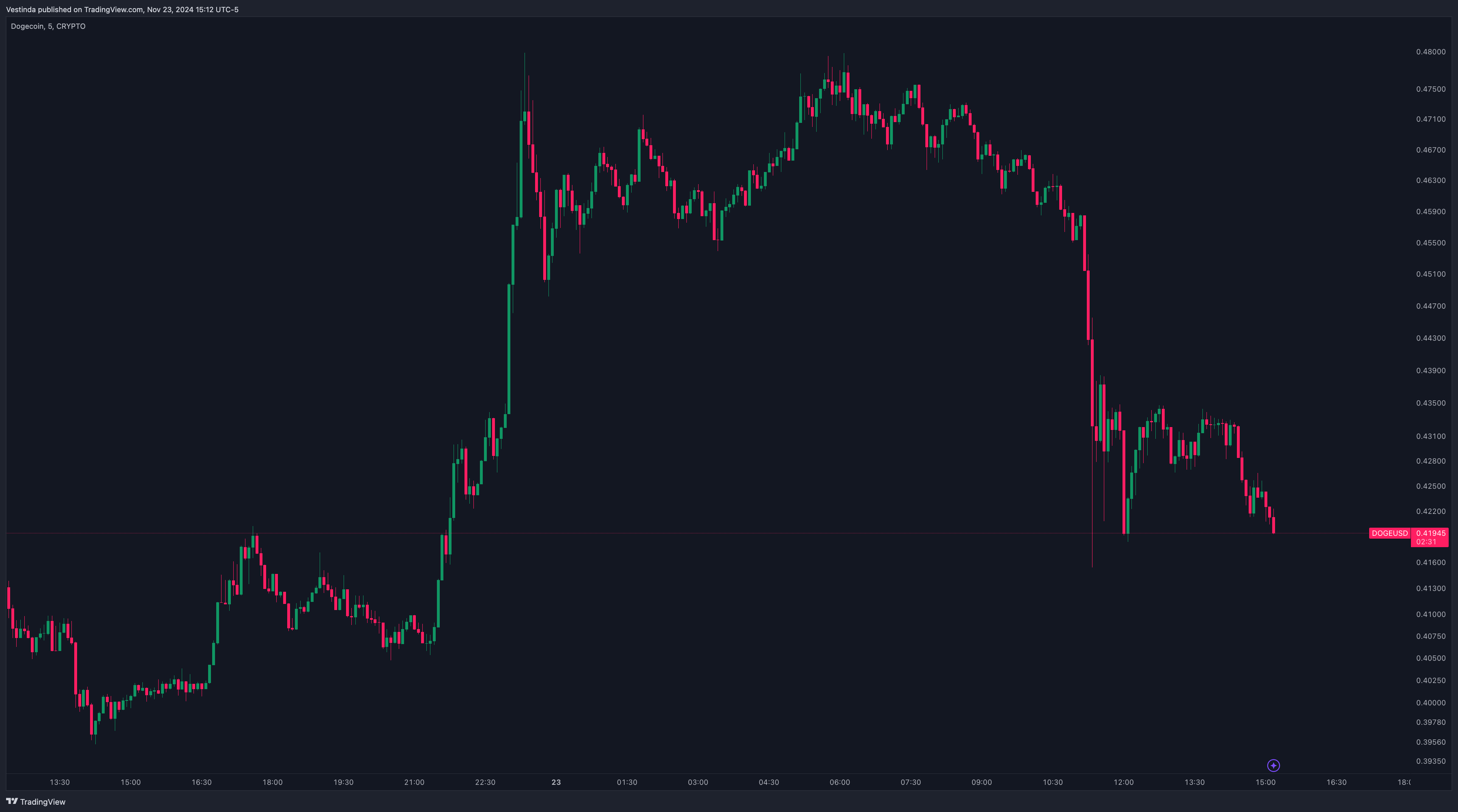
How It Works: Earn small profits with each trade execution. This approach requires capital and risk management but works well in low-volatility markets.
Adapt to Fee and Time Constraints
1. Focus on Low-Fee Exchanges
Choose platforms with minimal withdrawal, deposit, and trading fees to maximize potential profits. Consider layer-2 solutions (e.g., Dogecoin on Binance Smart Chain) for faster and cheaper transfers.
2. Arbitrage Using Stablecoins
Use stablecoin pairs like DOGE/USDT or DOGE/BUSD to reduce exposure to volatility during transfers. Look for discrepancies in DOGE prices relative to multiple stablecoins.
3. Cross-Exchange Wallet Features
Some platforms (e.g., Binance, KuCoin) allow internal transfers without transaction fees. Use these features for faster and cost-effective arbitrage-like trades.
Switch Focus from Arbitrage to Trend Trading
1. Breakout and Range Trading
Use tools like Bollinger Bands, MACD, and RSI to trade DOGE’s volatility instead of price discrepancies across exchanges.

2. Algorithmic Strategies for Volatility
Employ automated systems that monitor and capitalize on short-term price movements within single exchanges.
Leverage Derivatives and DeFi
1. Perpetual Swaps and Futures Arbitrage
Trade DOGE futures contracts on derivatives platforms, capturing funding rate discrepancies between perpetual swaps and spot markets.
Example: Go long on DOGE in the spot market and short in the futures market when the funding rate is high.
2. DeFi Arbitrage
Exploit price differences between decentralized exchanges (DEXs) and centralized exchanges (CEXs).
Example: Use platforms like Uniswap and PancakeSwap to identify mismatched liquidity pools for DOGE.
Why Arbitrage Is Less Feasible
- Market Efficiency: Increasingly efficient crypto markets reduce the frequency and size of price discrepancies.
- High Fees: Withdrawal, deposit, and trading fees often negate small arbitrage profits.
- Latency Reduction: Exchanges improve data synchronization, closing gaps faster.
- Competition: Arbitrage opportunities are quickly exploited by high-speed bots and institutional traders.
Conclusion
If traditional arbitrage has become impractical, adapt by exploring related strategies like statistical arbitrage, market-making, or derivatives trading. Focus on leveraging advanced tools, automation, and low-cost platforms to remain competitive. Additionally, consider expanding into newer or less-liquid assets where inefficiencies might still exist.
DOGE Arbitrage Example Showcase
Arbitrage trading involves taking advantage of price discrepancies across different markets to profit from buying low and selling high. For instance, a trader interested in DOGE cryptocurrency could buy it on one exchange where it is undervalued and sell it on another where it is overvalued. To execute this strategy effectively, speed is crucial. Traders must be quick to identify the price differences, as they can fluctuate rapidly. Automated bots or algorithms can provide an advantage by instantly executing trades and minimizing the risk of missing out on profitable opportunities. By utilizing two venues for buying and selling DOGE, traders can maximize their chances of capitalizing on price discrepancies and generating significant profits.
To illustrate, a trader might identify that DOGE is trading at a lower price on Exchange A compared to Exchange B. Using an automated bot, they quickly purchase DOGE on Exchange A and simultaneously sell it on Exchange B, capitalizing on the price discrepancy. This allows the trader to profit from the difference in prices without taking on significant market risk. By utilizing automated tools, the trades can be executed swiftly, ensuring the trader is not left behind in a fast-paced market. The process involves constantly monitoring price movements, executing trades promptly, and remaining adaptable to changing market conditions.
DOGE Arbitrage Risks & Challenges Section
DOGE arbitrage trading may present significant risks and challenges. Firstly, the extreme volatility of the cryptocurrency market exposes traders to substantial price fluctuations, potentially leading to significant losses. Further, liquidity issues can hinder the execution of trades, causing delays and missed arbitrage opportunities. As DOGE is not widely accepted by regulated exchanges, finding suitable trading platforms with sufficient volume can be a challenge. Additionally, the lack of regulatory oversight in the cryptocurrency industry poses risks related to fraud, hacking, and market manipulation. Traders must also consider the operational challenges of managing multiple exchange accounts and transferring funds quickly between platforms. Ultimately, successful DOGE arbitrage trading requires extensive research, a deep understanding of market dynamics, and the ability to effectively navigate these risks and challenges.
Short-Term DOGE Scalping Tactics: Profiting from Arbitrage
Scalping strategies can be lucrative when exploring short-term DOGE arbitrage opportunities. These strategies involve taking advantage of the small price discrepancies that can occur within a short time frame. By buying DOGE at a lower price and quickly selling it at a higher price, traders can make profits. Short sentences: Timing is crucial in scalping, requiring constant monitoring of the market. This strategy is efficient for those seeking quick profits. By implementing proper risk management measures, traders can minimize potential losses. Longer sentence: However, it's important to note that scalping can be risky due to market volatility, which can cause sudden price fluctuations that may lead to undesired outcomes.
Misaligned Markets: DOGE Arbitrage Inequities
The impact of market manipulation on DOGE arbitrage is significant. Market manipulation refers to the intentional and deliberate actions taken by individuals or groups to manipulate the price and volume of a cryptocurrency. This can have a detrimental effect on arbitrage opportunities for DOGE. Manipulative practices, such as spoofing or wash trading, can create false price signals and distort market conditions. This makes it difficult for arbitrage traders to accurately gauge the market and take advantage of price discrepancies. Moreover, the presence of market manipulation can increase market unpredictability and volatility, making DOGE arbitrage riskier. It is crucial for traders to remain vigilant and stay informed about market manipulative practices to mitigate the impact on DOGE arbitrage.
-
Track your
Crypto Portfolio -
Copy Crypto trading
strategies -
Build trading strategies
with no code
-
Backtest trading strategies
on Crypto, Forex, Stocks, etc. -
Demo Trading
Risk-free Paper Trading -
Automate trading strategies
with Live Trading
Frequently Asked Questions
Analyzing historical price data for DOGE arbitrage trading involves identifying trends and patterns to determine profitable trading opportunities. Traders typically examine past price movements, volume trends, and price correlations with other cryptocurrencies or market variables. Technical indicators like moving averages, Bollinger Bands, or Relative Strength Index (RSI) can provide insights into market conditions and potential entry or exit points. Additionally, evaluating historical arbitrage opportunities, price spreads, and liquidity across different exchanges aids in formulating effective trading strategies. Continuous monitoring and adaptation of strategies based on historical data analysis can increase the chances of successful DOGE arbitrage trading.
Yes, it is possible to lose money in arbitrage trading. Although arbitrage trades are typically considered low-risk investments, there are certain factors that can lead to losses. Slippage, where the actual execution price differs from the expected price, can cause losses. Additionally, transaction costs, such as fees and commissions, can eat into the arbitrage profits and result in net losses. Furthermore, market volatility and sudden price fluctuations can prevent profitable opportunities or even create losses if the prices move against the arbitrageur. Therefore, while arbitrage trading offers potential profits, it is essential to carefully manage risks and consider possible losses.
Handling regulatory uncertainties in DOGE arbitrage trading requires careful consideration and compliance with relevant laws and regulations. Firstly, traders should conduct thorough research to understand the legal framework and requirements surrounding cryptocurrency trading in their jurisdiction. Seeking legal advice can provide further clarity. Additionally, staying updated with regulatory developments is essential to ensure compliance. Traders may need to implement robust Know Your Customer (KYC) and Anti-Money Laundering (AML) procedures, and consider utilizing reputable and regulated exchanges. Ultimately, adhering to applicable regulations and adopting a proactive approach towards compliance can help navigate the uncertainties associated with DOGE arbitrage trading.
When choosing an algorithmic trading library for Dogecoin (DOGE) arbitrage, consider factors like ease of use, robustness, and support for real-time data. Look for libraries that offer features such as backtesting capabilities, support for multiple exchanges, and integration with popular programming languages. Examples include libraries like ccxt, pyalgotrade, and bt. Thoroughly research each library, compare their features, and evaluate user reviews to find the most suitable one for your specific DOGE arbitrage needs.
Not everyone engages in arbitrage due to various reasons. Firstly, arbitrage opportunities often require substantial capital investment, making it inaccessible for individuals with limited funds. Additionally, identifying profitable arbitrage opportunities demands expertise and constant monitoring of market conditions. Moreover, the speed and efficiency needed to execute arbitrage trades often require advanced technological infrastructure and access to real-time data, which may not be available to everyone. Lastly, regulatory constraints and transaction costs can hinder the profitability of arbitrage, discouraging widespread participation. Consequently, while arbitrage can be lucrative, it remains a specialized practice that is not feasible or accessible for everyone.
Conclusion
In conclusion, DOGE Arbitrage is a trading strategy that allows traders to take advantage of price differences in Dogecoin across different exchanges. By buying low and selling high, traders can profit from temporary price discrepancies. It is important to have accounts on multiple exchanges and use automated bots or algorithms to execute trades quickly. DOGE Arbitrage comes with risks and challenges such as market volatility, liquidity issues, and operational challenges. Scalping strategies can be lucrative for short-term arbitrage opportunities, but traders must be mindful of market manipulation and its impact on DOGE arbitrage. Staying informed and vigilant is essential in navigating the dynamic world of DOGE Arbitrage.

Successful traders rely on backtesting to be profitable.
Be like them with our
Free Backtesting Guide