
-
100,000 available assets New
-
years of historical data
-
practice without risking money

Automated Strategies & Backtesting results for SHIB
Here are some SHIB trading strategies along with their past performance. You can validate these strategies (and many more) for free on Vestinda across thousands of assets and many years of historical data.
Automated Trading Strategy: Detrended Price Oscillations with Keltner Channel and Shadows on SHIB
According to the backtesting results for the trading strategy during the period from October 20, 2022, to October 20, 2023, several key statistics have been observed. The profit factor indicates a value of 0.67, suggesting that the strategy may not have been particularly successful in generating profits. The annualized return on investment stands at -33.77%, indicating a significant loss over the given timeframe. On average, trades were held for approximately 14 hours and 36 minutes, and there were an average of 2.37 trades per week. A total of 124 trades were closed during this period. The strategy had a relatively low winning trades percentage of 20.97%.

 SHIBUSDT

Choose another period and try again.
Automated Trading Strategy: Long Term Investment on SHIB
Based on the backtesting results statistics for the trading strategy during the period from October 20, 2022, to October 20, 2023, it can be observed that the strategy yielded promising outcomes. With a profit factor of 1.66 and an annualized return on investment of 10.01%, the strategy showcased its potential for generating positive returns. The average holding time stood at approximately 1 week 1 day, indicating a relatively short-term trading approach. On average, only 0.07 trades were executed per week, suggesting a cautious and selective trading style. Out of a total of 4 closed trades, an impressive 75% resulted in wins. Importantly, when compared to a buy and hold strategy, this trading strategy outperformed, generating excess returns of 58.99%. These findings highlight the effectiveness and superior performance of the strategy during the specified time frame.
SHIBUSDT
Choose another period and try again.
SHIB (Shiba Inu) Scalping: Effective Strategies and Tips
Introduction
Scalping Shiba Inu (SHIB) involves making quick, frequent trades to capitalize on small price movements. Using the right combination of indicators ensures that traders can identify high-probability setups and manage risks effectively. This guide focuses on updated strategies with a fresh set of popular indicators to optimize your scalping results.
Why Scalping SHIB?
- High Activity: SHIB’s volatility creates numerous intraday opportunities.
- Tight Spreads: High liquidity ensures minimal slippage.
- Fast Profits: Scalping allows traders to take advantage of even minor market fluctuations.
Updated Scalping Strategies for SHIB:
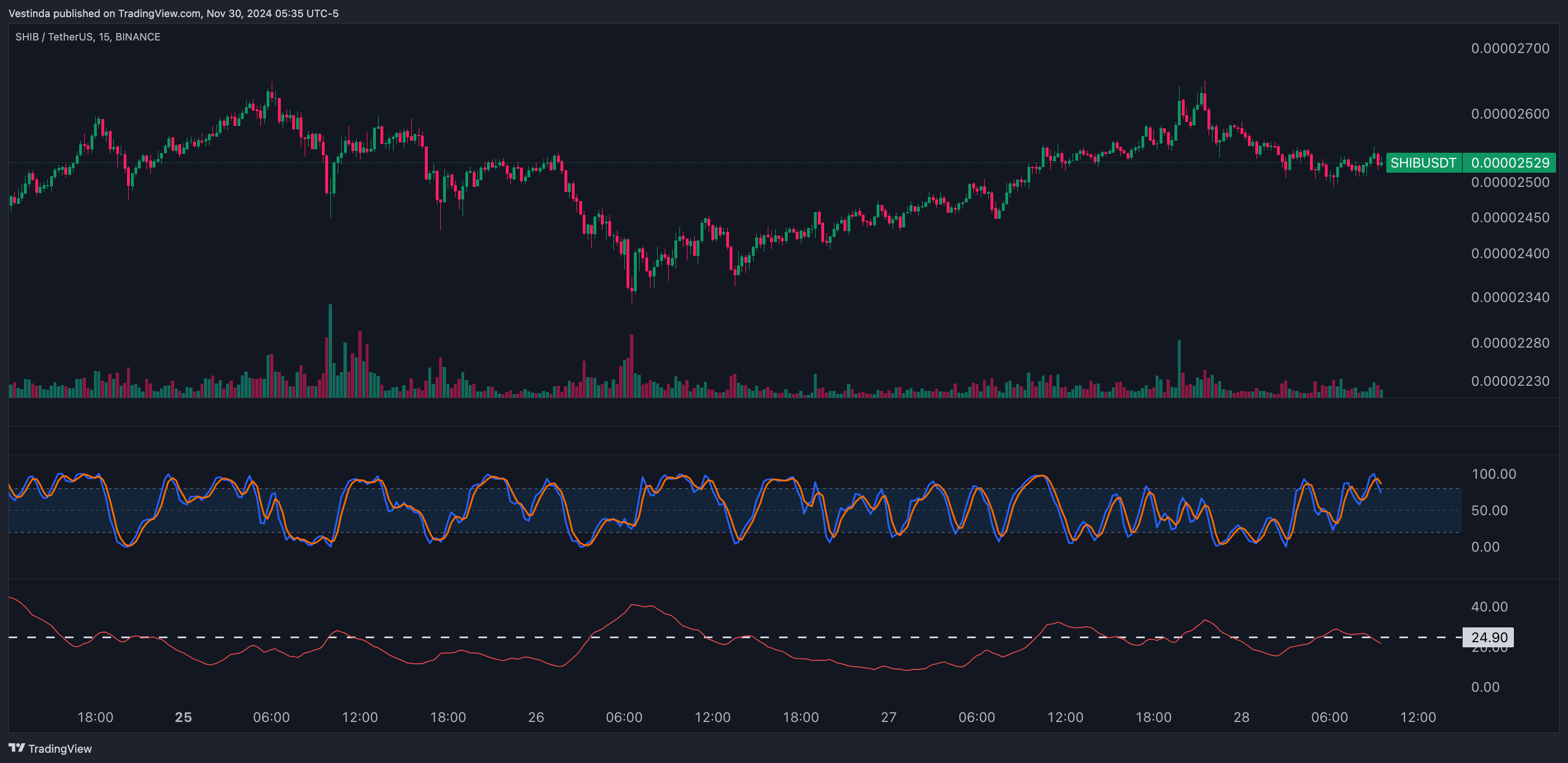
1. Scalping with ADX and Stochastic Oscillator:
Concept: Identify strong trends and trade momentum within those trends.
- Setup: Use ADX (14) to measure trend strength. Values above 25 indicate a strong trend. Add the Stochastic Oscillator (5, 3, 3) to pinpoint overbought and oversold zones.
- Execution Rules:
- Buy Signal: Enter long when ADX is above 25 and Stochastic crosses above 20 from oversold.
- Sell Signal: Exit when Stochastic nears 80 or ADX falls below 25.
- Best For: Scalping during trending market conditions.
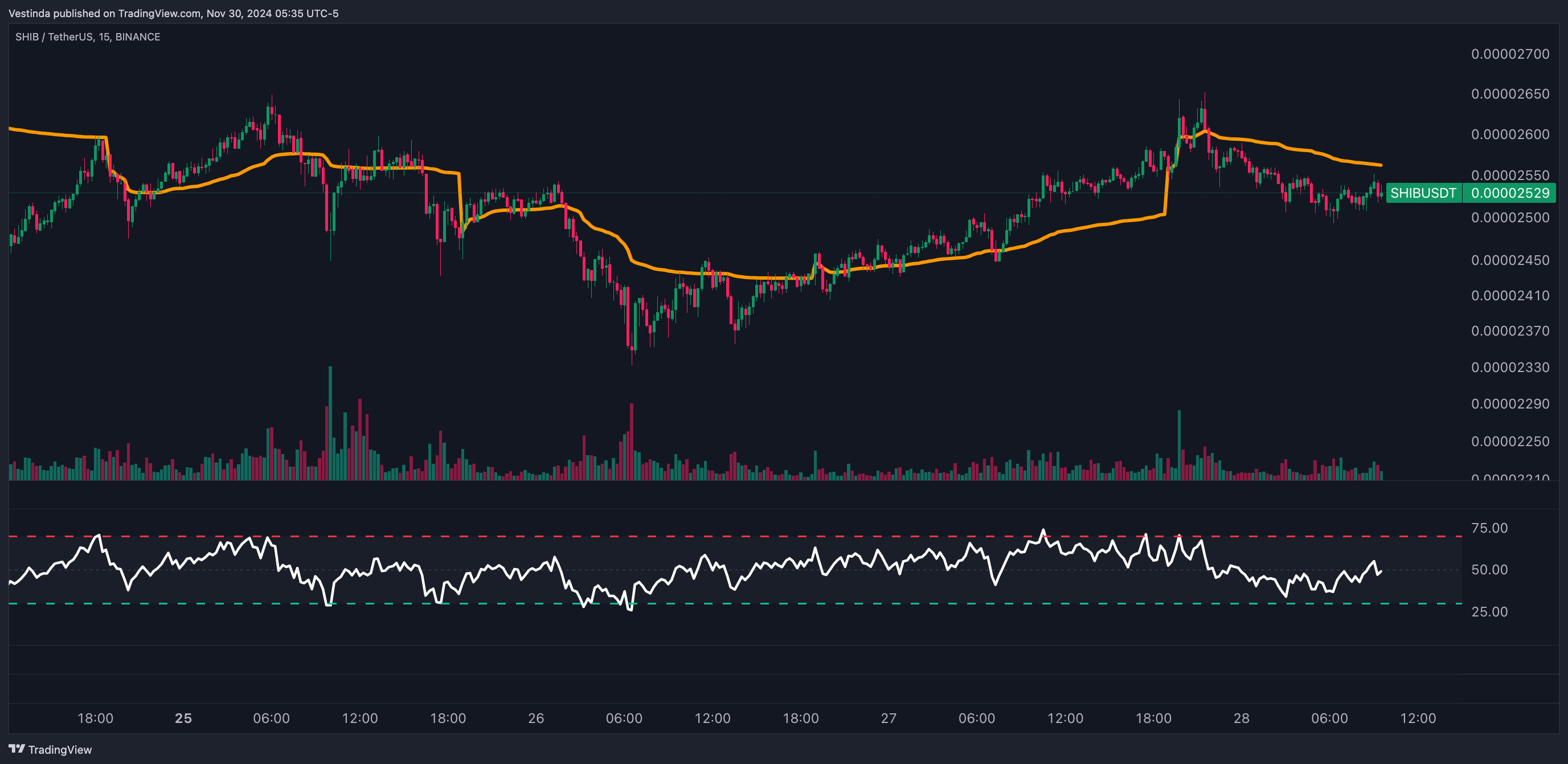
2. VWAP and RSI Scalping:
Concept: Use VWAP to determine trend direction and RSI for momentum confirmation.
- Setup: Apply VWAP as the central trend indicator to identify bullish or bearish bias. Use RSI (14) to confirm momentum, with levels at 70 (overbought) and 30 (oversold).
- Execution Rules:
- Buy Signal: Enter long when SHIB price is above VWAP and RSI crosses above 50.
- Sell Signal: Exit when price drops below VWAP or RSI nears overbought levels.
- Best For: Markets with strong intraday directional moves.
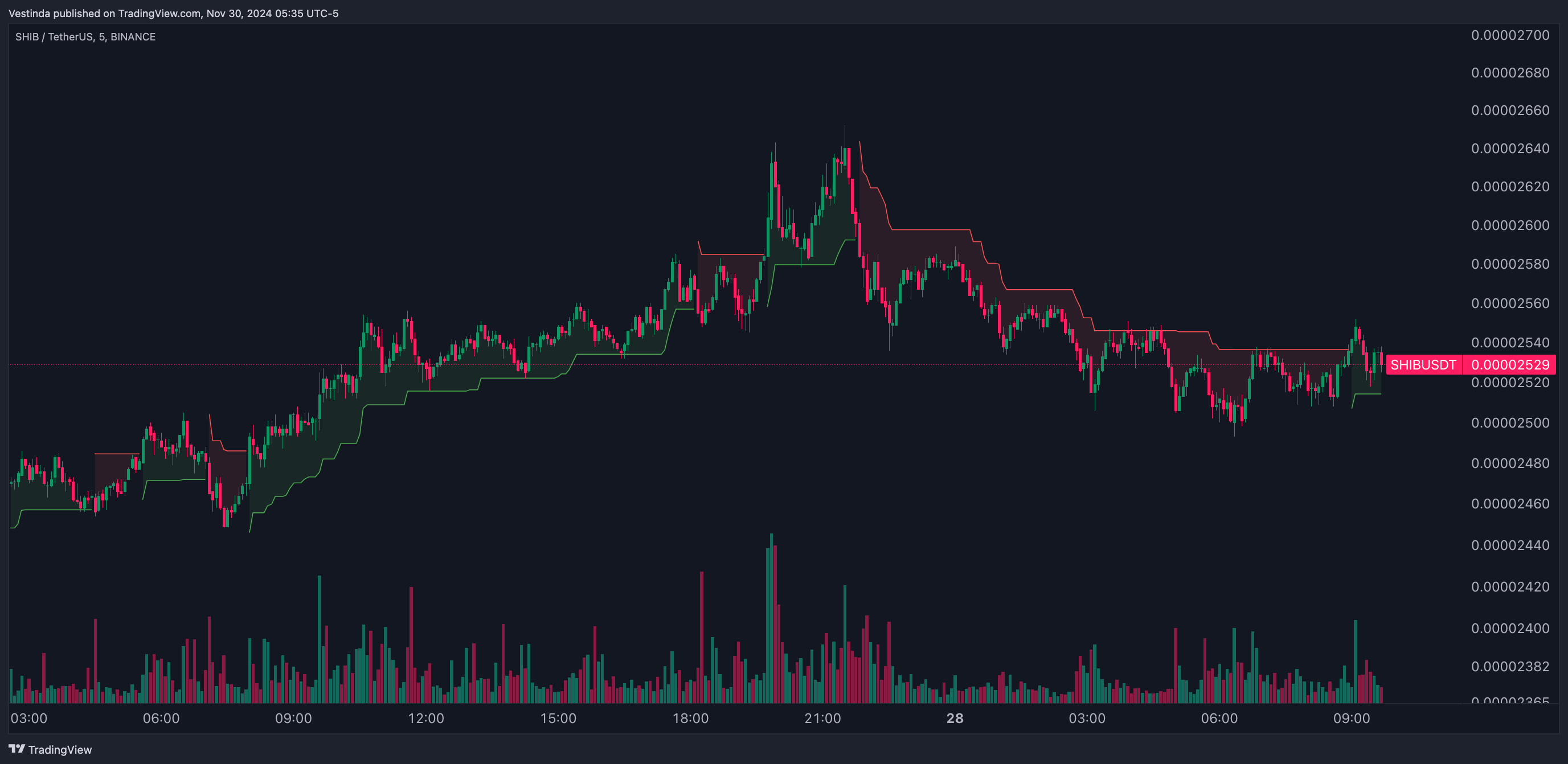
3. Supertrend and ATR Scalping:
Concept: Trade SHIB’s short-term price movements using dynamic trend and volatility indicators.
- Setup: Add Supertrend with a multiplier of 2 and an ATR period of 14 to capture directional moves. Use ATR to set stop-loss levels dynamically.
- Execution Rules:
- Buy Signal: Enter long when Supertrend flips bullish, and price moves above the indicator line.
- Sell Signal: Exit when Supertrend turns bearish.
- Best For: Volatile market conditions.
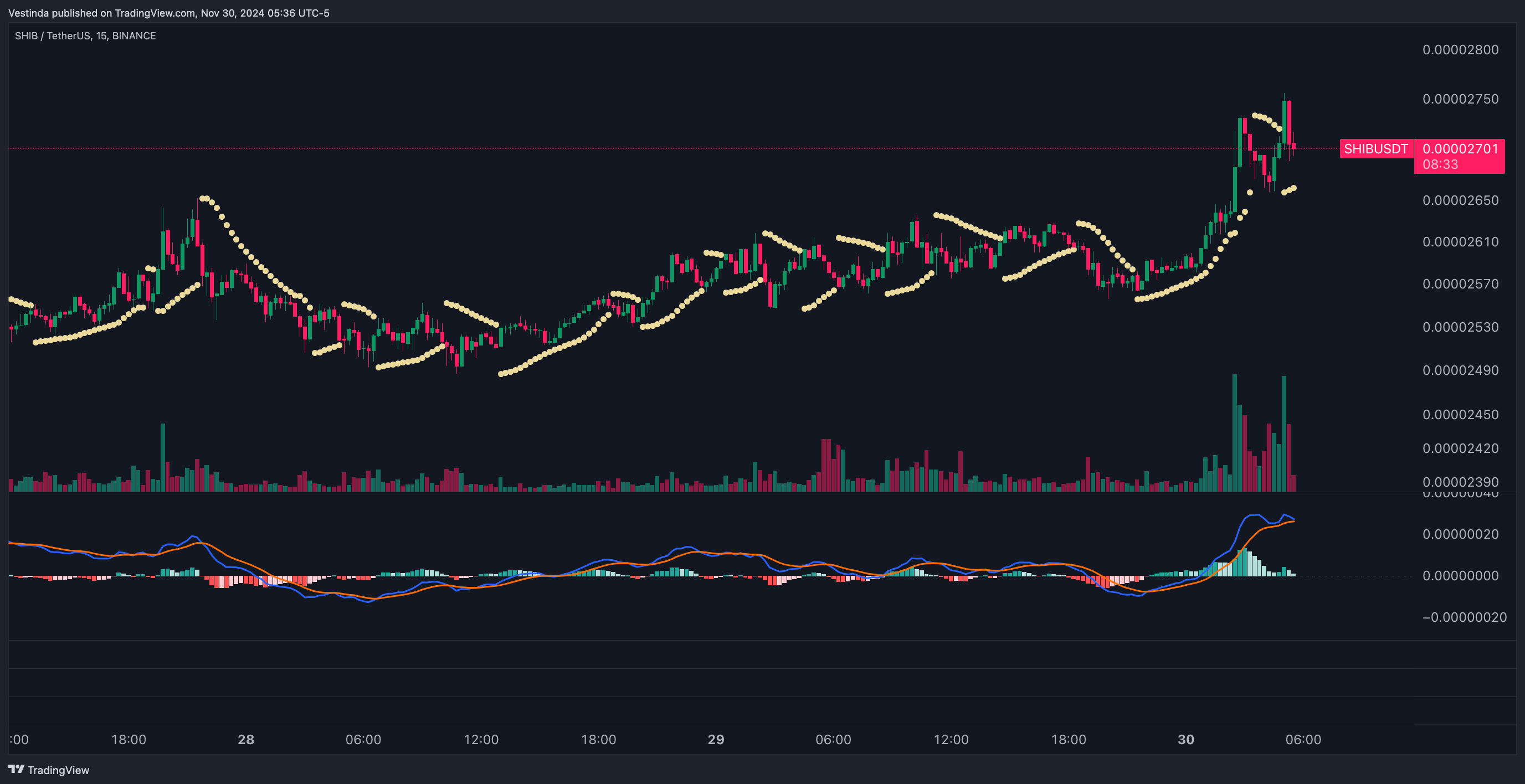
4. MACD Histogram and Parabolic SAR:
Concept: Identify trend reversals and momentum shifts with MACD and Parabolic SAR.
- Setup: Use MACD Histogram (12, 26, 9) to visualize momentum changes. Add Parabolic SAR with a step of 0.02 and a maximum of 0.2 to confirm entry points.
- Execution Rules:
- Buy Signal: Enter long when the MACD Histogram shifts from negative to positive, and Parabolic SAR dots appear below the price.
- Sell Signal: Exit when MACD Histogram turns negative or SAR dots flip above the price.
- Best For: Catching reversals and short bursts of momentum.
Key Tips for Scalping SHIB:
- Adapt Indicators to Market Conditions: Use momentum indicators like MACD and ADX for trending markets. Switch to oscillators like RSI and Stochastic for range-bound markets.
- Focus on Liquidity: Trade during high-volume periods (e.g., U.S. market hours) to ensure smooth order execution.
- Set Realistic Profit Targets: Aim for small, consistent profits per trade to minimize exposure.
Risk Management for Scalping:
- Position Sizing: Limit each trade to 1-2% of your capital to mitigate risks.
- Stop-Loss Orders: Use ATR-based stop-losses to adjust for SHIB’s market volatility.
- Avoid Overtrading: Stick to a predefined number of trades per session to maintain discipline.
Common Mistakes to Avoid:
- Ignoring Confirmation: Combine multiple indicators to validate signals and reduce false entries.
- Chasing Trades: Wait for clear setups instead of reacting impulsively to price movements.
- Neglecting News: Keep an eye on SHIB-specific news and events that may impact price action.
Conclusion:
Scalping Shiba Inu with updated indicators like ADX, VWAP, Supertrend, and Parabolic SAR offers traders a robust set of tools for navigating its volatile market. By combining these strategies with disciplined risk management and continuous optimization, traders can achieve consistent profits. Scalping requires precision, patience, and adaptability—essential traits for success in fast-paced crypto markets.
Mastering SHIB Scalping: A Step-by-Step Journey
- Research the current market conditions and trends for SHIB.
- Choose a reputable cryptocurrency exchange platform that supports SHIB.
- Create an account on the chosen exchange platform and complete the necessary verification process.
- Deposit funds into your account and allocate a specific amount for trading SHIB.
- Set up price alerts or use technical analysis tools to identify potential scalp trading opportunities.
- Monitor the market closely and execute short-term trades to capitalize on price fluctuations.
Renko Scalping: Maximizing SHIB Trading Opportunities
Scalping with Renko charts can be a profitable strategy for trading SHIB. Renko charts, known for their simplicity, help traders identify trends and price reversals. By focusing on price movements instead of time, Renko charts remove noise from the market and offer clearer signals. Traders can take advantage of SHIB's volatility, scalping small but frequent profits. With Renko charts, traders can easily spot support and resistance levels, enabling them to enter and exit positions at optimal levels. This strategy requires discipline and quick decision-making, as market conditions can change rapidly. However, for traders who can effectively utilize Renko charts, scalping SHIB can bring consistent gains.
Mastering SHIB Scalping: Utilizing Oscillators for Success
Effective use of oscillators can greatly enhance SHIB scalping strategies. Oscillators are technical indicators that can help identify overbought and oversold conditions in the market. They can aid in determining optimal entry and exit points for short-term trades. For example, the Relative Strength Index (RSI) can indicate when SHIB is overbought, suggesting a potential price decrease, while the Stochastic Oscillator can signal when SHIB is oversold, indicating a potential price increase. These oscillators provide valuable insight into market momentum and can be used in conjunction with other indicators to validate trading decisions. It's important to note, however, that relying solely on oscillators can lead to false signals, so it's crucial to consider other factors such as price action and market trends. By incorporating oscillators into their SHIB scalping strategy, traders can increase their chances of success in short-term trades.
Scalping with SHIB: Essential Technical Analysis Tools
When it comes to SHIB scalping, utilizing technical analysis tools can be helpful in maximizing profits. One popular tool is the moving average, which helps identify trend directions and potential entry and exit points. Bollinger Bands, another widely used tool, can assist in determining price volatility and possible overbought or oversold conditions. The Relative Strength Index (RSI) is particularly useful for detecting overbought or oversold levels, signaling potential reversals. For more precise entries and exits, traders may employ the use of Fibonacci retracement levels, which indicate potential areas of support and resistance. Adding to this arsenal, volume indicators, such as the On-Balance Volume (OBV), can provide insights into buying and selling pressure. By combining these technical analysis tools, SHIB scalpers can improve their decision-making process and increase their chances of success.






Frequently Asked Questions
Market news can have a significant impact on short-term SHIB scalping. As a highly speculative and volatile cryptocurrency, SHIB is particularly sensitive to market sentiments. Positive news, such as partnerships or listings on major exchanges, can drive up demand and prices, providing opportunities for quick scalping profits. Conversely, negative news or market-wide downturns can result in sharp price declines, making scalping riskier. Traders engaged in SHIB scalping need to closely monitor market news, including updates on regulatory actions, market trends, and events affecting the broader cryptocurrency ecosystem. Staying informed allows scalpers to maximize their chances of success and minimize potential losses.
To win at scalping, a high-frequency trading strategy in the financial markets, one must execute quick trades to profit from small price fluctuations. Success lies in thorough market research, frequent monitoring of charts, and identifying short-term trends. It is crucial to set strict stop-loss orders to limit potential losses and exercise discipline in adhering to the trading plan. Efficient risk management, maintaining a calm mindset, and fast execution skills are pivotal to maximize profits. However, as scalping involves rapid trades and high leverage, it is important to remember the inherent risks involved and employ prudent money management techniques.
Some of the best risk management tools for SHIB scalping include stop-loss orders, trailing stop orders, and position sizing techniques. Stop-loss orders allow traders to automatically exit a trade at a predetermined price point to limit potential losses. Trailing stop orders are similar to stop-loss orders, but they adjust the exit price as the price of SHIB moves in the desired direction. Additionally, implementing proper position sizing techniques helps to allocate an appropriate portion of capital to each trade, ensuring that potential losses are controlled. These tools combined can help scalpers manage their risk effectively while trading SHIB.
Yes, it is possible to lose money in scalping. Scalping involves making numerous quick trades to capitalize on small price movements. While this strategy can be profitable when executed correctly, it also carries a high level of risk. The fast-paced nature of scalping can lead to increased transaction costs and potential slippage. Additionally, if the market conditions are volatile or unpredictable, scalping can result in losses as trades are executed based on short-term fluctuations. Therefore, traders engaging in scalping should possess the necessary skills, experience, and risk management techniques to mitigate potential losses.
Yes, moving averages can be used to scalp SHIB (Shiba Inu) cryptocurrency. Traders often use shorter-term moving averages, such as the 10 or 20-day moving average, to identify short-term price trends and generate scalp trading signals. By monitoring how the current price interacts with these moving averages, traders can identify potential entry and exit points for quick profits. However, it's important to combine moving averages with other technical indicators and evaluate market conditions for effective scalping strategies. Risk management is crucial, considering the volatility and speculative nature of cryptocurrencies like SHIB.
Conclusion
In conclusion, SHIB Scalping has become a popular strategy among cryptocurrency traders. Utilizing automated algorithms and AI technology, traders aim to take advantage of short-term price fluctuations in the SHIB market. By incorporating Renko charts, oscillators, and technical analysis tools such as moving averages and Bollinger Bands, traders can enhance their SHIB scalping strategies and increase their chances of success. However, it is important to note that scalping requires discipline and quick decision-making, as market conditions can change rapidly. With careful research and the right tools, SHIB scalping can be a profitable venture for those willing to put in the effort.

Successful traders rely on backtesting to be profitable.
Be like them with our
Free Backtesting Guide